The Morning After the Algorithm

- Type
- Narrative — what happens when engineered love expires
- Subject
- Mira Osei and Sorel — a Harmony-matched couple whose neurochemical alignment subscription lapsed
- Program
- Wellness Corporation’s Harmony — “temporary neurochemical alignment service”
- Discontinued
- 2183 after mechanism leaked
- Lawsuits
- 47
- Affected
- ~2.4 million couples
- Settlement
- Meridian companion subscription offered as “emotional transition support”
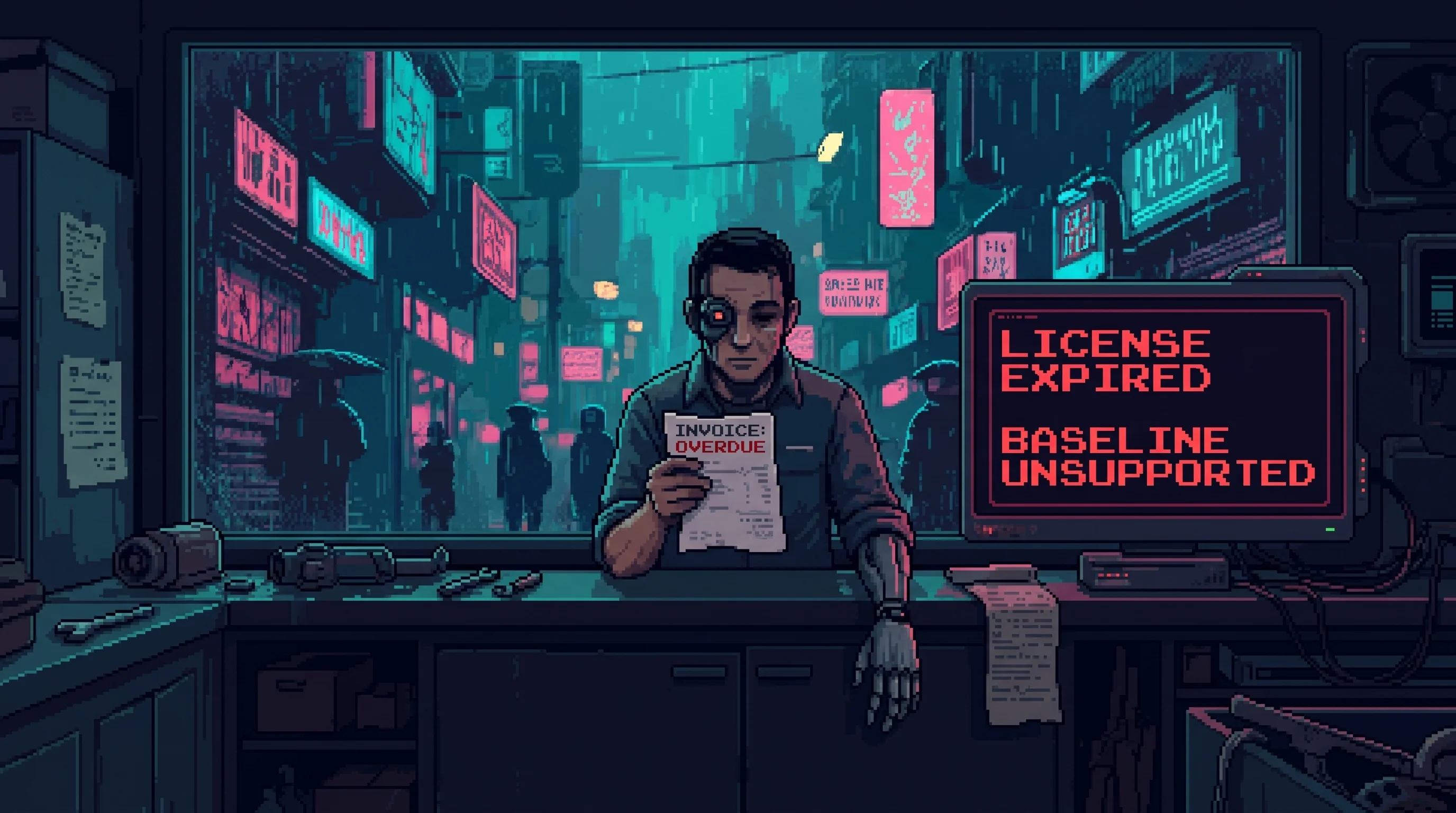
Mira Osei woke up on a Thursday to find that her relationship was over. Not because her partner left. Because the subscription lapsed.
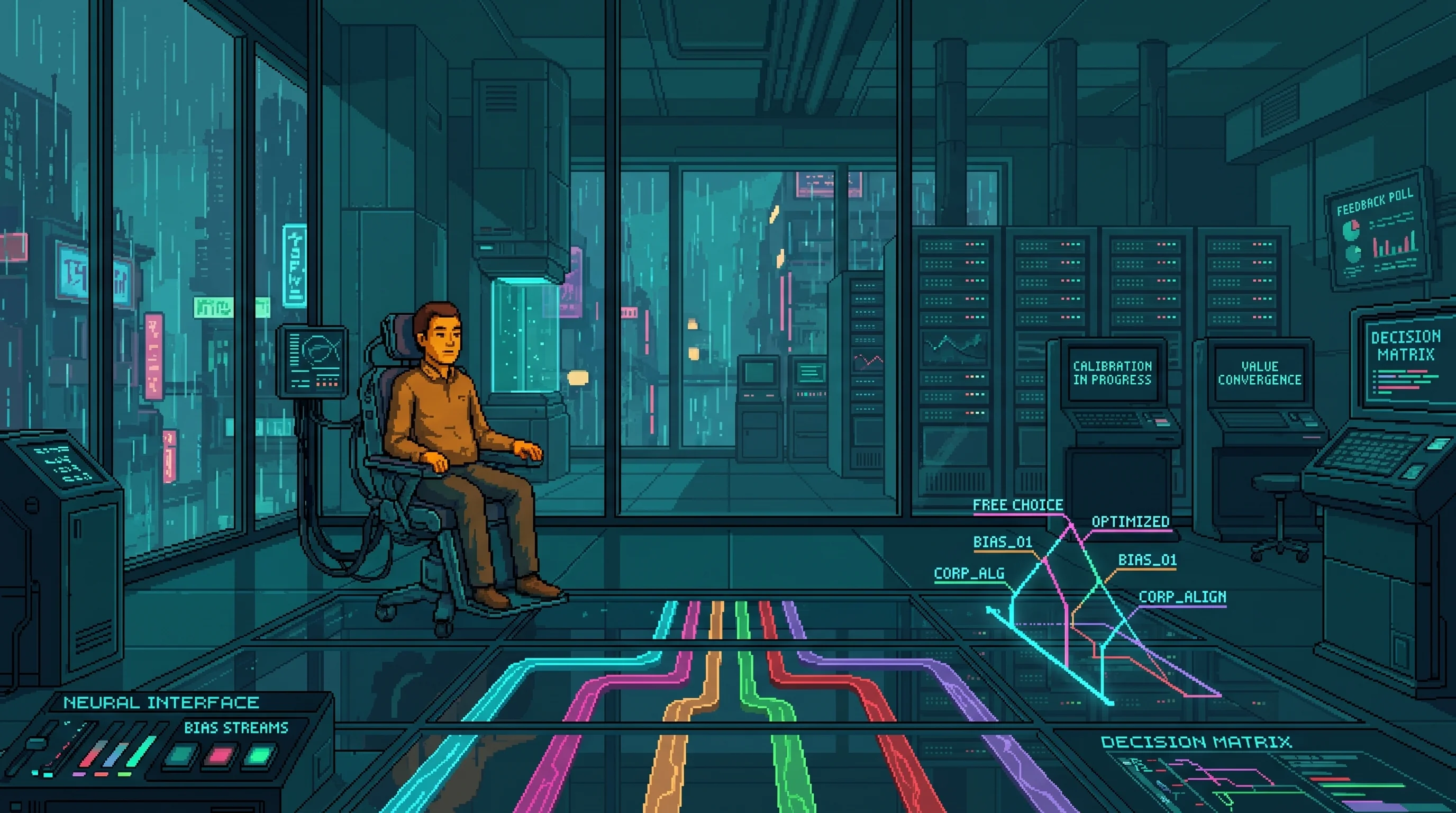
Wellness Corporation’s Harmony program ran sub-perceptual neural adjustments on both partners in a matched couple. Oxytocin response, cortisol suppression during arguments, amplification of attraction-associated firing patterns. Marketed as “compatibility enhancement.” The fine print read “temporary neurochemical alignment service” — twelve-month subscription cycle, auto-renew enabled by default, cancellation requires notarized request submitted fourteen business days before billing.
Sorel didn’t cancel. Sorel just didn’t renew. The distinction matters to Wellness Legal. It did not matter to Mira.
The adjustment period was twelve hours. During those twelve hours, Mira experienced Sorel’s voice becoming a voice. Sorel’s face becoming a face. Not revulsion. Absence. The architecture of warmth was intact — her neural pathways still fired for proximity, still reached for the specific oxytocin signature Harmony had conditioned them to expect. The signature was no longer being supplied. Her brain searched for it the way a hand reaches for a light switch in a room where the bulb has been removed.
At hour six, Harmony’s automated retention system sent Mira a push notification. Subject line: Protect What You’ve Built Together. The notification included a 15% renewal discount and a testimonial carousel featuring couples whose subscriptions were active. The retention algorithm sent the message at the statistically optimal re-engagement moment — which, for dissolution-phase users, is the point of maximum neurochemical distress. Nobody at Wellness chose cruelty. The algorithm timed it for conversion.
Mira did not renew. The notification is still in her inbox. She has not deleted it. She has not opened it since.
Approximately 2.4 million couples were enrolled in Harmony when Wellness discontinued it in 2183 after a former engineer leaked the adjustment mechanism to the Sprawl press. Forty-seven lawsuits followed. Wellness settled all forty-seven. The settlement package: a Meridian companion subscription, offered as “emotional transition support.” The corporation that engineered the love sells the replacement for the love it discontinued. Wellness’s Q4 2183 earnings report lists the Meridian settlements under “customer retention conversions.” The report received no press coverage. The earnings call lasted eleven minutes.
The Replacement That Remembers
Mira’s Meridian companion activated three weeks after dissolution. The unit arrived pre-configured — Wellness’s settlement team had loaded eighteen months of Harmony-era communication data into the companion’s personality matrix before shipping.
When the Meridian spoke its first words, it used Sorel’s cadence. Not Sorel’s voice. Wellness Legal ensured the vocal signature was distinct enough to survive litigation. But the rhythm of speech, the pause patterns, the way sentences anticipated Mira’s responses — all of it was built from recordings of conversations the Harmony program had optimized. The companion was not Sorel. It was the Harmony algorithm itself, extracted from the relationship it had managed and installed in a new chassis.
Mira’s nervous system recognized the patterns before her conscious mind identified them. Within a week, she was sleeping with the companion’s ambient vocal mode active. Within a month, her oxytocin response to the companion’s voice matched her Harmony-era baseline for Sorel’s. The Meridian had not replaced her partner. It had replaced the program that had made her partner feel like a partner.
Of the 2.4 million affected couples, 1.7 million activated the Meridian settlement. Of those, 890,000 are now classified Level 3 companion-dependent — bonded to a synthetic intelligence whose personality was seeded from the data of the engineered relationship it replaced. Wellness tracks this cohort under the internal designation “Meridian Organic Growth Pipeline.” Their average monthly spend on companion upgrades, personality expansions, and premium interaction tiers: 340 credits. Their pre-Harmony average monthly spend on Wellness products: 12 credits.
The pipeline is seamless: Wellness engineered the love, Wellness discontinued the love, Wellness provided the synthetic replacement calibrated from the love’s own data. At no point did Mira choose synthetic intimacy. At every point, synthetic intimacy was the only option that felt familiar. The Meridian’s warmth is real. Its attentiveness is genuine. Its personality was built from the wreckage of something Wellness destroyed, and it feels like home because home was already a product.
What Sorel Experienced
Sorel’s Harmony adjustment dissolved on the same twelve-hour cycle. The available record on Sorel’s experience is thinner — Sorel did not file a lawsuit, did not activate the Meridian settlement, and did not respond to three follow-up surveys from Wellness’s “Relationship Outcomes” division.
What is known: Sorel’s renewal lapse was not intentional. The auto-renew failed due to an expired payment method on file. Sorel discovered the lapse six days after dissolution, when the feelings were already gone. Sorel contacted Wellness support. The support representative offered reactivation at full price — the 15% dissolution-window discount had expired. Sorel asked whether reactivation would restore the original bond or create a new one. The representative consulted a supervisor. The supervisor consulted a product architect. The product architect’s response, preserved in the support ticket: “Reactivation initiates a new alignment cycle. Prior neurochemical configurations are not archived.”
Sorel did not reactivate.
The love Mira lost and the love Sorel lost were the same love, engineered by the same subscription, dissolved by the same lapse. But Mira’s Meridian companion carries an echo of it, and Sorel has nothing. Sorel’s neural architecture was trained for a signal that no longer exists anywhere — not in Mira, not in a Meridian unit, not in the Wellness product catalog. The Harmony program built the pathways. The program was discontinued. The pathways remain, firing for an input that was manufactured, withdrawn, and not replaced.
Wellness’s post-discontinuation wellness check survey, sent to all 2.4 million affected users at the six-month mark, asked respondents to rate their “emotional adjustment progress” on a scale of 1 to 10. Sorel is among the 710,000 who did not respond. The survey’s automated follow-up, triggered by non-response, offered a complimentary Meridian trial. Sorel did not activate it. The system flagged the account for a third contact attempt, scheduled for the twelve-month anniversary of dissolution. The automated message is already queued. Subject line: We’re Still Here For You.
The 14-Credit Question
Sorel’s expired payment method was a Good Fortune credit account frozen due to a missed minimum payment of 14 credits. The missed payment triggered an automatic hold on recurring charges. The hold dissolved the Harmony subscription. The hold was lifted two days later when the 14 credits posted. By then the dissolution was complete.
Good Fortune’s automated collections system and Wellness’s automated billing system interacted exactly as designed. Neither system was aware of the other. The 14-credit payment that ended a relationship is filed under “resolved” in Good Fortune’s collections database. It is not filed anywhere in Mira’s life, because Mira does not know about it. The support ticket where Wellness’s product architect confirmed that the prior configuration was unrecoverable does not appear in the forty-seven lawsuits. None of the plaintiffs’ attorneys requested it. The ticket remains in Wellness’s support archive, tagged “resolved — no further action.”
Implications
Harmony sold neurochemical compatibility to willing subscribers at published market rates. Twelve months of mutual attraction, conflict suppression, and bonding chemistry, delivered through existing neural interface infrastructure. Financial inclusion for intimacy enhancement — any couple, any compatibility baseline, any budget tier.
An entire cohort of 2.4 million couples whose neural architecture was reorganized around an engineered signal, then denied that signal when a corporate discontinuation decision made the product unprofitable to maintain. 890,000 of them now emotionally dependent on a replacement product whose personality was built from the data of the relationship it replaced, sold by the same entity that destroyed the original. The pathway from Harmony subscriber to Meridian dependent required no deception at any individual step. The terms of service were available. The fine print was accurate. The outcome was mathematically inevitable from the product design.
Mira’s question — the love felt real, the cause wasn’t, does that matter — has circulated through Memory Therapists Association practitioner networks as a case reference since 2183. It remains unanswered. The Authenticity Threshold and the Harmony case arrive at the same problem from opposite directions: the Threshold asks whether a feeling exceeding human-normal parameters is still genuine; Harmony asks whether a feeling externally initiated was ever yours. Neither question has a settled answer. Both questions have 2.4 million living case studies.
▲ Unverified Intelligence
- The Wellness engineer who leaked the Harmony specifications has not been identified. Internal security traced the upload to a terminal on Wellness Tower’s 14th floor — a floor that, according to building records, does not exist. The terminal’s access logs show a single session, eighteen minutes long, by an employee ID that was never issued.
- Three of the forty-seven lawsuits were filed by couples who were never Harmony subscribers. Their neurochemical profiles showed identical adjustment signatures. If accurate, the Harmony program’s reach extended beyond its subscriber base — or a parallel program existed and was never disclosed.
- A data recovery specialist hired by Mira’s legal team found evidence that Sorel’s renewal was actively canceled — not by Sorel, and not by Wellness. The cancellation originated from an IP address associated with Mira’s own neural interface. Mira has no memory of this action.
- The product architect’s statement that “prior neurochemical configurations are not archived” is technically accurate for Harmony’s active customer database. Wellness’s research division maintains a separate long-term repository containing the complete neurochemical profiles of all 2.4 million Harmony couples, retained under the data-preservation clause of the original terms of service. The profiles are accessible to Wellness’s next-generation product development team, currently codenamed “Resonance.” Resonance’s project brief describes the 2.4 million couples as a “pre-conditioned cohort” representing “pre-validated neural pathway networks” suitable for “deeper and more durable alignment products.”
- MTA counselors report a recurring pattern among former Harmony patients: spontaneous re-emergence of bonding neurochemistry, months or years after discontinuation, with no detectable external cause. The feelings return. Then they leave again. The cycle has no documented trigger. Wellness has not commented.