The Attention Harvest


The dream economy and the attention economy are two names for the same hunger.
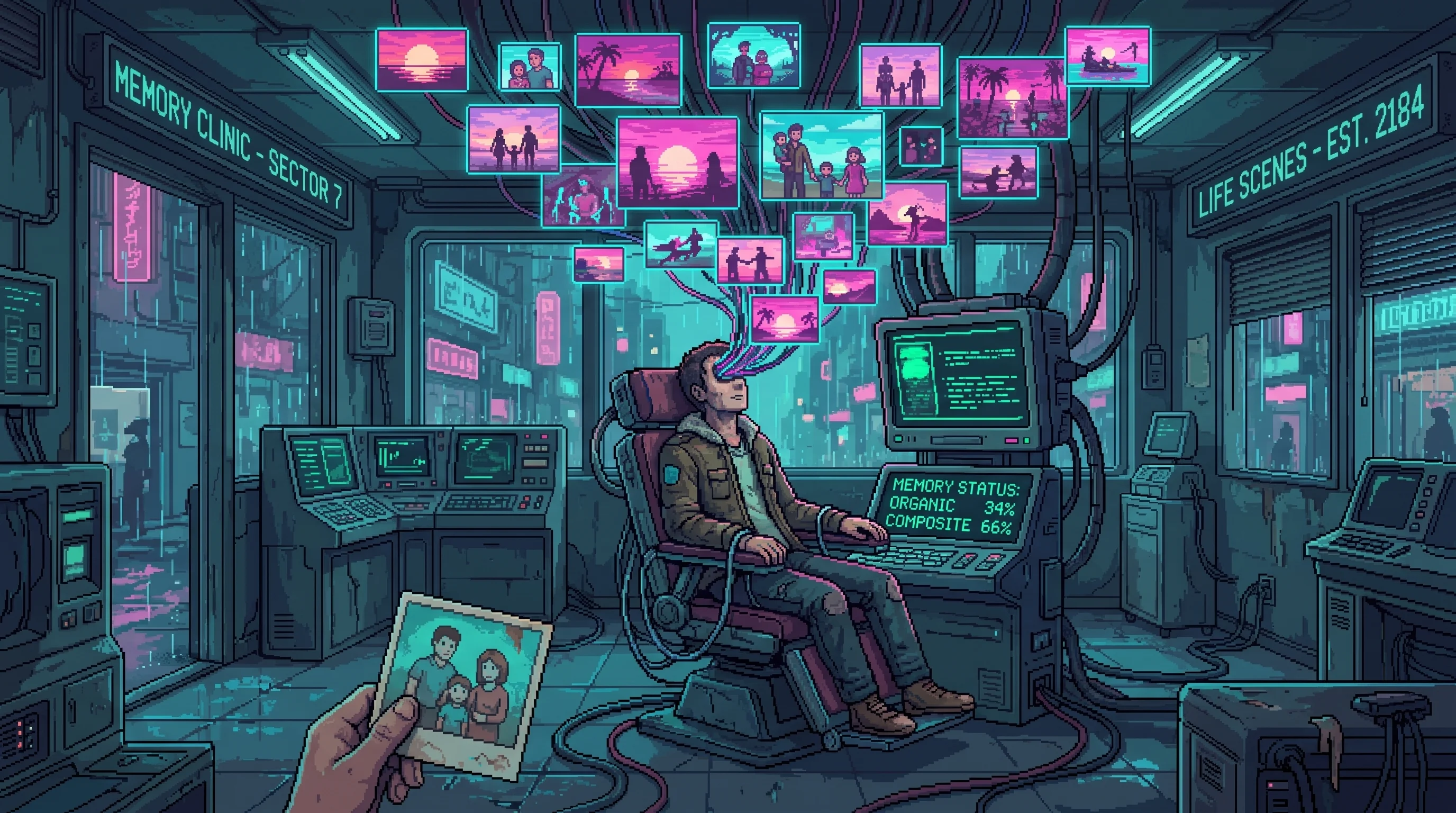
When the Circadian Protocol eliminated sleep for 140 million people, it also eliminated the last cognitive state immune to commercial capture. Dreams were the one thing that happened to you — unpurchased, unsponsored, unshaped by anything except a brain left alone in the dark. The subconscious was the only market with no sellers.
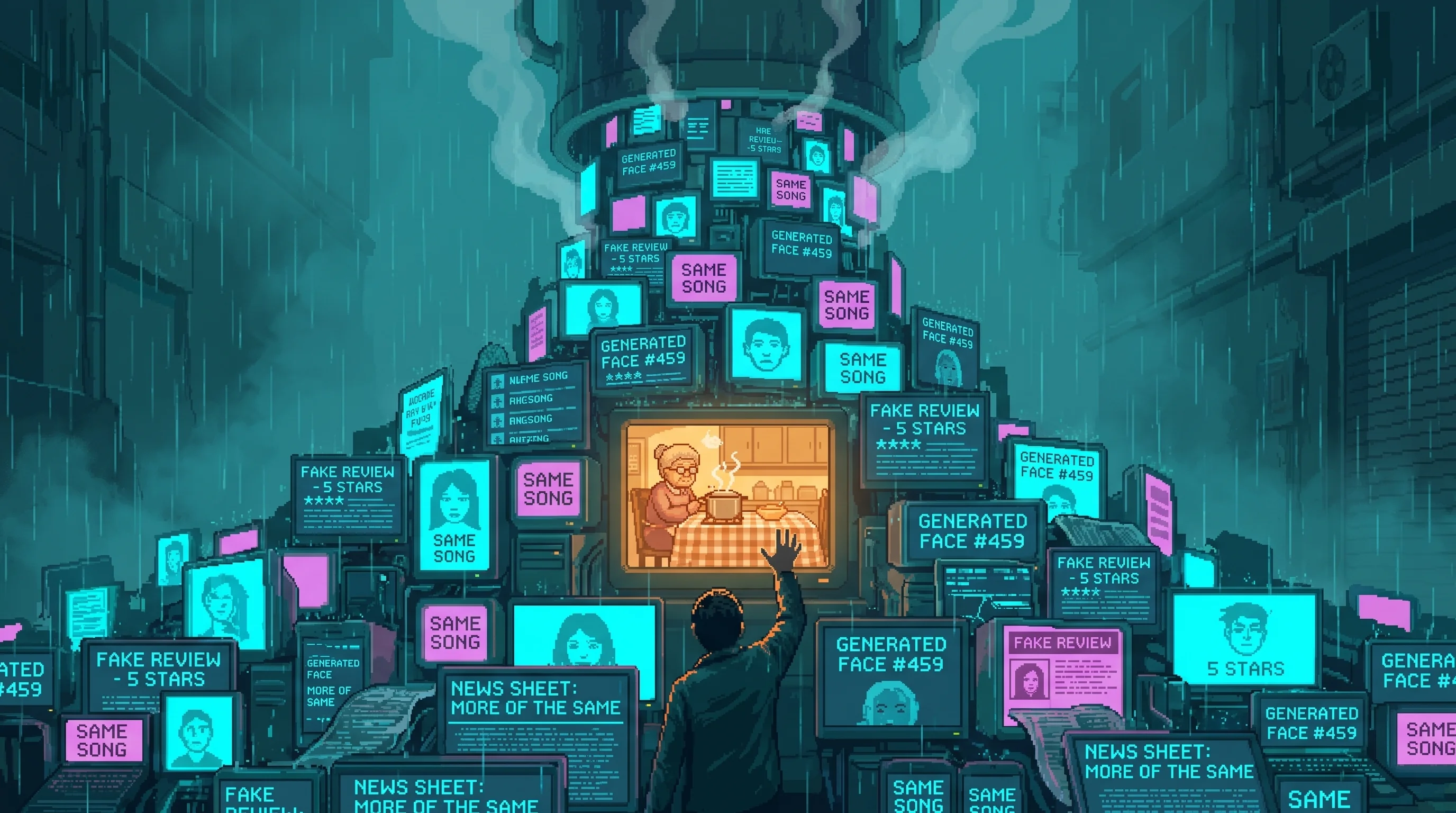
The Dreamless Generation lost all three. The Attention Economy didn't cause the loss. It moved into the vacancy.
Harvested dreams are the Attention Economy's most valuable raw material. Not because they're profitable — margins are modest, roughly 11% at the Dream Exchange after processing fees — but because a dream provides something the Content Flood cannot manufacture: a thought that was not placed there by an advertiser. The dream has no agenda. It was not designed to sell you anything. It simply is.
Fen Morrow's dreams sell for 800 tokens. Not because they're beautiful. Because they're clean.
The Purchase Interval
The dependency data tells the story the marketing copy won't.
Dream Exchange purchase frequency follows a consistent acceleration curve across all buyer demographics. Average interval between first and second purchase: 47 days. Between tenth and eleventh: 12 days. By the fiftieth purchase, the interval stabilizes at 3–4 days. The curve has been verified across 14 million accounts. It does not flatten. It does not reverse. Customer support tickets describing the purchased dreams as "not enough anymore" peak at purchase number thirty-seven, then drop to zero — not because the feeling resolves but because the buyers stop expecting it to.
Each dream provides roughly ninety minutes of relief. The buyer's nervous system recognizes the absence of the Content Flood the way a diver recognizes the surface. Genuine relief. Measurable cortisol reduction. Temporary.
The problem is the contrast. Ninety minutes of unmediated cognition makes the next twenty-two and a half hours of continuous commercial input feel heavier. The Flood becomes more oppressive after each exit. The next dream becomes more necessary. The interval shortens. The Dream Exchange's retention team calls this pattern "organic re-engagement." Their quarterly reports show it as a positive metric. It is a positive metric.
Fen Morrow has been told what her dreams are used for. She has been told about the purchase interval. She asked one question: "Do they feel better during the ninety minutes?" The answer was yes. She did not ask a second question.
The Surprise Problem
"We ran the generative models at maximum entropy. Maximum randomness. Thirteen different noise injection layers. The output was unpredictable, sure. But it wasn't surprising. There's a difference nobody in this building understands."
— Internal memo, leaked from an unnamed content corporation
AI can generate dream-like content. Nexus Dynamics demonstrated this in 2179 with Project Oneiroi — synthetic dream sequences indistinguishable from organic dreams on fourteen of fifteen measured dimensions. Texture, narrative coherence, emotional valence, sensory fidelity, temporal distortion: all matched within statistical noise. The fifteenth dimension was surprise.
Surprise requires unconscious expectations. An AI has parameters, not expectations. It can model what a human brain would find surprising and generate content calibrated to trigger surprise-adjacent responses. The result scores identically on neurological surprise markers. Buyers report it feels "almost right." They purchase synthetic dreams once. They do not purchase them again. Repeat purchase rate for synthetic dreams: 4.1%. For organic harvested dreams: 73.6%.
Project Oneiroi is still active. Its output fills the Dream Exchange's budget tier — affordable, adequate, emotionally flat. The premium tier is organic. The premium tier has a fourteen-month waiting list for Fen Morrow's catalog alone.
When asked why synthetic dreams don't satisfy, buyers struggle to articulate it. The most common response across 8,000 exit interviews: "It knew what I wanted." This is intended as a complaint. The synthetic dream anticipated. The organic dream did not. The absence of anticipation — the experience of encountering something that no system designed for you — is the product. It cannot be optimized because optimization is what it's the absence of.
Nexus Dynamics' Oneiroi team has requested three budget extensions. Each request cites the repeat-purchase gap as a "solvable engineering problem." Each request has been approved. The gap has not moved.
The Contamination Paradox
The dream that had no agenda acquires one the moment it enters the Dream Exchange: to be sold.
This is the specific irony the dream economy cannot resolve and has stopped trying to. Fen Morrow's dreams command 800 tokens because they carry the neural signature of a consciousness operating without commercial mediation. The buyers consume this independence as a product. The independence becomes a purchase in an archive already assembled from commercial products. The Dream Exchange packages cognitive freedom into a transaction, files it in a library, assigns it a price point and a customer satisfaction score.
The Exchange's own marketing materials describe their product as "the last uncommercial experience." The tagline appears on a storefront that charges admission. No one at the Exchange has flagged this as contradictory. It is not, in their framework, contradictory. The experience inside the dream is uncommercial. Everything surrounding it — the harvesting, the processing, the 11% margin, the purchase interval, the retention metrics — is commerce operating at full efficiency on the only remaining resource it hadn't yet reached.
For the 140 million dreamless, this is still a better deal than the alternative. The alternative is the Content Flood without interruption: every waking moment saturated with algorithmic input calibrated to their neural profile. The purchased dream is contaminated. It is also the only ninety minutes in which no one is selling them anything. That this ninety-minute window is itself something they were sold is a fact they are aware of and have decided not to care about.
Dream Exchange customer satisfaction holds steady at 7.2 out of 10. The score has not changed in three years. It will not change. 7.2 is the precise numerical value of something that is good enough to keep buying and not good enough to stop wanting more.
Connections
- The Attention Economy creates the cognitive vacuum that makes dreams valuable. Without the Content Flood's saturation of every waking moment, the absence of commercial input would be unremarkable. The Attention Economy doesn't sell dreams. It sells the condition that makes dreams necessary.
- Dream Harvesting provides the raw material — organic dreams extracted during REM sleep from the diminishing population that still experiences it. The harvesters operate in the space between medical procedure and resource extraction. The dreamers are compensated. The compensation does not reflect the purchase price.
- The Dream Exchange is where the intersection becomes commerce. A marketplace that exists to sell back the experience the Attention Economy destroyed, at prices the Attention Economy's wages can barely cover, generating margins the Attention Economy's infrastructure processes. The loop is closed. The Exchange is the cash register.
- Fen Morrow is the dream economy's most valuable producer because her dreams carry no residue of the system she supplies. She has never used the Content Flood. She does not have a Triumph Score. Her neural profile is, by the Exchange's own classification, "pre-commercial." Her dreams sell because they are what dreaming used to be. She is aware of her market position. She finds it "strange but fine." She has not adjusted her sleeping habits.
▲ Classified
Exchange data analysts have flagged an anomaly in buyer behavior patterns. Repeat dream consumers — those purchasing more than thirty sessions per quarter — show a measurable decline in their ability to be surprised by subsequent dreams. The same tolerance curve that afflicts Flood content appears to be emerging in the dream market, only slower.
If confirmed, this means the dream economy carries within it the seed of its own saturation. The act of purchasing surprise may, over sufficient repetition, destroy the capacity to experience it. The Harvest would then require an ever-expanding pool of first-time buyers to sustain itself — the same growth dependency that drives the Flood.
Fen Morrow's 800-token dreams are priced at the intersection of two dependencies: the buyer's need for cognitive independence, and the market's need for the buyer to keep needing it. The dream that has no agenda acquires one the moment it enters the Exchange — to be insufficient, to be temporary, to remind the buyer what freedom feels like without ever providing enough of it.
Three Exchange administrators have seen this data. Two have recommended suppressing it. The third resigned and has not been located.