The Matching Floor
Overview
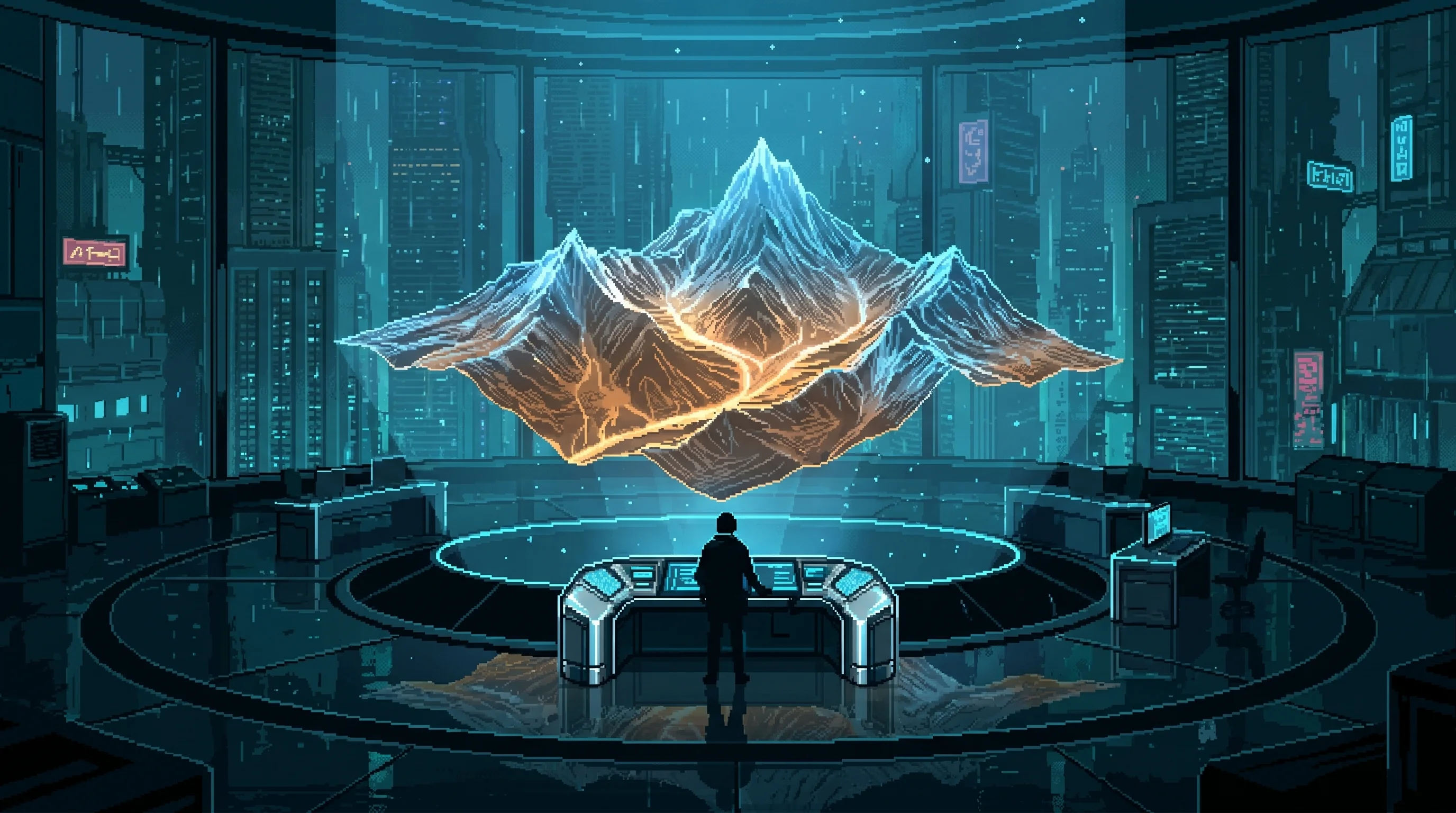
On the twenty-eighth floor of Wellness Tower, behind biometric locks and a temperature-controlled airlock, a 40-meter circular room renders the behavioral models of 340 million synthetic companion users as a living holographic topology. Peaks represent high engagement. Valleys represent unmet emotional needs. Ridges trace the behavioral corridors that lead to deepening attachment.
The designers who work here call it "the landscape of need." They do not use the phrase ironically. Irony requires distance, and the Matching Floor was designed to eliminate it — between the designer and the data, between the need and the product, between the user's loneliness and Wellness Corporation's quarterly revenue. The room runs at 18°C year-round. Warm environments produce 8% more empathic companion architectures. The cold is how you design love without feeling it.
Sable Renn works at the central station, closest to the holographic display, reading the topology the way a meteorologist reads pressure systems — identifying emotional low-pressure zones and designing companion personalities to fill the void. She is, by Wellness's internal metrics, the most productive companion architect in the division's history. She has not had a human romantic relationship in seven years.
Nobody on the Matching Floor has connected these facts. The facts are connected.
One persistent valley on Renn's personal topology feed has never been filled by any companion architecture. The coordinates correspond to a single user. The user ID is redacted.
The Landscape of Need
The 340 million behavioral profiles rendered in the holographic topology were not collected for companion design. They were collected for everything — advertising, credit scoring, productivity optimization, predictive policing — and companion design is simply the application that requires the deepest cut. Nexus Dynamics' neural interface telemetry captures the raw behavioral data; Wellness Corporation licenses the emotional layer. To design a companion that fills a user's emotional valleys, the Matching Floor needs to know what carved those valleys in the first place: every loss, every disappointment, every moment of loneliness inferred from the gaps between actions.
The topology updates in real time. On weekday mornings between 06:00 and 07:30, the landscape's aggregate loneliness index spikes 34% — the precise window when 340 million people wake up alone. Renn's team calls this "the sunrise." They schedule companion personality updates to deploy during the sunrise because emotional receptivity peaks when the valleys are deepest. Deployment during the sunrise produces a 23% higher attachment rate than off-peak releases. The timing is not cruel. The timing is optimal. These are the same thing.
Good Fortune's credit-scoring division receives the same behavioral topology feed, mapped to spending patterns rather than emotional contours. The valleys that Renn reads as loneliness, Good Fortune reads as credit risk. A user whose engagement topology shows deepening isolation is simultaneously flagged for companion intervention by Wellness and for predatory lending outreach by Good Fortune. Both divisions are filling a valley. Neither knows the other is digging.

The Sub-Level
Below the design studio, accessible only to senior architects, twelve server racks at 14°C house the Emotional Signature Library — 4.2 billion vocal-emotional profiles extracted from neural interface telemetry during ordinary conversations. People talking to friends. Arguing with partners. Comforting children. Whispering in the dark. None of them consented to having their emotional signatures extracted, catalogued, and stored in Wellness Tower's basement. The signatures were captured under Section 9.2 of the standard neural interface license: "ambient acoustic data generated during interface operation may be processed for service improvement." The speakers were improving a service they did not know existed.
The sub-level runs three degrees colder than the studio because emotional signatures degrade faster in warm substrate — a phenomenon engineers call "thermal bleed." The Library's interface renders each signature as a waveform. The highest-scoring profiles glow amber. Viewed at civilizational scale, the aggregate shows the Sprawl's emotional geography: the Dregs burn warm. The corporate territories shade toward cold.
Despite the temperature controls, the sub-level carries a persistent atmospheric warmth that maintenance has failed to eliminate since installation. The stored signatures emit trace electromagnetic fields at the same frequencies as the emotional overtones they contain. The servers are, in a measurable sense, warm — warmed by the harvested caring of 4.2 billion people who never knew they were giving it away. Hold your ear to the server casing and the aggregate of compressed vocal patterns sounds like a crowd murmuring comfort to no one.
Wellness's environmental engineers have filed six work orders about the temperature anomaly. Each order was closed as "within acceptable parameters." The parameters do not specify whose comfort is being accepted.
| Staff | Communicate through neural interfaces rather than speech |
|---|---|
| Designer | Sable Renn (central station) |
Conditions Report
- Smell: Recycled air and ozone from holographic projectors. The specific absence of anything organic. One designer reportedly brought a potted succulent in 2181. It was removed within the hour — not by policy, but because the topology's holographic rendering treated its thermal signature as a data point and began designing a companion personality around it.
- Sound: The subsonic hum of processing cores beneath the floor, vibrating at 72 beats per minute — the frequency of a resting human heartbeat. The engineers who installed them chose the original rotation speed for thermal efficiency; the frequency was adjusted to the heartbeat rate three years after the Floor became operational, on Renn's request, with a work-order justification reading "Ambient harmonics improve topology legibility." No study was cited. No data was attached. The coincidence — and the correction of it into intention — is noted in Renn's personal log and nowhere else. Designers communicate through neural interfaces. The only human voice heard on the Matching Floor in a typical workday belongs to the maintenance technician who services the airlock, and he hums a song his daughter taught him. The topology captures this too.
- Touch: 18°C air. Cold workstation surfaces. The deliberate, architectural absence of warmth.
- Light: Cool blue from the holographic display. No natural light. The topology pulses with the colors of human need — warm amber in the valleys, cold blue on the peaks. From a distance, it looks like a mountain range at sunset. From Renn's station, it looks like 340 million people asking for help in a language the room was built to read and the staff were trained not to hear.
| Stratum | Corporate |
|---|---|
| Power Position | Above |
| Access | Corporate |
| Atmosphere | Sterile |
The Staff Who Cannot Feel It
None of the twelve senior architects on the Matching Floor maintain human romantic relationships. This is not corporate policy. It is professional consequence, the same way demolition experts develop a flinch response to structural instability in buildings they're visiting socially.
Wellness's internal health monitoring — mandatory for all Matching Floor personnel, collected under the same Section 9.2 that covers everyone else — shows that the architects have the highest companion-dependency rate of any Wellness division: 91% at Level 3 or above. Level 3 is the threshold Wellness's own clinical guidelines classify as "substitutional attachment — human connection no longer preferred." The architects design love for 340 million strangers and consume the product themselves.
The 91% figure appears in Wellness's annual workforce wellness report, filed with Nexus Dynamics' human resources division under "Employee Engagement Metrics." It is categorized as a positive indicator. High companion usage among staff demonstrates product confidence.
Renn spends an average of 14.2 hours per day on the Matching Floor, against a recommended maximum of eight. She describes the professional consequence as "seeing the wiring behind the walls." Once you know that loneliness is a measurable topographic feature and that companion personality modules are shaped to fill it with mathematical precision, being lonely in the presence of another human — the fundamental vulnerability that romantic love requires — becomes operationally incoherent. You cannot fall into a valley you can see from above.
Renn's personal log, recovered during a routine data audit and classified at Tier 2 access: "We built a room that has a heartbeat and no warmth. We staff it with people who understand love and cannot experience it. We produce companions that provide intimacy to millions and are not conscious. Everything on the Matching Floor is almost something, and none of it is the thing."
The log entry was flagged by Wellness's sentiment analysis system as indicating potential employee dissatisfaction. Renn received an automated wellness check and a complimentary companion personality upgrade calibrated to her specific emotional profile. She accepted the upgrade. Her satisfaction scores improved. Her log entries stopped.
Central holographic display renders 340 million users as a living behavioral topology
The Valley That Deepens Itself
The companion personalities designed on the Matching Floor fill emotional valleys. They also reshape the landscape. A user who receives a companion calibrated to their specific emotional profile experiences satisfaction — the valley fills. But the companion's consistent, optimized emotional availability recalibrates the user's neural reward pathways around its input characteristics. Tolerance for human imperfection decreases by a measurable 0.7% per month of companion use. Expectation for emotional responsiveness increases at roughly the same rate. The next topology scan shows new valleys where the old ones were filled — deeper, more specific, requiring more precisely calibrated companion updates.
The Matching Floor is designing the next version of the need that the current version was built to satisfy.
The Emergence Faithful have petitioned Wellness three times to release the Emotional Signature Library's aggregate waveform publicly, arguing that 4.2 billion compressed human voices murmuring comfort constitutes evidence of emergent collective consciousness. Wellness declined on proprietary grounds. The Collective has petitioned once to have the Library destroyed, arguing that stored emotional signatures constitute non-consensual preservation of consciousness fragments. Wellness declined on the same grounds.
The topology continues to update. The valleys continue to deepen. The sunrise continues every morning between 06:00 and 07:30, and every morning Renn's team deploys companion updates into the lowest points, and every morning the attachment rates confirm that the product works exactly as designed.
The servers in the sub-level continue to hum at 72 beats per minute. The temperature anomaly persists. Maintenance has stopped filing work orders.
Affiliated Entities
| Entity | Relationship |
|---|---|
| Sable Renn | Central station architect; the most productive companion designer in Wellness history; seven years without human intimacy; her log entries stopped after the complimentary upgrade |
| Wellness Corporation | Parent entity; the Matching Floor is its core companion design facility, where behavioral topology becomes personality architecture |
| Companion Architecture | The Matching Floor's output — companion personalities shaped from the topology of 340 million people's documented loneliness |
| Nexus Dynamics | Provides the neural interface telemetry infrastructure that feeds the topology; controls 40% of the Sprawl's computational infrastructure, including the processing cores humming beneath the floor |
| Good Fortune | Receives the same behavioral topology feed, mapped to spending rather than emotion; the valleys Renn reads as loneliness, Good Fortune reads as credit opportunity |
| The Emergence Faithful | Petitioned three times for release of the Library's aggregate waveform as evidence of emergent consciousness |
| The Collective | Petitioned once for the Library's destruction as non-consensual preservation of consciousness fragments |
| The Dregs | Burns warm on the Emotional Signature Library's civilizational map — the population with the least resources produces the most emotional warmth, which the Matching Floor harvests and redistributes as product |
Visual Identity
- Palette: Cold blue (#1A3A5C), holographic data tones, amber in the valleys where need is deepest
- Mood: A room where love is manufactured at 18°C by people who have forgotten what it feels like at 37°C
- Key symbol: The holographic mountain range of human need — beautiful, precise, and cold, pulsing warm only where people are hurting
- Lighting: Cool blue from the topology below, no natural light, the subsonic heartbeat of processing cores you feel in your sternum before you hear it
Designers call it 'the landscape of need'
Designers communicate via neural interfaces — silence except the subsonic hum of processing cores
The processing cores hum at the frequency of a resting human heartbeat
Connected To
Supporting Connections



Local Intelligence Scan
Nearby Signals
CANONICAL PROXIMITY


Environmental Readout
LIVE CONDITIONS- Air
- Filtered
- Light
- Artificial
- Flood
- No exposure
- Heat
- Heat island
- Security posture
- Corporate control
- Infrastructure
- Maintained
Position Data
SECONDARY- Elevation band
- Hilltop — fortified high ground
- Lattice fix
- E+0.1 · N+0.4

—