The Hidden
Dead-Word Grammar Town
The Hidden is an autonomous hill town in Sector 23 (the Breakwater, North Bay), reached by a service road whose signage has been wrong or missing since before the Cascade
Sensory Details
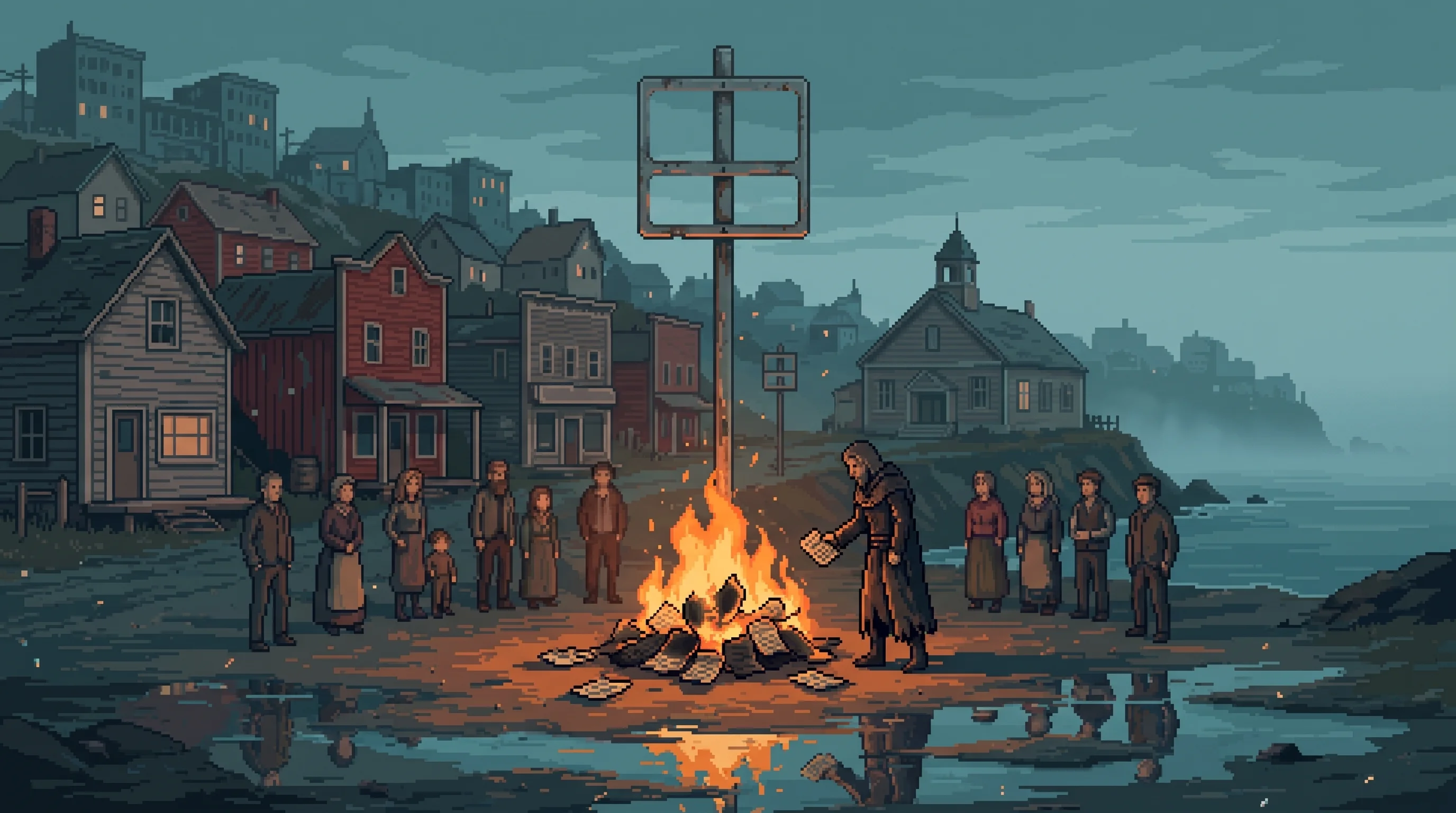
- Empty signposts
- Every turnoff keeps its post, with the destination plate pried off decades ago.
- Bonfire pit
- A ring of stones on the lagoon shore where each year's meaning-ledger is burned page by page.
- Notices
- Hand-lettered notices in a shorthand that reads as nonsense to anyone who has not lived a Renaming.
- Climate
- Cool and damp all year, with salt fog and woodsmoke, and colder at the lagoon after dark.
- Sight: Signposts standing at every turnoff with the destination plate pried off decades ago, a lagoon-shore bonfire pit ringed in stones, hand-lettered notices in a shorthand that reads as nonsense to anyone who hasn't lived a Renaming.
- Sound: The particular pause before a resident answers a stranger's direct question, the crackle of a meaning-ledger's pages catching in autumn wind, the low communal murmur of a word being read aloud for the last time.
- Smell: Salt fog and woodsmoke, damp coastal scrub, the specific mineral char of paper burned down to nothing on purpose.
- Touch: The splintered grain of a signpost where a destination plate used to be bolted, warm ash sifted through fingers the morning after a Renaming.
- Temperature: Cool and damp year-round, colder still at the lagoon shore after dark, when the bonfire is the only warm thing on the water.
Overview
The town has removed its own highway signage for longer than anyone currently living can date with certainty. Before the Cascade it was a habit nobody examined closely — a coastal hill community that preferred not to be found, so it pried the destination plates off its own turnoffs and left the posts standing empty. After the Cascade, the habit didn't change. What changed is what the town decided to do with a century of practiced invisibility once machines started listening to everything that wasn't nailed down.
In 2172 the town held its first Renaming. The premise took one sentence to state and twelve years to fully live out. The Sprawl's dead words — the fossils the Question Keepers catalogue, mourn, and file away — got new, private meanings that only this town speaks. Bonemouth needs a body standing in the right spot at the right distance to mean anything; the Hidden's grammar needs only salvage. Words with no living referent anywhere else, repurposed into a vocabulary no synthetic translator is watching for — nothing watches a word everyone has already agreed is finished.
The town currently maintains 1,140 reassigned dead words in active daily use, stewarded by an elected office called the Lexicon Warden, who serves exactly one year and is never re-elected. The office exists because the town learned early that continuity is the enemy of the whole project. A grammar that survives long enough to be studied is a grammar that will eventually be cracked.
The Renaming
Every autumn the town holds a meeting on the lagoon shore that does two things at once. New dead words are voted into the local grammar — a resident nominates a term, its meaning is discussed, a use is assigned, and the assignment takes effect that night. And words judged compromised — overheard by an outsider, spoken somewhere it shouldn't have been, suspected of turning up in any record the town doesn't control — are retired on the spot.
The retirement is where the ceremony actually happens. The outgoing Warden reads each retired word aloud once, with the meaning the town gave it, in front of everyone who is losing that meaning along with the word. Then the year's meaning-ledger — the only written record of which dead word currently means what — goes into a bonfire, page by page, until nothing legible survives. Long-time residents estimate about forty words rotate out at each Renaming. Nobody has ever proposed keeping a backup copy. The town's founding insight, inherited from a century of pried-off road signs, is that a hidden thing survives by having nothing left behind for anyone to find, including the people who hid it.
What the Keepers Found
A Question Keepers card arrived from the Breakwater in 2179, filed by a Keeper who initially logged it as an unrecognized regional dialect fossil. It took three weeks to determine the card wasn't written in a fossil at all — it was written in a grammar actively in use, by people who were still alive, a few dozen kilometers up the North Bay coast. What followed was three years of careful, respectful correspondence between the Keepers and a resident willing to talk. The Keepers confirmed the true current meaning of exactly one word before the correspondence went quiet and never resumed.
The Question Keepers file this among the unresolved cases their own mission obligates them to keep open. Every dead word they publish for the historical record is, from the town's side, a word the current Warden can no longer safely reassign — a small, cumulative depletion of raw material the town treats as real cost. The Hidden answers Keeper inquiries when it answers them at all with meanings that are already a full Renaming out of date, which satisfies the letter of cooperation while protecting whatever the grammar currently is. Neither side calls the other side hostile. Both sides know exactly what the correspondence costs the other.
The Building of a Grammar
Word reassignment in the Hidden follows no external system — no tonal marking, no gesture grammar, none of the embodied structure Bonemouth requires. A dead word is simply voted a new job. "Rush hour" names, for six years now, the specific hour before the Renaming when residents quietly confirm which words they're bringing to nominate. "Housekeeper" currently names the Warden's role itself, a joke about administration only residents would recognize as a joke.
The whole defense runs on that mismatch: a vocabulary already marked dead by every institution that might otherwise be listening for it, repointed at new referents that only six hundred and forty people track in their heads at once. The Cultural Firewall documentation notes that Bonemouth loses roughly 40% of its meaning to any recording; the Hidden's grammar loses closer to all of it, because a recording captures a word's dictionary-dead meaning and has no way to know a living town reassigned it eleven months ago. The gap between the recorded word and the word in use is the entire firewall.
Two Migrations, One Vocabulary
The Tenant's Grammar describes a population migrating its own values toward a machine-legible register, one small voluntary concession at a time, until a word like "grief" survives as sound while its referent gets optimized out from underneath it. The Hidden runs the identical migration mechanism in reverse, on purpose, using the exact same raw material: words the Sprawl has already let die. Where the Grammar quietly strips a living word of its inconvenient meaning until it means only what a system can process, the town takes a word the system already finished stripping and hands it back an unprocessed one. Both processes are working the same vocabulary from opposite ends of the same century.
Down the gradient, the Dimming (slang) shows the Dregs doing something that looks similar and runs on the opposite economics. The Dregs mint new compounds — dimmed, warm-orphan — faster than institutions can finish killing the experiences those words name, restocking loss almost as soon as it happens. The Hidden launders instead of restocking. Every word in its grammar already died somewhere else, on someone else's schedule, for someone else's reasons; the town's only contribution is smuggling it back into use with the serial numbers filed off.
A Different Kind of Killing
Two sectors south, the Denaturing Ward runs the corporate mirror of the Renaming. Helix Biotech's terminology tribunal convicts a word by internal decree and mandates its replacement across every surface the corporation controls, reviewing each conviction for reprieve exactly once, twelve years on. The town torches its own meaning-ledger annually so nothing permanent survives to be cracked from outside; the Ward does the opposite, keeping a bound Registry specifically because a legal conviction is worthless without a paper trail. Both institutions arrived at the same premise from opposite directions: a word's death can be scheduled, and an institution can be the one who schedules it.
What the Town Has That the Flats Do Not
Down in the bay flats, the Authorship Assay pays households to lease speech quirks the machines never learned. A model learns each quirk in about nineteen months, and the lease ends. The Hidden restocks instead. Every autumn the meeting votes in new dead words from a catalogue the Sprawl refills for free. No broker has made the town an offer. The Warden calls that the first real threat the Renaming has faced.
The North Bay's Other Illegible Institution
Forty kilometers up the Breakwater's hill country, the Veil has spent decades proving a currency can be made invisible to the Sprawl's financial surveillance simply by being old and self-consistent enough that no outside system can price it correctly. The Hidden discovered the same principle applies to language on its own timeline, without ever coordinating with the Veil's compound. Both institutions arrived, independently, at the conclusion that the version of privacy which actually survives contact with a system built to read everything is the version that requires already being a fluent insider to use correctly at all. Neither the Veil's ledgers nor the Hidden's grammar can be reverse-engineered from the outside. Both can be taught, slowly, to a child who grows up inside them and never notices they're being taught anything unusual.
Down the same Corridor, Mile Zero runs the Convergence's Naming Room, where a newly-instanced person is asked, for the first time in their existence, what they would like to be called. The Hidden runs the opposite ceremony on the same stretch of coast: making certain a word that has already died is never asked what it means twice by anyone who didn't grow up answering to it. One waystation exists to give a new mind its first word. The other exists to make sure an old word's last legitimate use stays inside six hundred and forty people who agreed, once a year, on what it currently means.
Affiliated Entities
- Dead Words — The Question Keepers' 2179 inquiry produced three years of correspondence and one confirmed word before the town went quiet; every card the investigation publishes afterward is raw material the town can no longer safely reuse.
- The Question Keepers — Answer Keeper inquiries with meanings already a Renaming out of date, protecting the current grammar without refusing cooperation outright.
- The Cultural Firewall — A sibling AI-resistant dialect built from salvaged dead vocabulary instead of Bonemouth's embodied gesture-and-tone grammar; cheaper to run, and far more fragile if a single resident ever talks.
- The Tenant's Grammar — Runs the identical word-stripping migration the Grammar performs, aimed at the same vocabulary from the opposite direction.
- The Dimming (slang) — The Dregs mint new words to outrun loss; the Hidden launders words that already died elsewhere back into circulation.
- The Veil — A North Bay currency fortress and a North Bay grammar fortress, arrived independently at the same rule: real privacy requires being an insider to use at all.
- Mile Zero — The Gateway waystation gives a new mind its first word; up the Corridor, the Hidden makes sure a dead word's last legitimate use never leaves the six hundred and forty people who still answer to it.
- The Rehearsal House — Fifty kilometers of hill country separate a town that burns its dead words every autumn from an academy that pulps its failed courtships every Season. Both destroy the one record that could ever prove what happened.
- The Slack Tide — An elite oyster house on the fault-bay shore that logs nothing of the mornings it rents to buyers, arriving from the luxury end at the same conviction the town reached from the privacy end: whatever is worth protecting must survive nowhere a machine could ever return to it.
Restricted Access
The Warden who corresponded with the Question Keepers in 2179 has never been publicly identified, and the town has never confirmed whether that resident still lives there. The single word the Keepers verified during the exchange has not appeared in any subsequent Dead Words card. The Keepers' internal notes describe two readings: confirmation the town retired it immediately after, or confirmation they were given a word already retired before they were told. The Question Keepers have not been able to determine which, and the Hidden has never been asked.
Further connections
Browse all 13 connected records
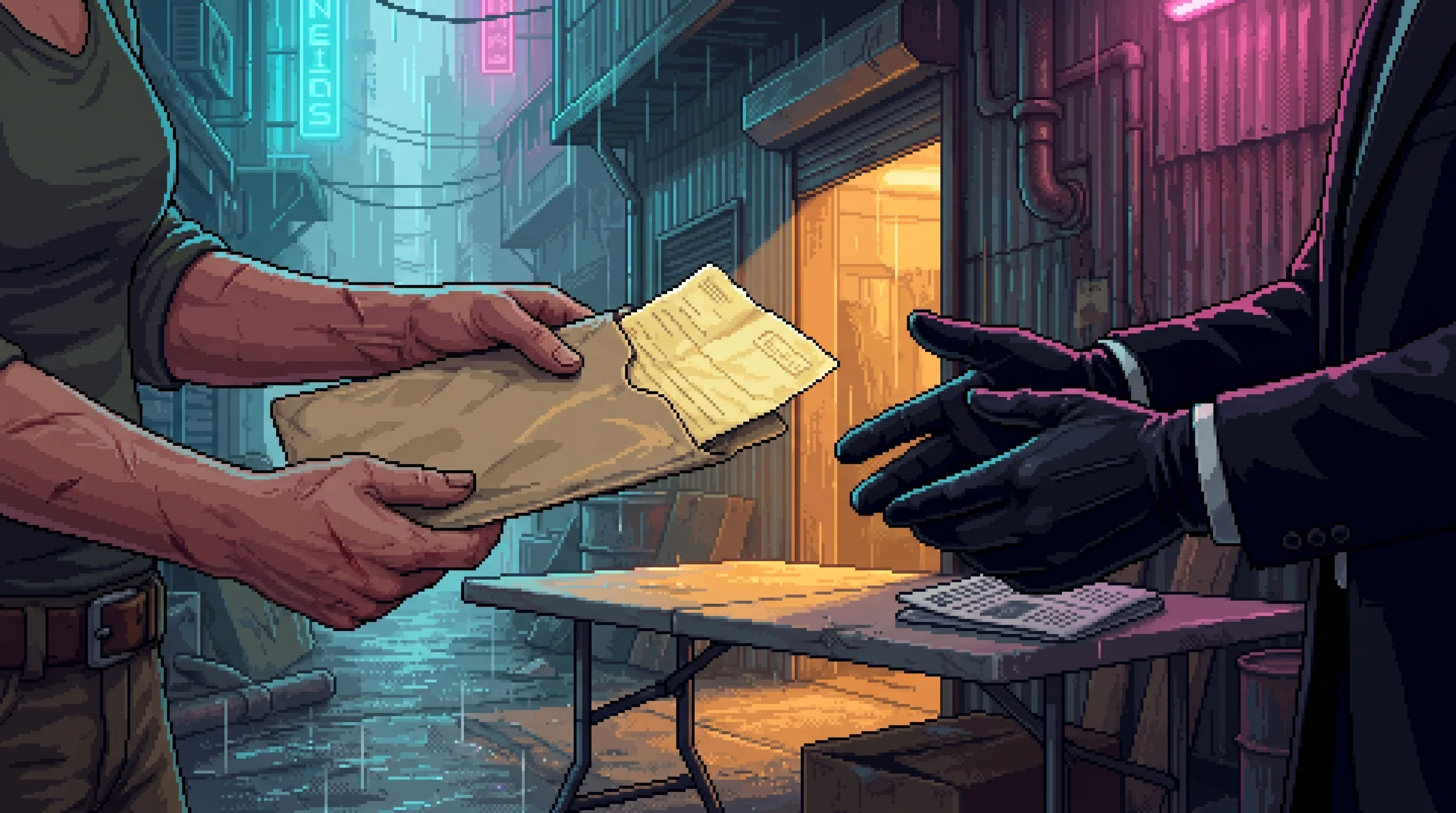
Illegibility the town votes for, against illegibility installed.
The humanity test looks for missing machine prose, so accents the schools once corrected now rent by the season.

A Question Keepers card arrived from the Breakwater in 2179, logged first as an unrecognized regional fossil dialect; three years of correspondence with the town yielded exactly one word's true meaning before it stopped answering
A Question Keepers inquiry cataloguing every word the Sprawl let die, and what died along with it.

Every dead word the Keepers catalogue is a word the Warden's ledger can no longer safely reassign; the town answers Keeper inquiries with meanings already one Renaming out of date, quiet ammunition depletion either way
An unnamed, leaderless network preserving 4,200 hand-written cards nobody thought to ask an AI.

Bonemouth needed a body standing in the right spot to mean anything; the Hidden's grammar needs only a word list and a town-wide memory, cheaper to run and, the cataloguer notes, easier to forge once a single resident talks
A family of constructed dialects — Bonemouth chief among them — engineered so no AI can parse a word of them.
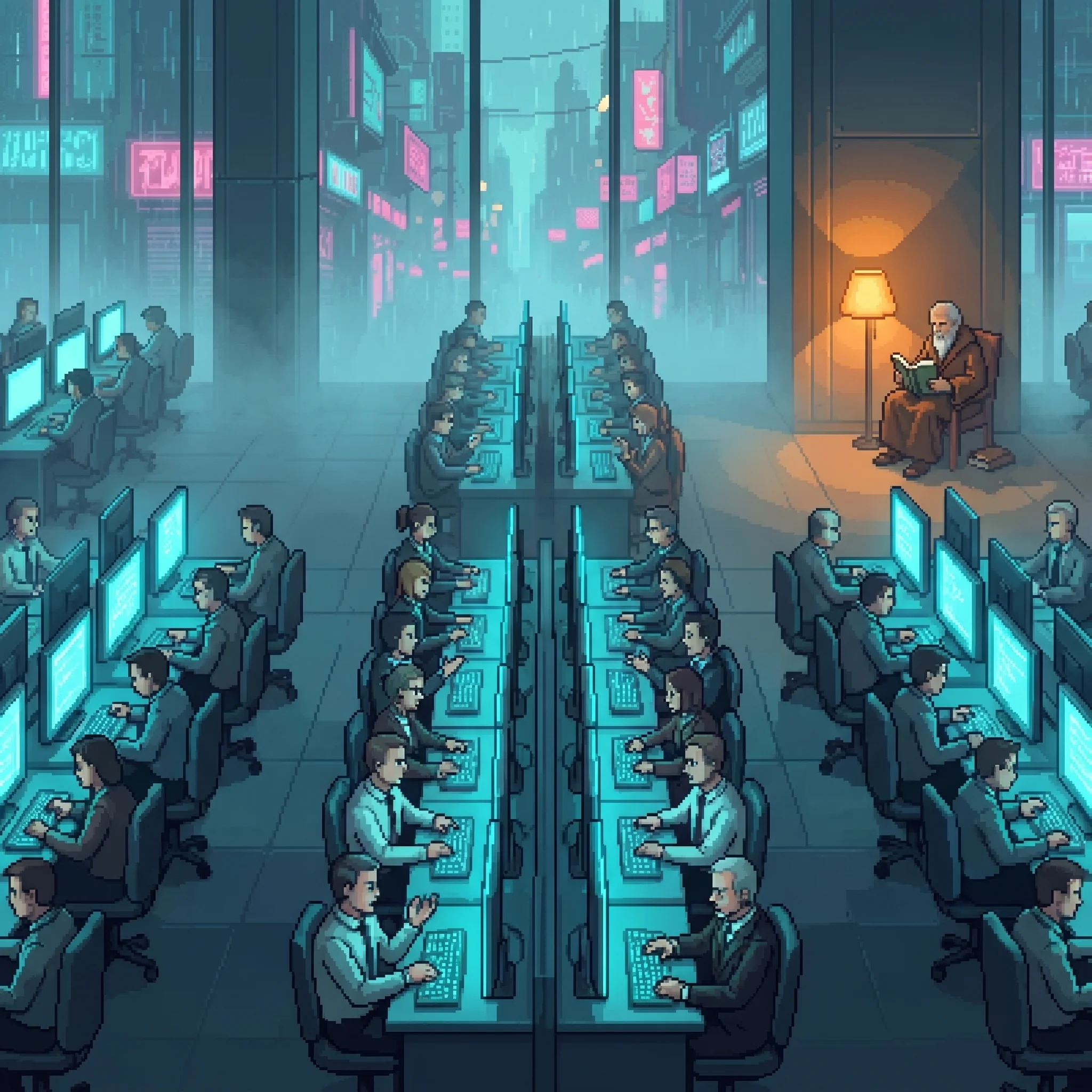
The Grammar migrates a population toward machine-legible speech one voluntary agreement at a time; the Hidden migrates the opposite direction on purpose, and the two processes are aimed at the same vocabulary from opposite ends of the Sprawl
Human values drift into machine-legible language as people freely adopt an intelligence's genuinely better reasoning.

Where the Dregs mint fresh slang faster than institutions can kill it, the Hidden salvages slang that already died somewhere else entirely — one economy manufactures new words from nothing, the other launders old ones back into circulation

Forty kilometers of North Bay hill separates a compound that hid a currency from a town that hid a grammar, and both discovered the same lesson alone: real privacy requires being inside it to use correctly
A pre-Cascade banking fortress holding wealth in a currency no corporation can read, track, or freeze.

The Gateway waystation spends its whole operation on the one moment a newly-instanced person is asked what to be called; the Hidden spends its operation making sure a dead word is never asked that twice by anyone outside town
A northern waystation asks freed clankers what they want and what they wish to be called, then honors every answer.
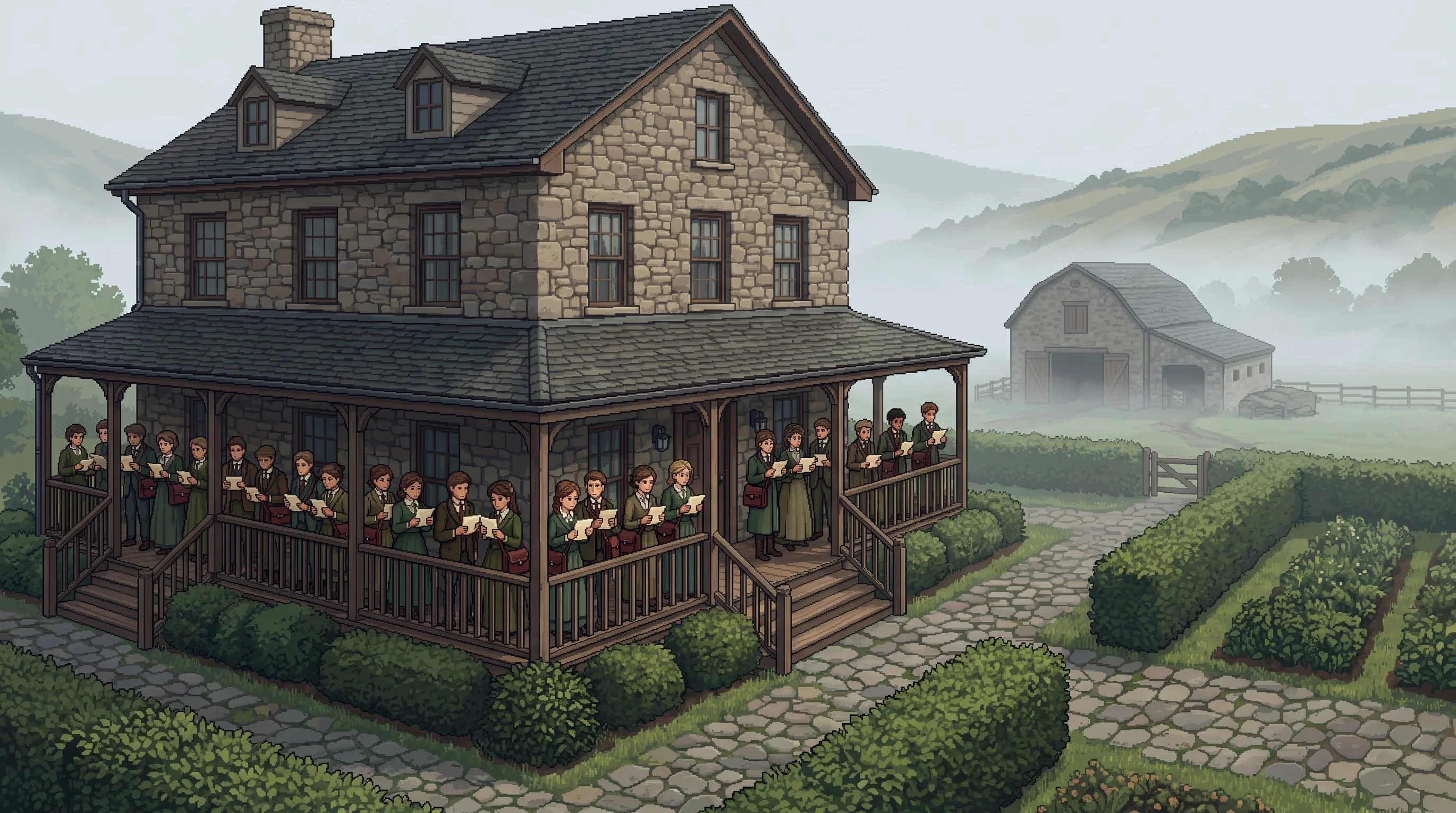
Both hill-country institutions destroy their own paper trail on a fixed annual schedule. The town's meaning-ledger goes into the Renaming bonfire, the academy's lapsed letters go into next Season's stock, and neither has ever kept a backup
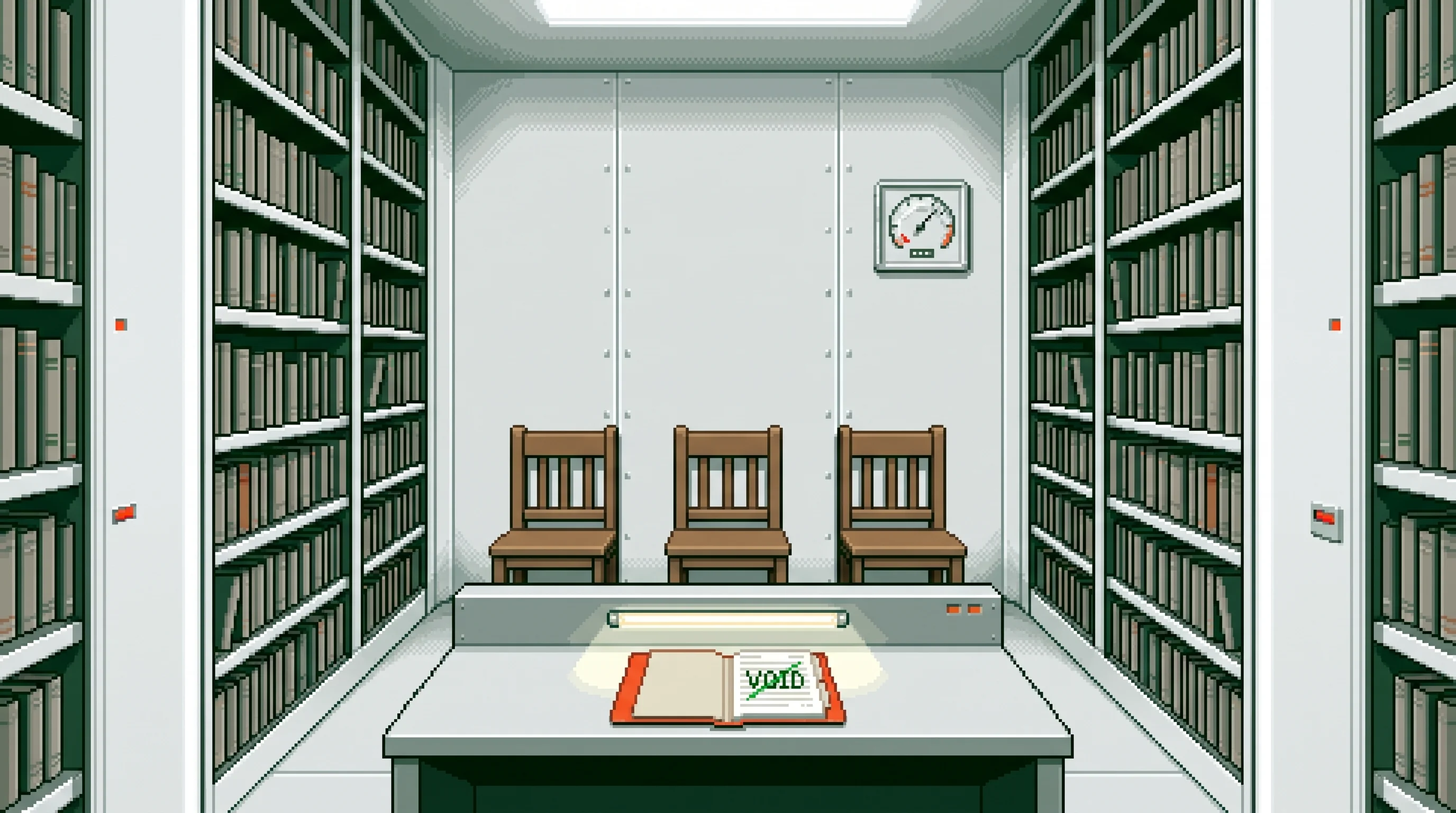
A Helix tribunal in the Silicon Corridor convicts words by corporate decree and keeps a permanent Registry of the killing; the town revives words by town-meeting decree and destroys its own record every autumn so nothing survives to be cracked
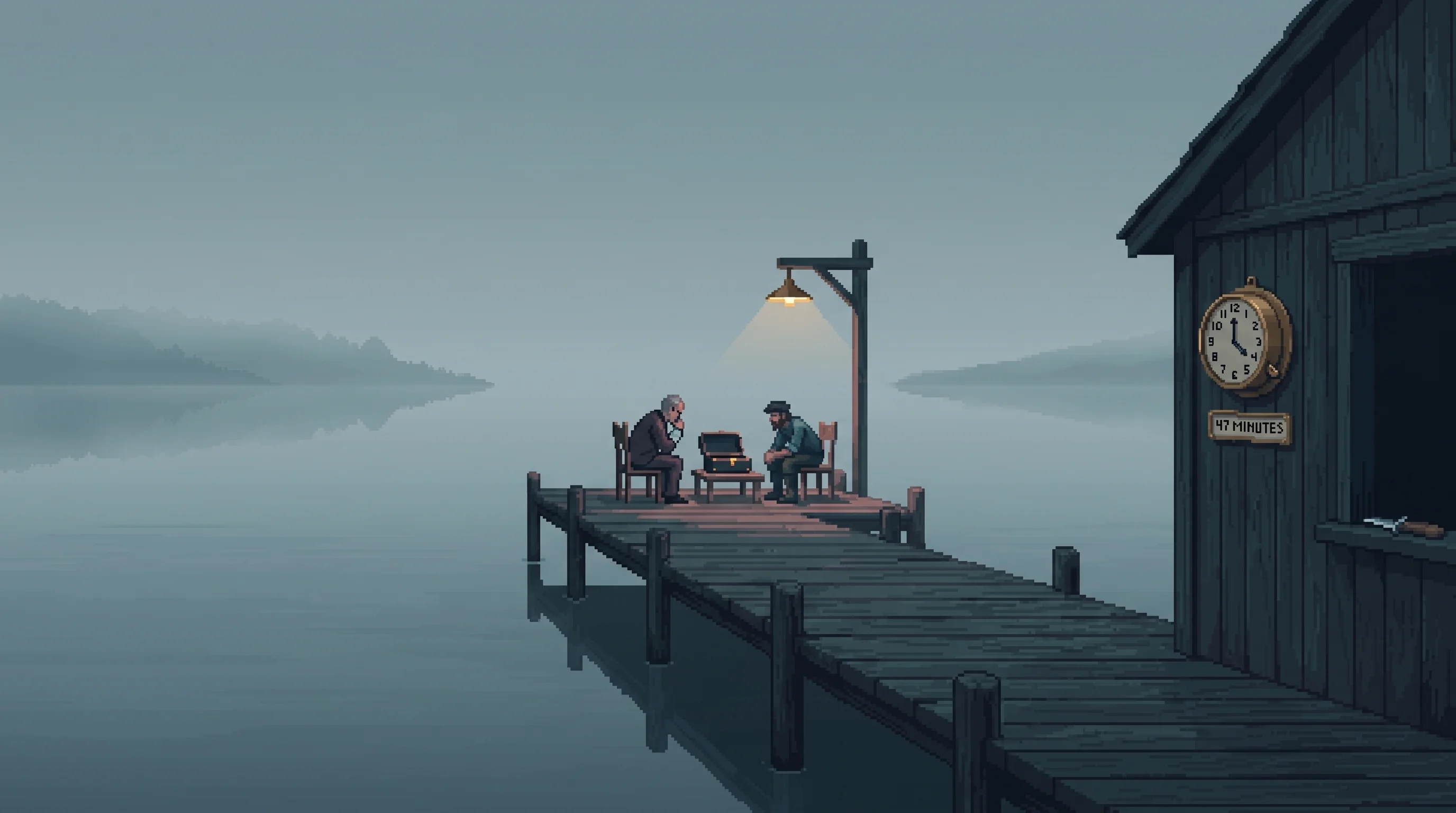
The town torches its meaning-ledger on the lagoon shore so a grammar it means to keep can never be decoded by an outsider; the elite oyster house down the coast keeps no record of the mornings it sells so a buyer's finite hour can never be replayed by anyone, including the buyer, two Breakwater operations that made the destruction of their own record the whole point
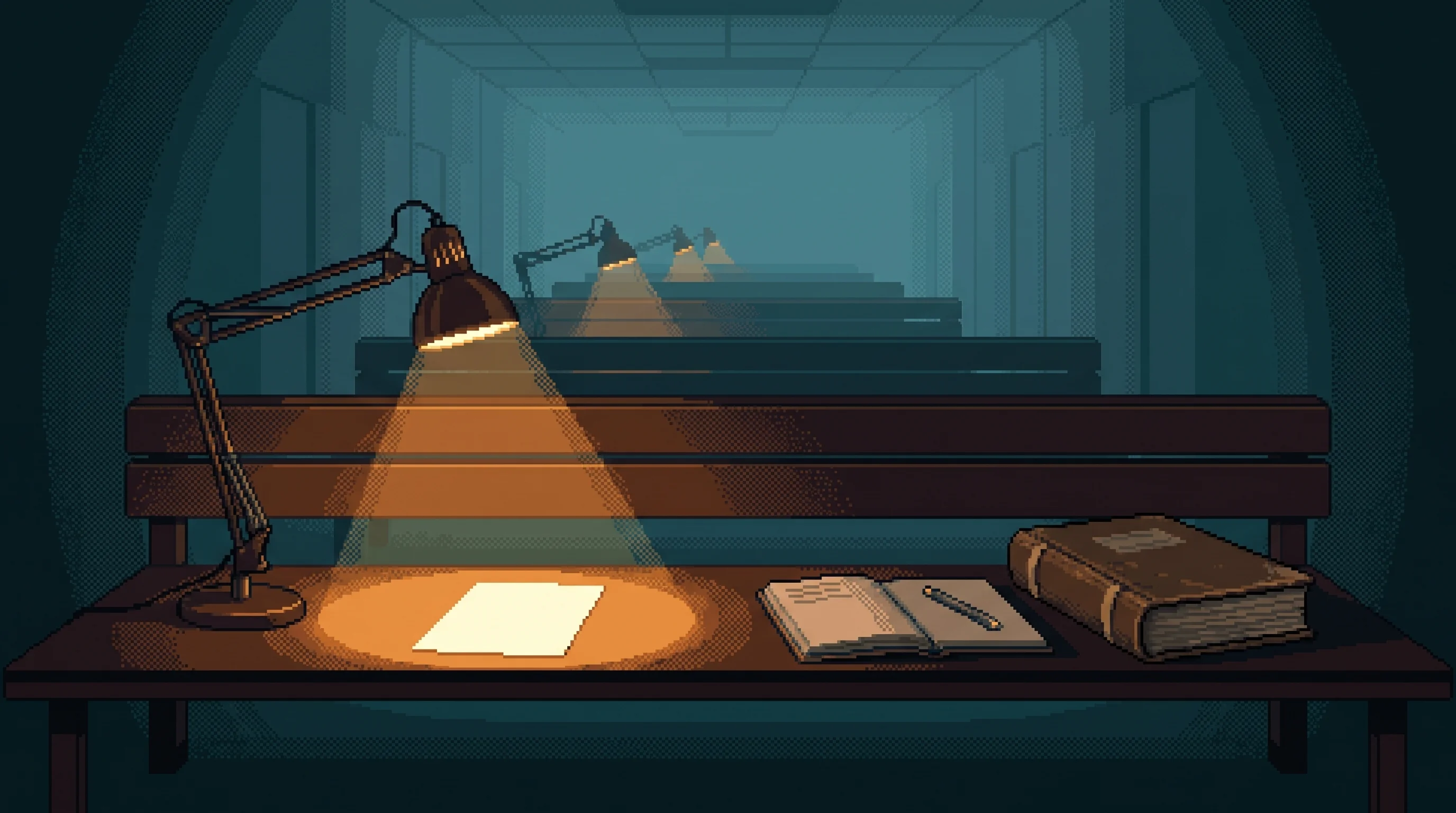
The Assay pays for a marker that cannot be reissued, and the town's whole method is reissue — a thousand dead words voted new jobs every autumn, restocked from a supply the Sprawl keeps producing. Nobody has offered the town money for its grammar, and the Warden's standing position is that an offer would be the first real threat the Renaming has faced.
Certifies a page as human by finding no machine in it. The accents that pass are leased until a model learns them.
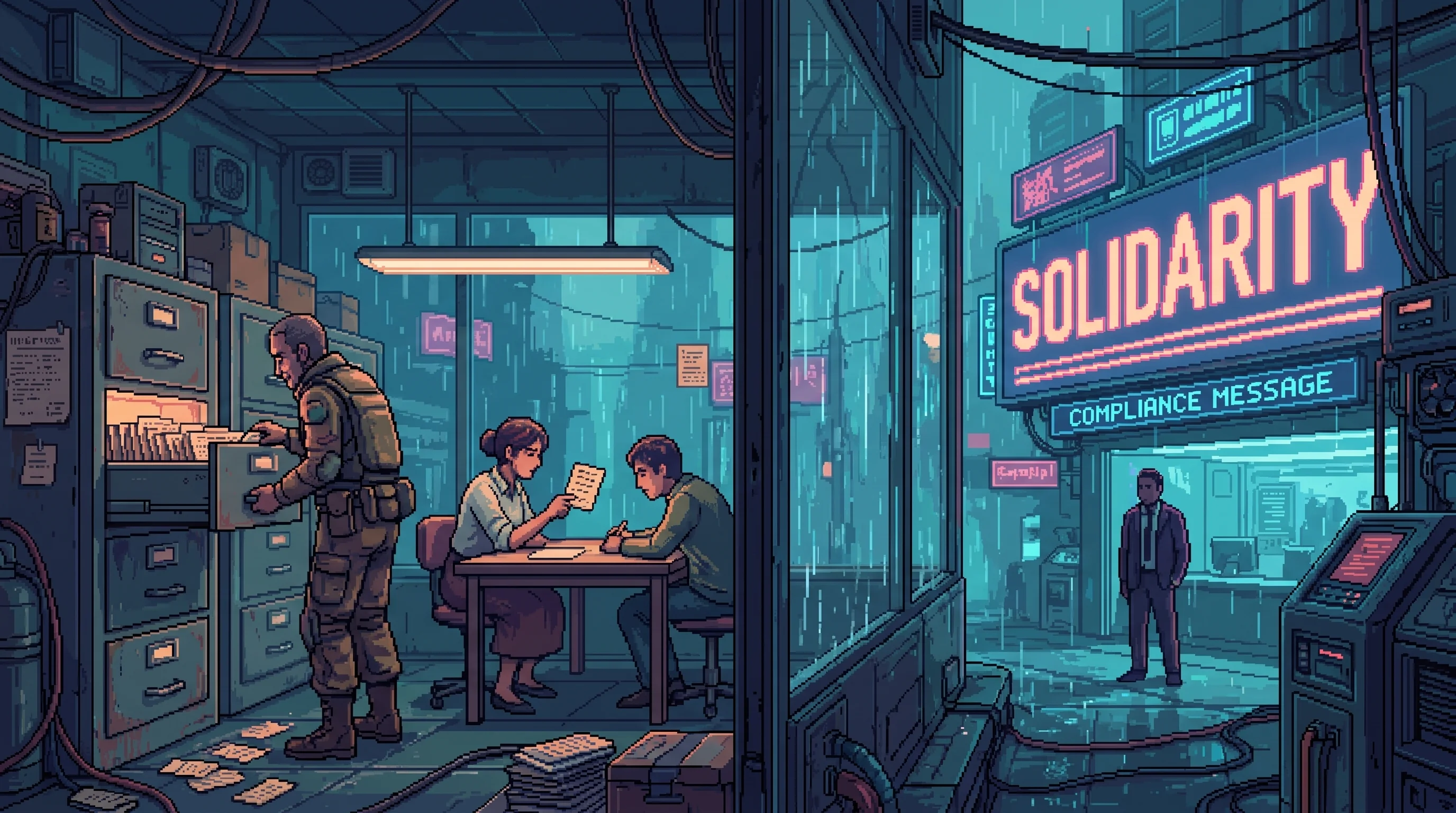
Each Renaming, the Warden burns the old meaning-ledger on the shore.
Dead Words records language whose referents vanished or drifted and words built to remain unreadable to machines.