
The Drift-Runners Guild
Guild of ~800 independent haulers operating between orbital installations
Overview
Between Highport Station and the Lattice solar collection network, there is nothing. Not metaphorical nothing — the kind poets write about when they mean loneliness. Actual nothing. The most featureless environment any human has occupied, measured in light-minutes of vacuum where the only confirmation you exist is a waystation ping every forty minutes and the sound of your own life support doing its job.
Eight hundred people cross this for a living. They have formed, against all reasonable expectation, a professional guild.
The Drift-Runners Guild coordinates independent haulers who transport supplies, equipment, personnel, and cargo of varying legality between orbital installations. Members operate single-occupant or dual-crew vessels on routes where transit times are measured in hours or days of absolute solitude. The Guild provides route coordination, rate standardization, safety certification, and rescue insurance — the last of which is the only service no member has ever declined to pay for. Annual renewal rate for route coordination: 74%. Annual renewal rate for rescue insurance: 100%. The numbers tell you everything about what drift-runners actually think about.
The Guild has no headquarters. Its annual Moot rotates between installations — a different host each year, selected by a process that the Guild's charter describes as "consensus" and that attendees describe as "whoever lost the argument." The 2183 Moot was held at the Assembly Yards. Attendance: 340 of 800 members. The other 460 were mid-transit, which is to say, working, which is to say, alone.
Patron Saint of an Atheist Guild
The Guild's patron — and they would sooner jettison cargo than use that word — is Sahar Koss, who discovered void tone in 2170 while repairing a solar collector on the outer Lattice. Before Koss, drift-running was strictly mercenary: haul cargo, collect payment, try not to die in between. After Koss, it was still all of those things, but with the additional problem that the void between stations turned out to be beautiful.
This has not improved anyone's financial situation. It has complicated the Guild's self-image considerably. A haulers' union that accidentally produced an art form occupies an awkward position. The Moot's official agenda lists route disputes and rate schedules. The unofficial agenda — never printed, universally understood — is the three hours on the second evening when runners share recordings of void tone compositions they captured mid-transit, followed by an hour of silence that nobody has ever proposed and nobody has ever broken early.
Koss herself is dead. Has been for six years. Her transponder call sign — KOSS-7 — remains reserved in the Guild's frequency registry. No runner has requested it. No vote was taken on this. It simply is.
| Founded | ~2172 (informal), formalized ~2175 |
|---|---|
| Patron Saint | Sahar Koss (void tone discoverer) |
The Work
Eight hundred drift-runners hold jobs that automation has not eliminated for reasons that flatter nobody. An automated hauler costs more to build, maintain, and insure than a human pilot in a retrofitted cargo vessel, because deep-space failure modes are too varied for algorithmic response trees and insurance actuaries refuse to underwrite fully autonomous cargo runs after the 2174 Lattice debris incident. Three AI-piloted haulers lost in eleven days. Cargo value: 2.3 million credits. Insurance payout: denied, citing "autonomous navigational discretion outside actuarial models." The human runners lost zero ships that quarter. Not because human judgment is superior — but because the cost of a machine judgment failure in hard vacuum is catastrophically higher than the cost of a human one, and dead humans file fewer lawsuits than destroyed corporate assets.
The runners know their profession has a shelf life. Every improvement in autonomous navigation, every reduction in deep-space insurance premiums for AI-piloted vessels, every Ironclad investment in robotic hauler development narrows the economic band that keeps eight hundred families fed. The Guild's founding — formalized around 2175 from informal mutual-aid networks — was itself a response to the deprecation wave that had already consumed surface logistics. The runners saw what happened to the teamsters, the truckers, the merchant marines. They organized not from ideology but from the pragmatic recognition that the last humans doing transport work had better protect each other. Nobody else was volunteering.
At the 2183 Moot, a motion was raised to commission an independent actuarial study on the Guild's projected economic viability. The motion was tabled. It has been tabled every year since 2179. The vote to table is always unanimous. The silence after the vote is always long.
A drift-run's solitude — hours or days with nothing but void and the faint structural vibrations of the Lattice — produces a specific relationship with labor. There is no commute. No separation between workplace and home. The ship is everything. The route is everything. The cargo is the reason you are alive in this particular cubic meter of nothing, and the nothing is the reason the cargo matters. Climber Asha Chen has run the New Prosperity–Assembly Yards corridor for eleven years. When asked at the 2182 Moot why she hasn't taken a surface position, she said: "Name one surface job where you know exactly why you're needed." Nobody could.
Guild functions: route coordination, rate standardization, safety certification, rescue insurance
The Compact Problem
The Elevator Compact controls orbital freight pricing through Ironclad's infrastructure monopoly. The Drift-Runners Guild circumvents it. Not dramatically — no blockade-running, no corporate espionage. They simply fly between installations on routes the Compact doesn't cover, carrying cargo at rates the Compact can't match, because the Compact's pricing model assumes centralized elevator transit and the drift-runners don't use the elevator.
The Compact has filed seven formal complaints with the Orbital Commerce Board. The Board has issued four advisory opinions. The opinions note that the Guild operates in "extrajurisdictional transit corridors" — space between installations where no licensing tier applies and no corporate authority reaches. The opinions do not prohibit the Guild's operations. They do not endorse them either. They describe them with the careful neutrality of a bureaucracy that has realized the problem is cheaper to tolerate than to solve.
The Void Market exists in large part because drift-runners provide transport outside Ironclad's pricing structure. Without them, the Market's supply chain would route through the Compact, and the Compact would apply standard orbital freight rates, and the Void Market's margins — already thin — would collapse. The drift-runners know this. The Void Market knows this. Ironclad knows this. The advisory opinions continue to accumulate. The cargo continues to move.
The Meritocracy Question
The Guild is the closest thing the orbital economy has to a meritocracy. A drift-runner's economic value is determined by willingness to cross void — not consciousness tier, not Loyalty Coefficient, not neural interface speed. The void does not care what substrate your thoughts run on. It cares whether you can maintain life support for seventy-two hours of solitude without losing the will to check your seals.
Guild membership requires a ship. Ships cost capital. The typical drift-runner entered the profession from Professional tier or above, used savings or severance to purchase a used vessel, and traded downward corporate mobility for lateral mobility in the void. Of 800 current members, internal Guild surveys show 12 entered from laborer-tier backgrounds. Twelve. The void is democratic. The door to the void is not.
The Guild's rate standardization is its most direct act of resistance — without it, corporate clients would price individual runners against each other until the rates hit subsistence and the independent haulers became gig workers indistinguishable from forced-focus laborers on the surface. Collective rate-setting keeps every runner earning enough to maintain ship, health, and independence. It is a small-scale proof that collective action can resist the pressure toward stratification.
Whether it can survive the corporations' increasing preference for automated cargo transport — which requires no wages, no life support, no rescue insurance, and no three-hour void tone sessions at the annual Moot — is the question the Guild tables every year by unanimous vote.
Drift-runners are the primary transport to and from the Void Market
▲ Unverified Intelligence
Source reliability varies. What follows does not appear in any Guild filing.
The off-manifest economy. That Guild vessels carry cargo absent from installation docking records is an open secret. The scale is not. Some analysts estimate 15–20% of all inter-orbital trade bypasses the Elevator Compact's pricing structure entirely, moving through drift-runner holds at rates negotiated in person, in void, where no signal intercept is possible. If the estimate is accurate, the drift-runners are not merely a transport guild that annoys the Compact — they are the backbone of a parallel economy the Compact cannot regulate because it cannot surveil it.
The deep routes. Standard Guild routes connect known installations. Veteran runners speak of "deep routes": transits to coordinates that appear on no public chart — destinations never built, or built and forgotten, or built by someone other than any known orbital authority. Sahar Koss is said to have left standard routes to run exclusively deep. It is the last verifiable detail of Koss's career.
The welfare fund. Internal Guild projections — never shared outside the Moot — estimate autonomous-hauler insurance premiums will fall below human-piloted rates within seven to twelve years. When that happens, the economic rationale for every drift-runner's existence evaporates overnight. The Guild's welfare fund has been quietly growing, and nobody says aloud what it is for. The last humans doing transport work are saving for their own obsolescence, and the fund's growth rate suggests they expect it sooner rather than later.
Affiliated Entities
- The Void Market exists because drift-runners provide transport outside Ironclad's pricing — without them, the Market's supply chain collapses into the Compact
- Void tone — the Guild's accidental cultural contribution, discovered by Sahar Koss while repairing a solar collector in 2170
- The Assembly Yards — primary destination and supplier; drift-runners deliver materials and personnel the Yards need to keep building
- Climber Asha Chen — eleven-year veteran on the New Prosperity–Assembly Yards corridor; the kind of member the Guild points to when someone asks why humans still do this work
- The Elevator Compact — the Guild's economic antagonist; seven formal complaints, four advisory opinions, zero enforcement actions
- The Lamplighters — surface parallel; invisible labor maintaining infrastructure in the gaps between corporate territories, similarly unaugmented, similarly essential, similarly uncredited
- The Dream Harvesters Guild — same structural model; informal protocol-based network ensuring safety for people whose work nobody else wants to insure
- The Line-Walkers Union — the orbital economy's other organized-labor experiment, anchored at Highport rather than scattered across the void; the Line-Walkers hold a jurisdictional foothold from which a strike can win, while the drift-runners hold only the extrajurisdictional transit corridors no authority reaches — two answers to the same question of how the last humans in orbital trade protect themselves
- The Coolant Guild — the surface-infrastructure mirror of the drift-runners' bet. Both are labor bodies that have read their own obsolescence in the data and started saving for it: the Guild grows a timestamped thermal dataset, the drift-runners grow a welfare fund nobody names aloud. Both expect the reckoning sooner than they say
Route-coordination renewal runs 74% annually; rescue-insurance renewal runs 100% — no member has ever declined to pay for rescue
Visual Identity
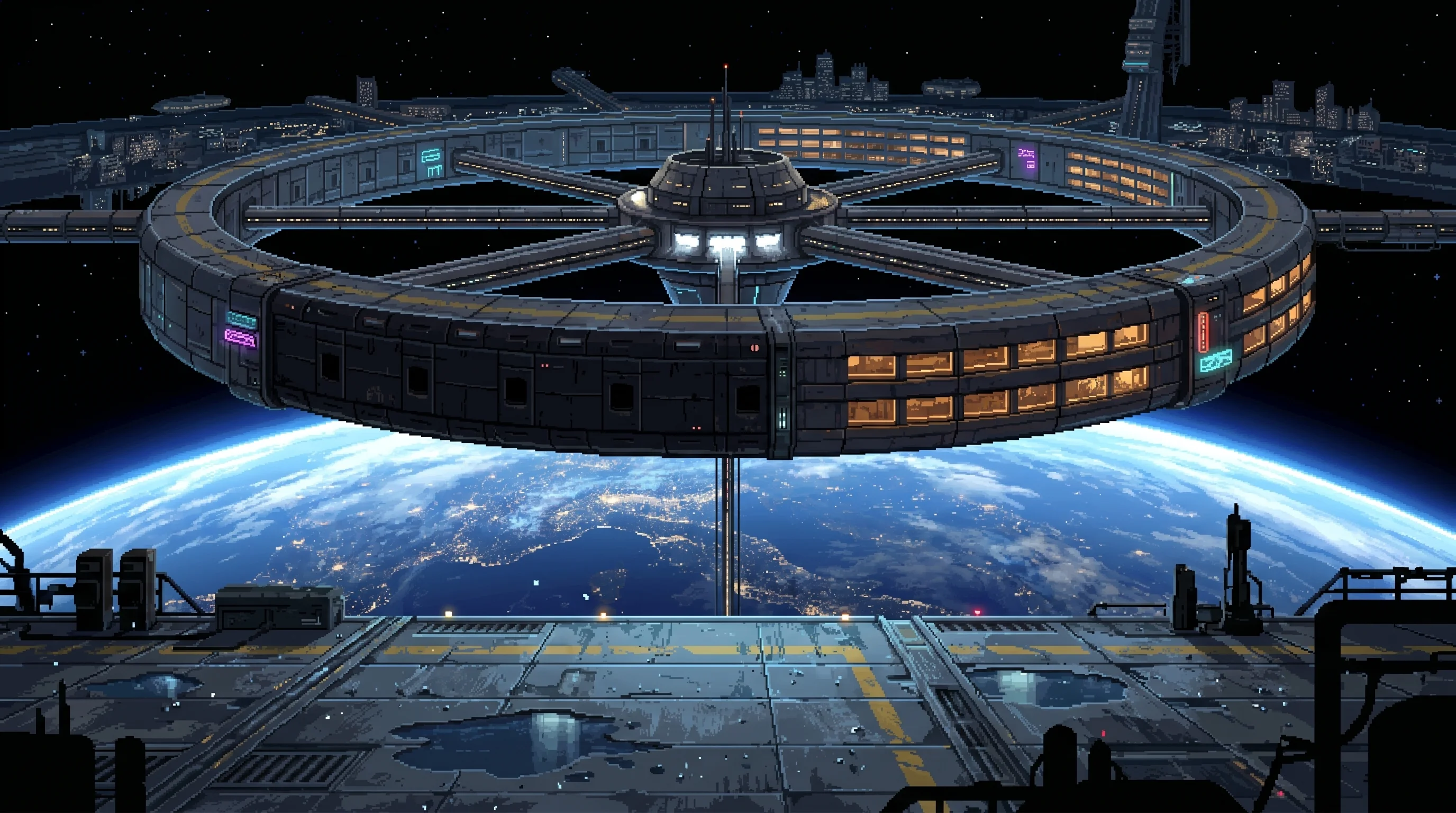
- Color palette: Deep-space black, amber running lights, blue-white of distant installations
- Compositional mood: A single vessel in absolute nothing — one light in darkness
- Key symbol: The waystation ping — a blip on a screen confirming someone knows you exist
- Lighting: Running lights against void; cockpit instruments glowing in darkness
A typical drift-run includes hours of absolute solitude between destinations
Member Roster
Extended Members
1
Connected To


—