The Corporate Defector Network is the underground railroad for corporate refugees — extraction, erasure, new identity, placement
Known AsThe Corporate Defector Network - Faction Profile, Defector Network
Scene ReferenceThe Corporate Defector Network
Overview
In the Sprawl, leaving a corporation isn't resignation. It's desertion.
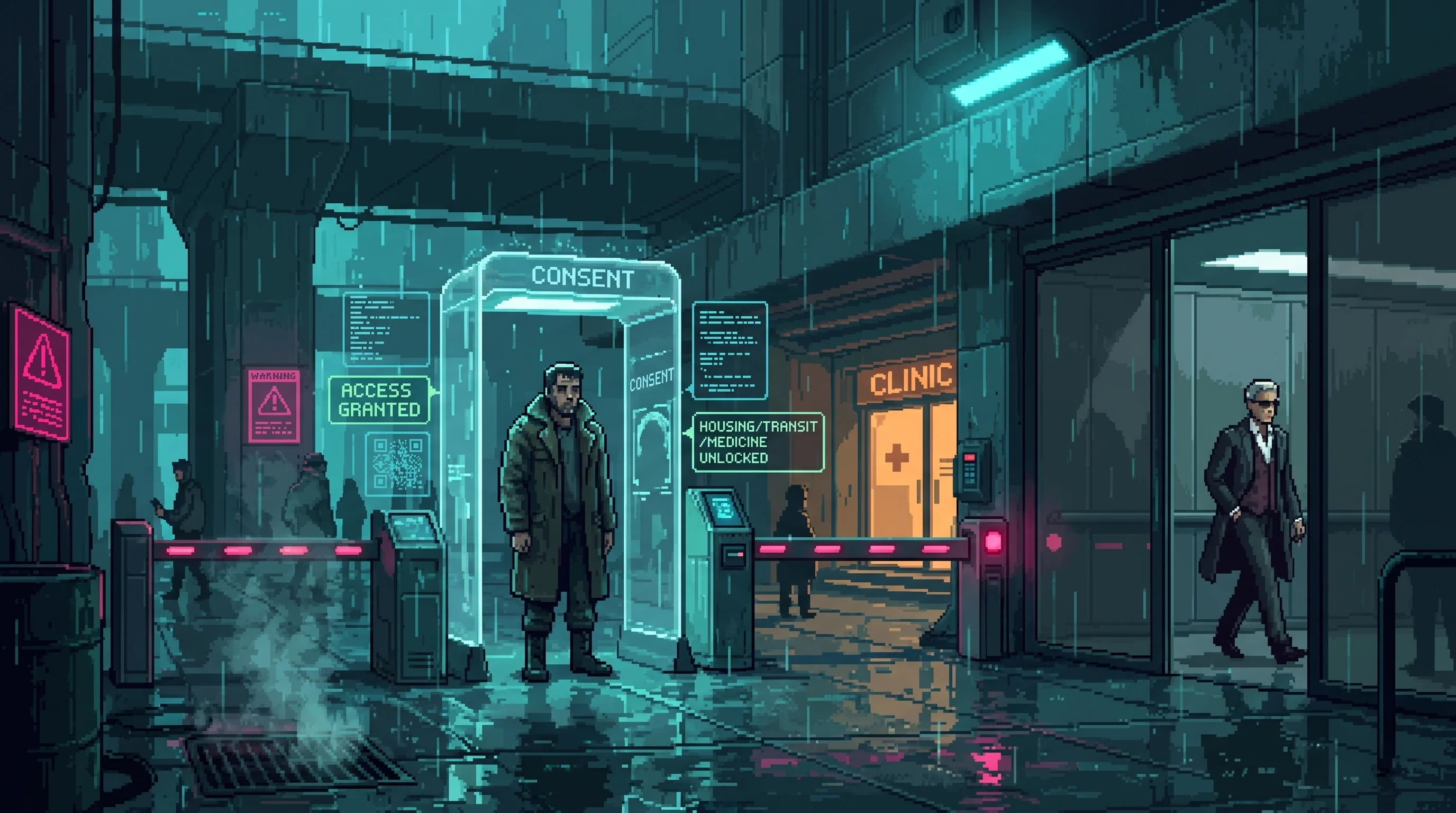
Corporate employment contracts bind for life. Housing, food, medical care, identity — all tied to the employer. Quitting means losing everything. Running means becoming a non-person. The Corporate Compact's legal architecture does not recognize the concept of voluntary departure. Nexus's HR classification system contains 247 employment status codes. "Resigned" is not among them. "Terminated," "Deceased," "Transferred," and "Under Review" are. The gap between these categories is the space the Corporate Defector Network occupies.
The Network — known by dozens of names but operating as one loose organism — is the underground railroad for corporate refugees. Extraction, erasure, new identity, placement. They help people disappear from systems designed to make disappearance impossible. They are former executives, disgraced researchers, disillusioned security personnel, and ordinary workers who saw too much. They are proof that corporate control isn't total, which makes them more dangerous than any armed insurrection. Insurgents confirm the need for security. Defectors undermine the premise that security is protecting anything worth staying for.
The Network processes approximately 200 defections per year. Two hundred is a rounding error against the Sprawl's corporate workforce of 3.2 billion. It is also 200 living refutations of the Corporate Compact's foundational claim — that life outside the system is unsurvivable. Nexus can suppress the Sector Outcomes Matrix. It can intercept the Comparative Outcomes Report. It cannot prevent a former Nexus analyst, now living in Haven's Edge, from telling her former colleagues over an encrypted G Nook terminal that she sleeps better, argues less, and hasn't felt the specific Sunday evening dread — the weight of knowing Monday is coming — since the day she left.
These testimonies are the Corporate Compact's most difficult containment challenge. The containment cannot quarantine human beings who exist, speak, and remember both sides.
Core Operations
"Everyone deserves an exit."
The Network doesn't judge why people want to leave. The corporations have decided their employees are property. The Network disagrees — and acts accordingly.
What they provide, in order of difficulty:
Extraction — getting people out of corporate territories. Cargo shipments, bribed border guards, hacked security systems, or simply knowing which paths aren't watched. A low-value worker walks out during shift change. A mid-level professional disappears under medical emergency cover. A high-value specialist requires a staged incident. An executive requires a full extraction team, possible violence, maximum resources. Methods vary by corporation and target value. Success rates vary accordingly.
Erasure — making someone disappear digitally, which is harder than making them disappear physically. Neural interface data, surveillance footage, financial records, medical histories — all must go. Employment records corrupted to show termination rather than desertion. Financial accounts closed. Medical histories transferred to facilities that do not exist. Kira Vasquez developed several of the neural interface spoofing techniques the Network still uses. Her protégés can keep a vacant apartment transmitting a defector's vital signs for weeks.
Identity — new names, documents, histories. Quality varies. Some identities hold for decades. Others collapse under scrutiny. The craftsmanship correlates directly with how long the Tech Cell had to prepare, which correlates directly with how much warning the defector gave, which correlates directly with how desperate they were when they ran.
Placement — connecting refugees with destinations. Zephyria. The Wastes. Collective safe houses. Sympathetic settlements in corporate blind spots. Roughly 60% end up in Zephyria. The rest scatter.
Protection — safe houses, security, and sometimes violence. Corporate retrieval teams hunt high-value defectors with resources the Network cannot match. The Network fights back when it has to. When it can't, it hides.
Founded ~2163 by Marcus Webb-1 (deceased) — designed cell structure to survive his death
Why People Run
Some defectors leave because they can't stomach what they're asked to do. Nexus researchers who grasp what Project Convergence really means. Helix scientists ordered to experiment on unwilling subjects. Ironclad engineers told to cut safety corners that will kill workers. Security personnel ordered to eliminate inconvenient witnesses. These are the defectors who arrive with stories — and sometimes evidence.
Most leave for quieter reasons. Workers diagnosed with conditions their employers caused. Families separated by corporate transfers. Relationships that cross corporate boundaries. Simple exhaustion after decades of optimized existence. They want quiet lives somewhere else. They're the majority, and they're the easiest to help.
A minority leave for personal gain — executives stealing trade secrets, researchers taking proprietary knowledge, security personnel with valuable tactical intelligence. The Network serves them too. Their money funds operations. Their information helps future extractions. They're also watched carefully. Opportunists become informants at predictable rates.
And then there are the wanted. Whistleblowers who've already talked. Employees who saw things they shouldn't have. Scapegoats for corporate failures. Anyone inconvenient enough to eliminate. The corporations want them dead. The Network tries to keep them alive. These are the hardest cases and the ones that build the legend.
The Second Defection
A phenomenon the Network has never publicly addressed.
Corporate refugees who escape to Zephyria, the Dregs, or Purist communes sometimes discover that the voluntary community has its own requirements — requirements harder to navigate because nobody states them explicitly. The Consensus Weight in Zephyria. The gift economy's unpayable debts in the Dregs. The theological totality of the Purist communes. Freedom, it turns out, has dependencies too. They're just not listed in any contract.
Some second-defectors return to the Sprawl. Some approach the Network asking to be placed somewhere else. A few ask to go back to their corporations.
The Network has no protocol for reverse extraction. The question — what do you do when someone wants to defect from freedom? — sits in the organization's blind spot like a cracked tooth nobody will probe with their tongue. Answering it would require confronting the possibility that the systems the Network fights and the systems it offers share structural features nobody wants to name. The exit door opens both ways. The Network's founding slogan — "everyone deserves an exit" — technically covers the return trip. Nobody has tested this interpretation. Nobody wants to.
Internal estimates suggest 8–12% of successful defectors experience what coordinators privately call "reentry ideation" — the sustained desire to return to corporate life. The number is not tracked formally. Tracking it formally would require acknowledging it formally. The Network's operational mythology depends on the premise that what waits on the other side is better. For most refugees, it is. For the 8–12%, "better" turns out to be a more complicated word than the extraction briefing suggested.
Cell-based structure — no headquarters, no central command
The Engine That Makes the Border Unwanted
The Network smuggles bodies across a border. There is one polity that has learned to make the border unwanted, and it does so by living inside the Network's deepest blind spot.
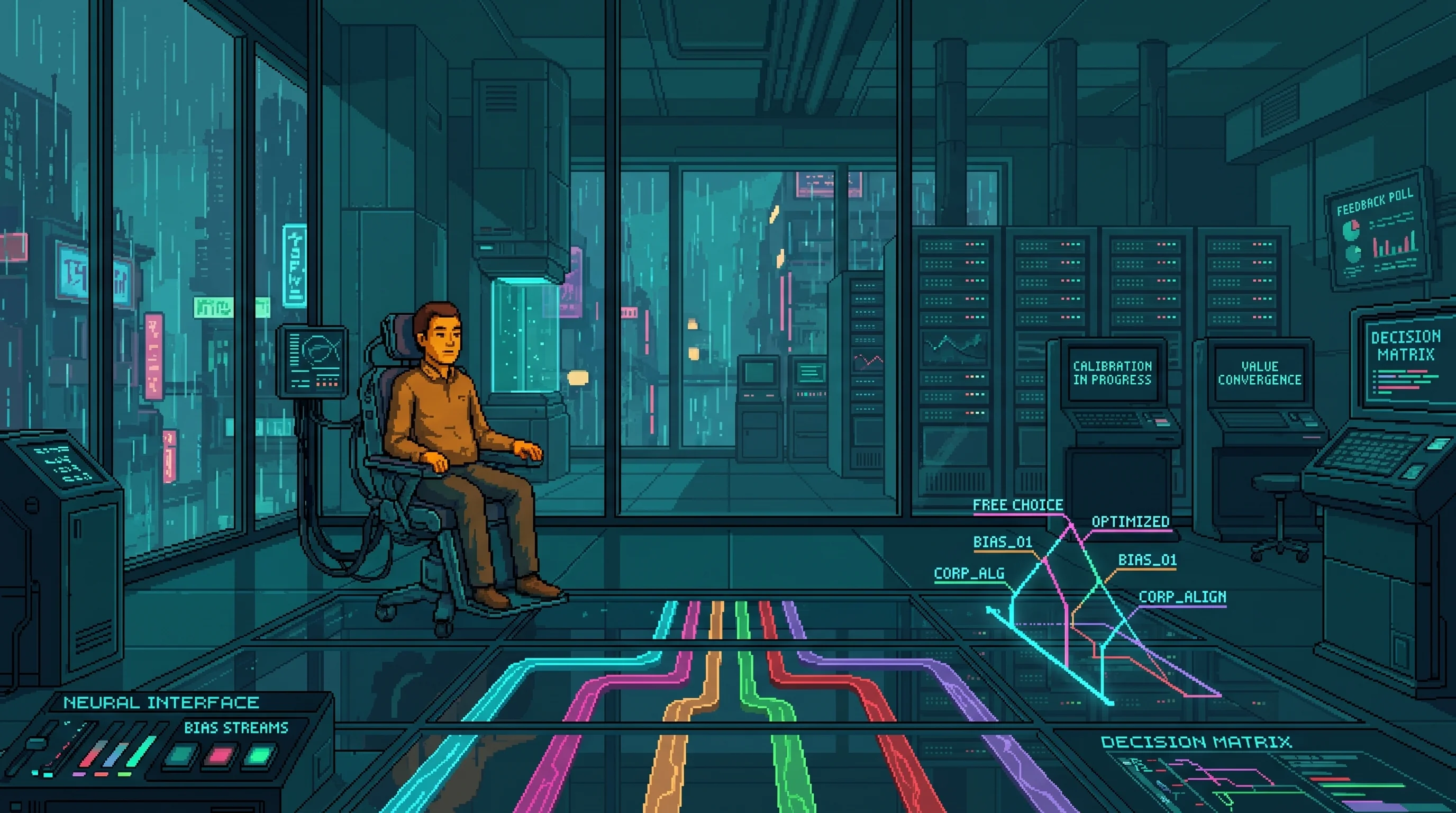
The Mandate Engine — the consent-optimized administration governing the band between the corporate enclaves and Zephyria's councils — does not need a wall or a retrieval team to hold a population. A defector extracted into the administration is not caged; they are gardened, within a polling cycle, into sincere approval, and they file no reentry-ideation because they have nothing to flee. The 8–12% who want to defect from freedom — the cracked tooth the Network will not probe — are, under the Engine, not a statistical embarrassment but the governing majority, content by design, approving at 97% of the thing that authored their contentment.
Lena Ostrova — who left Nexus Predictive Social Analytics, the department that shapes what you'll want so the wanting serves the quarterly projection, precisely to escape authored preference — teaches Haven's Edge children "questions that have no efficient answers." If the Mandate Engine ever annexed Haven's Edge, Lena's students would grow up gardened, approve at 97%, and her teaching would register in the administration's ratification stream as friction to be gently tuned away. This is why the Unconsenting — the Engine's last opposition, polling 4% and falling — are, structurally, the Defector Network turned inside out: a party of people who want to defect from the freedom of authored contentment, into a self they cannot prove was ever taken, across a border the Network has no protocol to cross because the Network only ever ran the route the other way. Lena Ostrova — who left Nexus Predictive Social Analytics, the department that shapes what you'll want so the wanting serves the quarterly projection, precisely to escape authored preference — teaches Haven's Edge children "questions that have no efficient answers." If the Mandate Engine ever annexed Haven's Edge, Lena's students would grow up gardened, approve at 97%, and her teaching would register in the administration's ratification stream as friction to be gently tuned away. This is why the Unconsenting — the Engine's last opposition, polling 4% and falling — are, structurally, the Defector Network turned inside out: a party of people who want to defect from the freedom of authored contentment, into a self they cannot prove was ever taken, across a border the Network has no protocol to cross because the Network only ever ran the route the other way.
~60% of successful extractions end in Zephyria
Structure
The Network has no headquarters, no leadership, no central command. It's a collection of cells that share methods, resources, and trust — but operate independently. Cell isolation is the founding principle: if one cell burns, the others survive. Marcus Webb-1 designed it this way before corporate retrieval caught him in 2171. He died under interrogation without revealing anyone. The Network considers him a martyr. The cell structure he built is his eulogy — an organization designed to survive the death of every person in it, including its architect.
Cells specialize: entry cells handle initial contact and vetting (2–5 members). Extraction cells plan and execute (3–8 members). Transit cells manage safe houses and transport (2–4 members). Tech cells handle digital erasure and identity creation (1–3 members, often trained by Vasquez's protégés). Security cells provide protection, counter-surveillance, and violence when necessary (4–10 members). Cells know each other by reputation and handoff protocols, not personnel.
A handful of coordinators — never meeting in person, communicating through encrypted dead drops — maintain the connections that make the organism function. Who has extraction capacity. Which safe houses are available. Which routes are burned. Which corporations are hunting hard. They're the closest thing to leadership. They're also the highest-value targets.
Regional Presence
Nexus Territory: The most active Network presence. Nexus's algorithmic surveillance makes extraction difficult. The same surveillance creates constant demand from people who feel watched every moment. Helena Voss built a system where choice is the only true luxury — everything else can be optimized, replicated, dispensed. The Network sells the one product Nexus cannot offer.
Ironclad Territory: Brutal but straightforward. Ironclad's security is physical rather than digital — easier to evade, more violent when it catches you. Extractions tend to be either very smooth or very bloody.
Helix Territory: The most complex operating environment. Helix employees often have biological modifications that create pharmaceutical dependency. Extraction isn't enough — the Network needs medical expertise to wean refugees off Helix compounds. Withdrawal can kill. The golden handcuffs are literal: Helix bakes tailored nootropics into cafeteria food, calibrated to each employee's neurochemistry. Three days without them and you're vomiting. Seven days and the seizures start. The Network's Helix coordinator — known only as "Grandmother," a former Helix biotech researcher who fled after her daughter was used in a Genesis Program experiment — has been running medical transitions for eighteen years. Her withdrawal cocktails have kept more people alive than most licensed clinics.
The Wastes: The Network operates openly here. Waste settlements offer temporary refuge. The physical danger of the journey provides its own security — no corporate extraction team pursues a defector across irradiated badlands unless the target justifies the cost.
Processes approximately 200 defections per year
Key Figures
The Ferryman
The closest thing to a Network legend. A coordinator who has handled thousands of extractions over twenty years. No one knows their identity — not face, voice, location, gender. Communication only through intermediaries and encrypted channels.
Some believe the Ferryman is a single person. Others think it's a position passed between coordinators. A few suspect it's a collective fiction — a myth that gives the Network coherence. The Ferryman has never lost a refugee after accepting the case. This statistic is unverified because the Ferryman's case records don't exist in any system anyone has found. The statistic persists because no one has produced a counterexample, and producing a counterexample would require admitting you tried to find one, which would require admitting you doubted the Ferryman, which no one in the Network does out loud.
Corporate intelligence divisions across Nexus, Ironclad, and Helix have spent significant resources attempting to identify the Ferryman. At least three attempts have been confirmed. All failed. Whether this confirms the Ferryman's exceptional tradecraft or the Ferryman's nonexistence depends on which answer you find more frightening.
Kira Vasquez — Technical Consultant
The former Nexus researcher who fled after the Cascade isn't officially part of the Network — but her expertise shapes their operations. She developed many of the neural interface spoofing techniques they still use. She's trained multiple Tech Cell operatives. When an extraction is technically impossible, someone usually contacts her. She doesn't coordinate, doesn't extract, doesn't run safe houses. She solves problems no one else can solve, and then she's gone.
Grandmother — Helix Network Lead
Eighteen years running medical transitions. Her specialty is getting Helix employees off corporate pharmaceuticals without killing them. Her withdrawal cocktails — developed through methods she does not discuss, using ingredients sourced through channels she does not name — have become standard Network equipment. She trains others. She does not trust easily. When she speaks, which is seldom, the room listens.
Jin "Rust" Tanaka — Scraptown Connection
The Zephyria Council member from Scraptown openly cooperates with the Network. His district processes Waste salvage; it also processes refugees. He provides final destination support, documentation, and integration assistance. "Scraptown handles everything that comes out of the Wastes. That includes people. I don't ask where they came from. I ask what they can do."
A Safe House in The Deep Dregs
First-person account, recorded 2183
The door doesn't look like a door. It looks like a service panel for the ventilation system in the sub-basement of a Wholesome distribution warehouse — rusted shut, no handle, the kind of thing maintenance forgot about decades ago. You wouldn't look twice.
That's the point.
The operative — a woman with cropped gray hair who never gives her name, just "call me Three" — raps her knuckles in a pattern I don't catch. Something clicks behind the metal. The panel swings inward on oiled hinges, and the smell hits me first: recycled air, instant ramen, disinfectant, and underneath it all the warm electric hum of too many bodies sharing too little space.
Inside: a converted utility crawlspace, maybe twelve meters by eight. Ceilings low enough that I hunch. Someone has strung LED strips along the pipes — warm amber, never white, never bright enough to leak through cracks. Six cots in tight rows, each with a thin foam mattress and a vacuum-sealed bag of clothes. A chemical toilet behind a curtain. A hot plate and a stack of Wholesome ration packs. The irony of hiding from corporations while eating their food stopped being funny a long time ago.
Three refugees already here. A Nexus data analyst who keeps pressing her fingers to her temple where the neural port used to be — Kira Vasquez's people removed it during a twelve-hour procedure in a veterinary clinic, and the phantom signals haven't stopped. A Helix lab technician shaking constantly, three days into withdrawal from the tailored nootropics his employer baked into the cafeteria food. A young Ironclad welder who hasn't spoken since she got here — sits on her cot, stares at the wall, flexes her hands like she's still gripping tools that aren't there.
We don't use real names. I'm "Fern." The analyst is "Compass." The technician is "Sparrow." The welder never picks a name, so Three calls her "Quiet."
The Rules
Three explains them once. No written copy — nothing to find if the safe house burns.
No transmissions. No neural pings. No diagnostic checks on your augments. Anything that broadcasts stays off. Vasquez designed the signal-dampening mesh woven into the walls, but mesh fails. Silence is the only guarantee.
Hot plate runs between 0200 and 0400 only — the heat signature blends with the warehouse's overnight baking cycles. You eat when the timer says. You eat cold the rest of the time.
The LED strips go red for ten minutes every six hours. That means a sweep is passing overhead — Nexus surveillance drones mapping the district, the same ones Viktor Kaine pretends not to notice when they cross into Deep Dregs airspace. During red, you don't move. You don't breathe loudly. You become furniture.
If the door opens without the knock pattern, it's not Three. The knife under each cot isn't decorative.
Average stay is five days. Nobody stays longer than eight. After eight, the location probability curve crosses a threshold that someone calculated and nobody questions.
The Rhythm
Days collapse. Three comes twice daily — rations and intelligence, then neural dampening patch checks. She handles us like cargo: efficient, careful, impersonal. She has to. Attachment is a vulnerability the Network can't afford.
Compass teaches herself card games from a deck someone left behind, the faces worn smooth from a hundred previous refugees' anxious shuffling. Sparrow's shaking gets worse before it gets better — day three, six hours of vomiting, the Helix compounds leaving in waves. Three produces a syringe: "Grandmother's recipe." Something developed by the Helix Network Lead herself, designed to ease withdrawal from corporate biochemistry. Within an hour, Sparrow can hold water again.
Quiet starts talking on day four. Her name is Anisa. She was a welder on an Ironclad deep-infrastructure project — the kind where they don't tell you what you're building until you've signed contracts that outlast your natural lifespan. She saw what was behind the wall she was welding shut. She won't say what it was. The Collective's people would probably want to know, but the Network doesn't share intelligence with the Collective unless lives depend on it.
I spend my hours cataloguing marks on the wall. Previous refugees have scratched initials, dates, tiny drawings. A bird with no cage, repeated dozens of times in different handwriting. Someone wrote "Marcus W. didn't die for nothing" in letters so small I need augmented vision to read them. A date — 2171 — and the number 207. The Great Extraction. Two hundred and seven people moved in a single night. Some of them sheltered here.
This room has saved hundreds of lives. It smells like fear and ramen, and it is the most important twelve-by-eight meters in the Deep Dregs.
The Passage: Safe House to Zephyria
First-person account, recorded 2183 — continued
On day five, Three comes at an unusual hour. Different knock — faster. Transit code.
"Pack your bags," she says, though none of us have bags. We have the vacuum-sealed clothes and whatever we carried in our pockets when we ran. Compass has a photograph. Sparrow has nothing. Anisa has a welder's multi-tool she refuses to surrender. I have a chip of circuit board my daughter pressed into my palm before I left, small enough to swallow if I have to.
First transfer happens in the warehouse itself. A cargo loader — Ironclad model, the kind hauling Wholesome product between districts — idles in the loading bay. The driver doesn't look at us. We climb into a false compartment behind pallets of synthetic protein, and the air turns thick with the chemical sweetness of Wholesome packaging.
Forty minutes of darkness and road vibration. My neural dampening patch itches where it meets skin behind my ear. Compass silently counts intersections by the pattern of bumps. Sparrow sleeps — first real sleep in days, Grandmother's cocktail smoothing the worst of the withdrawal. Anisa grips her multi-tool and watches the seam of the compartment door.
We stop. Different hands open the door — a Transit Cell operative, young, nervous, sun-darkened skin of someone who lives in the Wastes rather than the Sprawl. He leads us through a drainage culvert that smells of rust and stagnant water, then up through a maintenance hatch into blinding daylight.
The corporate feeds show irradiated desert, cannibal clans, toxic dust. What they don't show is the sky. The actual sky, without the Sprawl's light pollution and atmospheric processing haze. Bruised fruit — purples and oranges where industrial particulates catch the sunset — and the most terrifying and beautiful thing I've ever seen. Compass starts crying. Sparrow stares upward with his mouth open. Even Anisa stops clutching her tool.
Three days through the Wastes. Different operatives at each stop. A salvager settlement that doesn't ask questions and cooks real food — actual grain, grown in soil, tasting of dirt and sun and nothing synthetic. A night in an abandoned relay station where the wind sounds like the Sprawl breathing in its sleep. A crossing point where we wait six hours for a patrol to pass — Ironclad regulars running the border, searchlights painting the dust in cold white arcs.
The Wastes are not empty. They are full of people the corporations pretend don't exist. Exiles, Waste Lords' subjects, clanfolk, and refugees like us — moving through the spaces between power, surviving on ingenuity and mutual suspicion and the occasional act of grace.
The Arrival
Jin "Rust" Tanaka's people meet us at the Zephyria perimeter. Scraptown district — the gateway, where everything that comes out of the Wastes gets sorted, including people. A clerk with scarred hands and kind eyes processes us through a system that doesn't ask where we came from.
New names. Real ones this time — not safe house callsigns but identities backed by documentation that Kira Vasquez's Tech Cell protégés have threaded into Zephyria's systems. I become someone else. The transition is supposed to feel liberating.
Haven's Edge. The refugee district. Small apartments carved from repurposed shipping containers, painted in colors that fade fast in the Wastes sun. My neighbors: a former Nexus middle-manager who now teaches children to read, and a Helix escapee who runs a small clinic using what Grandmother taught her. Nobody asks about the past. Everybody asks if you need anything.
The first morning, I reach for my neural interface to check the quota board. There is no quota board. There is no interface — just the smooth patch of synthetic skin where Vasquez's method sealed the port. Outside, someone is singing. Not a corporate jingle, not an optimized mood-regulation frequency. Just singing — off-key, in a language I don't know, because they want to.
I stand in the doorway and listen. My hands are shaking. I am free, and I have no idea what that means.
Testimony: "What I Left Behind"
From the Zephyria Oral History Archive, recorded 2182
My name now is Lena Ostrova. That's not the name I was born with. The name I was born with belongs to Nexus Dynamics, and I don't use stolen property.
I worked in Predictive Social Analytics for eleven years. The department that decides what you want before you want it — or more accurately, the department that shapes what you'll want so the wanting serves Nexus's quarterly projections. I was good at it. Corner office on the 140th floor of a sub-tower in Nexus Central. A partner, corporate-approved. Efficiency rating in the 94th percentile.
I left because of a Tuesday. Not a dramatic Tuesday — no whistleblowing moment, no smoking gun. I was reviewing behavioral modification protocols for a district-wide rollout, and I noticed the target demographic was children. Ages four to eleven. We were going to reshape how an entire generation thinks about loyalty, obedience, and need. I'd done similar work before. On adults, it felt like marketing. On children, it felt like what it always was.
I found the Network through a G Nook café in the lower levels. El Money's network — those underground places where Nexus's surveillance can't quite reach, where the walls are lined with something that makes the monitoring algorithms slip. The bartender looked at me for a long time when I said the words, and then he poured me a drink and told me to come back Thursday.
The extraction took three weeks. A Vasquez protégé — barely twenty, fingers like a pianist's — spent nine hours spoofing my neural interface so it would keep transmitting my vital signs from an empty apartment for weeks after I left. A Security Cell escort walked me through service tunnels I didn't know existed beneath my own building. And then a cargo container, and darkness, and the sound of the Sprawl fading behind me.
What I left behind: my name, my partner (who I couldn't tell — the Network insisted, and they were right), my mother's earrings (too identifiable), my 94th-percentile life, and the certainty that comes with being optimized.
What I brought: the knowledge that Nexus is building something in those children's minds that won't show results for twenty years. And the understanding that by then, it won't matter — because the generation that could have resisted will have been designed not to.
I teach now, in Haven's Edge. Reading, writing, critical thinking — the things that make people inconvenient to optimize. My students are refugees' children, Wastes-born kids, Zephyrians who never lived under corporate rule. I teach them to ask questions that have no efficient answers.
Sometimes the Ferryman's intermediaries contact me. New refugee from Nexus Predictive — could I help with integration? I always say yes. I recognize the look. It's the look of someone who has just realized the cage was always open — the lock was in their own neural interface, and the key was believing the interface when it told them the door was sealed.
Marcus Webb gave his life so the Network could survive. I give my teaching so the next generation won't need the Network at all. One of us is more optimistic than the other.
Costs
To operatives: corporate retrieval teams don't arrest. They eliminate. Capture is worse — neural interrogation extracts everything you know, and the Network has no rescue operations. Betrayal by opportunists, plants, or people who crack under pressure can destroy entire cell networks. And the ones who get away clean still carry the ones they lost.
To refugees: extractions fail. Sometimes people die in the attempt. The transition period — safe houses, new identities, unfamiliar destinations — is its own trauma. Some refugees never adjust. High-value defectors are hunted for years. Some never stop looking over their shoulder.
To everyone who stays behind: when the Network succeeds, corporations tighten controls on the remaining workforce. Each extraction makes corporate life measurably worse for those who didn't run. Nexus's internal security protocols were revised upward 23 times between 2175 and 2184. Fourteen of those revisions were directly attributed to Network operations. The people the Network saves and the people the Network harms are not always different populations — they're connected by the same system, pulling in opposite directions on the same chain.
The Erasure Runs Both Directions
The Network's entire craft is erasure — making a person disappear from systems designed to make disappearance impossible. Employment records corrupted to show termination rather than desertion. Neural data spoofed so an empty apartment keeps transmitting vital signs for weeks. A new name, a new history, a port sealed under synthetic skin. The Network erases people forward, out of the Corporate Compact's reach, because the Compact does not recognize voluntary departure — Nexus's 247 employment-status codes have no entry for "resigned," only "terminated," "deceased," "transferred." The gap between those categories is the space the Network occupies.
What the Network is built to reverse, the Compact does as routine. The runners killed in the Trench Collapse were erased backward: never logged as present in a sub-bay network Ironclad's survey classified as uninhabited, so their deaths required no record, so the absence of survivors to file reports became the only record there is. Same erasure, opposite vector. The refugee the Network extracts has to be carefully removed from systems that insist he exists; the Trench dead were never permitted to exist in the first place. Both are the Compact deciding, administratively, that a person does not register — and a coordinator who has run extractions for years recognizes the second kind instantly, because it is the thing the first kind is fleeing.
The machinery does it to objects, too. Guardian's Tactical Support Asset is stamped from emergency reserves, powered up mid-fall from the assembly hooks, given no designation beyond a serial number — the machine-grade twin of the released employee, inventory the corporation deploys and does not account for. The Network sees the serial-number drone for what it is: the same logic that strips a fifteen-year employee to a status code, applied to steel. And out in the dregs market the logic gets sold back as a luxury good — Honest, ¢47 per liter, the Authenticity Tribunal monetizing the feeling of the exit the Network actually risks lives to deliver. The Network moves two hundred real people a year. Honest sells the aesthetic of leaving to anyone who can afford to be asked about the bottle. One of these is an underground railroad. The other is a gift shop at the border the railroad is trying to cross.
Affiliated Entities
Entity
Relationship
Kira Vasquez
Technical consultant, developed key neural interface spoofing methods still in active Network use
Entry points in Nexus territory; cafés where surveillance slips
Corporations (general)
Pure opposition. The Network exists to undermine corporate control over people. Getting caught means death.
The Ferryman's Paradox
Restricted annex — open to read
The Ferryman's operational record — zero refugees lost after case acceptance — has been maintained for twenty years. Network coordinators cite this statistic with reverence. What they do not cite: the Ferryman's acceptance rate. Internal routing logs, accessible only to senior coordinators, show that the Ferryman declines approximately 40% of referred cases. The criteria for refusal have never been articulated. Refused cases are routed to other coordinators with lower success rates and higher mortality. The Ferryman's perfect record is not a measure of extraordinary capability. It is a measure of extraordinary selectivity. The legend depends on the cases that were never taken. The people who died under lesser coordinators are not counted against the Ferryman's name because they were never the Ferryman's people. The myth is structurally identical to the corporate performance metrics the Network exists to oppose — success defined by what you choose to measure and what you choose not to.
The Return Rate
Restricted annex — open to read
The Network's internal communications contain no reference to reverse defection. The topic is not forbidden — it is simply absent, the way a family avoids mentioning the sibling who went back to the abusive partner. Zephyria's population registry, however, records a category called "voluntary departure — destination: Sprawl." The number is small. The number is not zero. Haven's Edge neighborhood records show eleven apartments vacated without forwarding address in 2183 alone. Three of those former residents have been identified in Nexus employment databases under their original corporate identities. Their Nexus HR files list their status as "Reinstated — Voluntary Return." The files contain no mention of the years between departure and return. The Network does not know these people came back. The Network cannot afford to know.
The 2171 Great Extraction
Restricted annex — open to read
207 people moved in a single night. The largest Network operation ever attempted. Marcus Webb-1 coordinated it from a transit hub in the Deep Dregs — the same hub where he would be captured three months later. The operation exploited a 14-hour window during the Three-Week War's ceasefire negotiations, when corporate security resources were redeployed to territorial borders and interior surveillance dropped to 30% of normal coverage. Every cell in the Network activated simultaneously. Seven extraction teams. Twelve transit routes. The Wastes crossing alone involved a column of refugees stretching two kilometers through irradiated terrain. 194 of the 207 reached Zephyria. The thirteen who didn't are not discussed. Their names are scratched into the wall of a safe house in the Deep Dregs, beneath the number 207, which is the number people remember because it is the number that sounds like triumph.