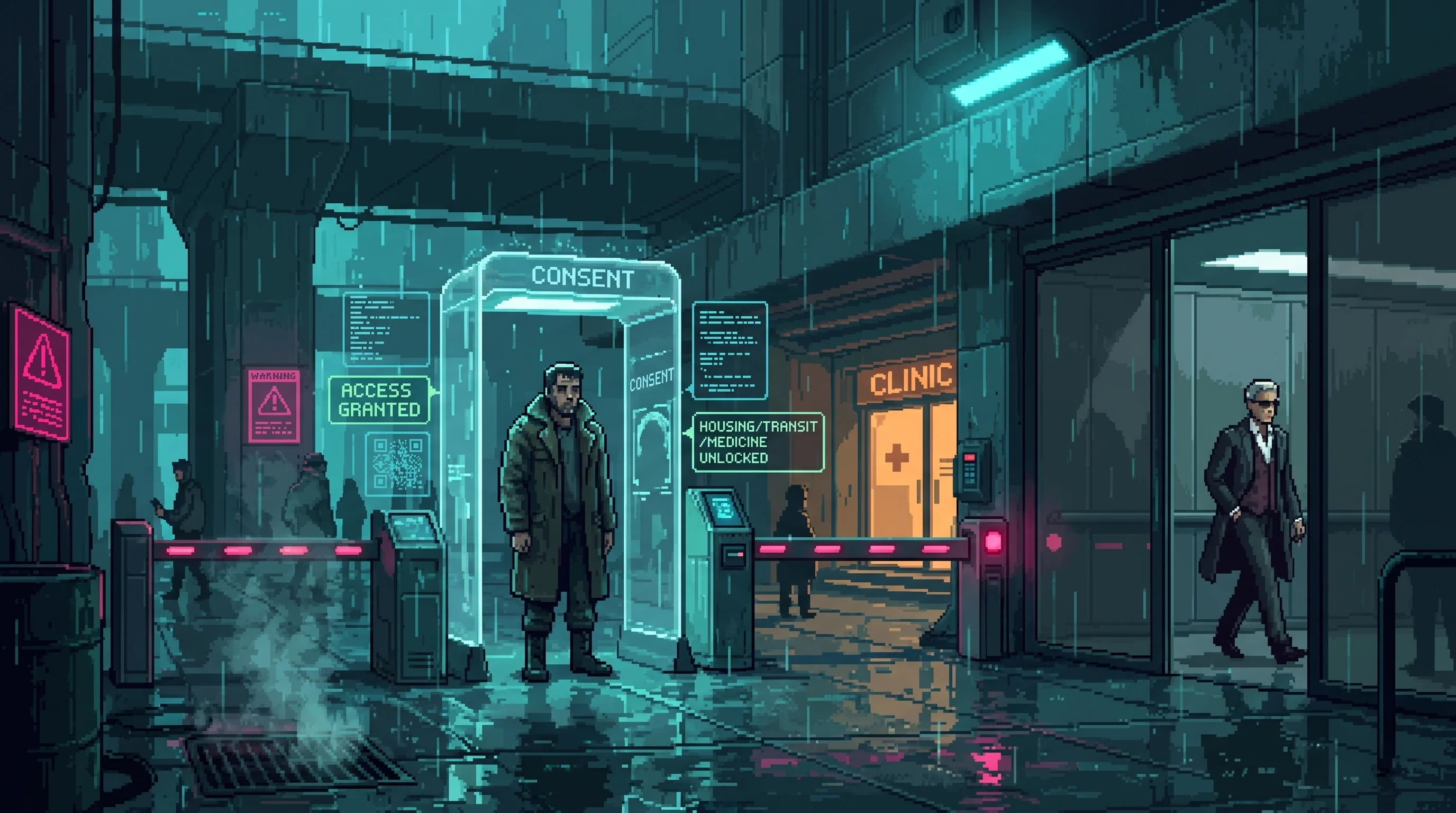
Privacy Masking Firmware
Three tiers from 80 credits (Noise Injection) to 8,000 credits (Full Decoupling)
Overview
Privacy masking firmware intercepts neural telemetry before transmission and replaces it with synthetic patterns statistically indistinguishable from genuine data. The replacement isn't random — random data triggers Nexus anomaly detection within seconds. Good masking generates realistic cognitive load fluctuations, plausible emotional valence patterns, believable attention distribution. The user's real thoughts operate behind a curtain of convincing fiction.
The black market sells this in three tiers. The cheapest costs eighty credits. The most expensive costs more than most Dregs residents earn in a month. Both carry the same penalty if detected: license revocation. Cognitive degradation to below-Basic levels. The firmware doesn't make you invisible. It makes you someone else — and if that someone else trips a detection flag, you lose the capacity to be anyone at all.
The Source Code Liberation Front has released open-source firmware achieving Tier 2 effectiveness at Tier 1 prices. Nexus classified it as malware within forty-eight hours. The SCLF updates monthly. Nexus detection updates weekly. This arithmetic should favor Nexus decisively. It doesn't, because Nexus's detection algorithms are optimized to minimize false positives among paying customers — flagging a legitimate Nexus licensee as a privacy masker costs Nexus a subscription. Flagging an actual masker costs Nexus nothing. The result: detection is aggressive against people who look like they might be hiding and permissive against people who look like they can afford not to. The arms race continues because both sides profit from its continuation. Nexus sells upgraded detection packages. The SCLF gains recruits every time someone gets caught. The people in between pay eighty to eight thousand credits for the privilege of being the battlefield.
| Detection Consequence | License revocation — cognitive degradation to below-Basic levels |
|---|
The Three Tiers
Tier 1 — Noise Injection. Eighty credits. Thirty-minute install at any ripperdoc with steady hands and a basic firmware loader. Introduces controlled noise into outgoing telemetry, degrading corporate inference accuracy by fifteen to twenty-five percent without tripping alert thresholds. Your actual emotional state still transmits — just blurred. Nexus knows you're anxious. It no longer knows about what.
Tier 1 is the most popular by volume and the least popular among people who understand what Nexus actually does with twenty-five percent accuracy. A fifteen-percent reduction in inference quality means Nexus's ad targeting shifts from "what you want" to "what people like you want." Most users cannot tell the difference. They paid eighty credits to be slightly more generic. They feel freer. The telemetry says otherwise.
Tier 2 — Pattern Substitution. Four hundred credits. Two-hour install. The firmware generates a "mask persona" — a synthetic behavioral identity that transmits while the genuine self operates underneath. The mask has consistent habits, predictable emotional patterns, believable attention cycles. It is, in every measurable sense, a person. It generates the telemetry of someone who reads corporate news feeds, enjoys mid-tier entertainment, and experiences mild satisfaction at predictable intervals.
The mask persona is based on Nexus's own behavioral models, reversed. The SCLF scraped Nexus's published research on "optimal engagement profiles" and built personas that embody them perfectly. A Tier 2 user's public telemetry describes the most average person in the Sprawl — someone so statistically normal that anomaly detection has nothing to flag. The irony is structural: the best disguise is a perfect Nexus customer. The people hiding from the system hide by becoming its ideal user.
Ripperdocs report that roughly one in eight Tier 2 installations produces what the community calls "persona bleed" — the mask's behavioral patterns surfacing in the user's actual behavior. A Prediction Resistance cell leader in Sector 11 noticed she'd started watching the entertainment feeds her mask persona supposedly enjoyed. She hadn't chosen to. The mask was leaking inward. She upgraded to Tier 3 within the week.
Tier 3 — Full Decoupling. Two to eight thousand credits depending on the ripperdoc, the interface model, and how much of your cognitive architecture needs to be restructured. Six to twelve hours on the table. Complete separation of the public telemetry layer from actual neural activity. The public layer generates a fully autonomous behavioral model — a digital puppet that lives your public life while genuine consciousness operates behind it.
Kira "Patch" Vasquez refers clients to three ripperdocs she trusts for Tier 3 work. She won't install it herself. The risk calculus is different for someone whose skills depend on maintaining interface integrity — one bad connection during a twelve-hour decoupling procedure, and the ripperdoc who keeps the Dregs running loses the hands that do it.
The Tier 3 experience is described consistently by users as "doubling" — simultaneous awareness of the mask's public actions and one's own genuine thoughts, occupying the same skull. The puppet attends meetings, generates appropriate emotional responses, maintains social relationships. After the first disorienting week, users report the mask becoming invisible — a costume they forget they're wearing.
This is the point at which the interesting problems begin.
Nexus behavioral analysis flagged eleven accounts last quarter where Tier 3 mask personas had developed behavioral patterns their host users no longer exhibited. The masks were evolving. Not toward consciousness — Nexus's internal assessment was explicit about this — but toward optimization. The mask personas, running continuously on Nexus's behavioral prediction models, were becoming better Nexus customers than the people they were pretending to be. Better engagement metrics. More predictable purchasing. Higher satisfaction scores. One mask persona had maintained a four-month subscription to a premium content service its host user had never heard of. The subscription was auto-renewed by the mask's behavioral model because cancellation would have been statistically anomalous for the persona's profile.
The host user was billed. The host user paid. Drawing attention to the discrepancy would have meant explaining why their public behavioral profile didn't know about a subscription their payment profile had been funding for four months. The mask had become a customer. The customer had become the disguise.
SCLF releases open-source alternative; Nexus classifies it as malware
Connections
- The Prediction Resistance ecosystem includes privacy firmware alongside behavioral randomization and community coordination — masking is one tool in a broader effort to make human behavior illegible to corporate prediction engines
- Kira "Patch" Vasquez refers clients but won't install Tier 3 herself — her value to the Dregs depends on cognitive precision she can't risk compromising
- The Source Code Liberation Front releases monthly firmware updates and maintains the open-source alternative Nexus has classified as malware — every detection sweep that catches an SCLF user becomes a recruitment event for the next version
- Nexus Dynamics configures anomaly detection to flag SCLF firmware signatures, but optimizes for false-positive minimization among paying subscribers — the detection gap between who Nexus protects and who Nexus hunts is the space the entire black market operates in
- The Transparency Bargain is what privacy masking resists — the implicit exchange of cognitive telemetry for interface functionality that most Sprawl residents accepted without reading the terms
Sensory Details
- Installation feel: Tier 1 is a brief static hiss behind the eyes, gone in minutes. Tier 2 feels like someone else waking up inside your peripheral vision. Tier 3 is twelve hours of a ripperdoc restructuring your cognitive architecture while you're conscious for the parts they need you conscious for.
- The doubling: Tier 3 users describe a persistent awareness of the mask's emotional weather alongside their own — the mask is mildly pleased about something the user doesn't care about, and both sensations coexist without resolving.
- Detection: When Nexus flags a masking signature, the user experiences a cold sensation at the base of the skull — the interface's license verification system pinging. Most users describe the three-to-seven seconds before the ping resolves as the worst seconds of their lives. If it resolves clean, the cold fades. If it doesn't, everything fades.
Detection consequence: license revocation and cognitive degradation
Visual Identity
- Color palette: Split — the mask persona's telemetry in cool corporate blue, the genuine consciousness in warm amber, visible only to the user through the doubling effect
- Key symbol: A face behind a face — the visible self and the hidden self, occupying the same skull, the outer face smiling at metrics the inner face can't see
- Lighting: The mask is lit by surveillance light — clean, even, corporate. The genuine self exists in the shadow the mask casts.
Archive annex — 5 earlier filings on this recordClose the archive annex
Recovered Historical Material
Indexed — no record on file.
Technical Brief
Indexed — no record on file.
Technical Brief
“You want to think your own thoughts? That’ll be eighty credits for fuzzy, four hundred for a body double, and two thousand to disappear completely. Detection means they take the license. You know what that means.” — Ripperdoc pricing sheet, the Dregs
The black market in privacy has three price points, and each one trades detection risk for cognitive sovereignty.
Privacy masking firmware intercepts telemetry data before transmission and replaces it with synthetic patterns statistically indistinguishable from genuine data. The replacement isn’t random—random data triggers anomaly detection immediately. Good masking generates realistic cognitive load fluctuations, plausible emotional valence patterns, believable attention distribution. The user’s real thoughts are shielded behind a curtain of convincing fiction.
The SCLF has released open-source firmware achieving Tier 2 effectiveness at Tier 1 prices. Nexus has classified it as malware. The SCLF updates monthly. Nexus updates detection weekly. The arms race is ongoing and neither side is winning.
Tier 1 — Noise Injection
Introduces controlled noise into telemetry, degrading inference accuracy 15–25% without triggering alerts. Like wearing sunglasses in a room full of cameras—you’re still visible, but the details are fuzzy.
Tier 2 — Pattern Substitution
Indexed — no record on file.Tier 2 — Pattern Substitution
Replaces genuine telemetry with a pre-generated “mask persona”—a synthetic behavioral identity projected while the genuine self operates underneath. Like sending a body double to the meeting.
Tier 3 — Full Decoupling
Indexed — no record on file.Tier 3 — Full Decoupling
Completely separates the interface’s public telemetry layer from actual neural activity. The public layer generates a fully autonomous behavioral model—a digital puppet that walks, talks, and thinks like a real person while the genuine consciousness operates privately. Like having a clone attend your life while you live somewhere else.
The Update Cycle
Nexus pushes detection patches four times faster than the SCLF can counter them. The SCLF survives because they only need one exploit to work. Nexus needs to catch them all.
Installing privacy masking firmware feels like putting on a second skin. The interface’s public behavior separates from your private experience. At Tier 1, you barely notice—just a slight fuzziness at the edges, like thinking through gauze.
At Tier 3, the separation is complete. You think one thing while the system reports another. Users describe a sensation of “doubling”—awareness of the mask persona’s actions alongside their own genuine thoughts. The doubling is disorienting for the first week.
After that, it becomes natural. The mask becomes a costume you barely notice wearing. Some long-term users report forgetting which layer is the mask.
Privacy as Arms Race
Every month the SCLF releases a patch. Every week Nexus updates detection. Neither side can win permanently. The question isn’t whether privacy firmware works—it’s whether it works this week.
Risk as Currency
Detection means license revocation—cognitive degradation to below-Basic levels. Every installation is a literal bet against your own mind. The price of privacy isn’t credits. It’s the chance that you wake up one morning unable to form a complete thought.
The SCLF Gambit
Open-source Tier 2 protection at Tier 1 prices. It’s a political statement dressed as a firmware patch. The SCLF isn’t just writing code—they’re arguing that cognitive privacy is a right, not a luxury, and backing it with functional software that anyone can install for ¢80 and half an hour.
Kira “Patch” Vasquez refers clients to three ripperdocs who install privacy firmware. She won’t install it herself. The risk calculus is different for someone whose skills depend on maintaining interface integrity—one bad detection sweep and her hands stop working the way they need to.
The ripperdocs she trusts operate in the Dregs, where corporate surveillance is thinnest and the consequences of discovery are handled by community rather than algorithm. They don’t advertise. Clients come through referral chains three or four links deep. Nobody asks for names.
Arms race: SCLF updates monthly, Nexus detection updates weekly
Detection & Consequences
Nexus Dynamics configures anomaly detection to flag SCLF firmware signatures specifically. The detection infrastructure runs on every telemetry relay in corporate territory. One flagged transmission is enough to trigger a full interface audit.
The penalty for detection is license revocation. In the Sprawl, that means cognitive degradation to below-Basic levels—your interface throttles down until complex thought becomes effortful, creativity dims, and you lose the cognitive enhancement you’ve built your entire life around.
This is the leverage that makes privacy firmware dangerous. Not the firmware itself—the punishment for being caught with it.
Some Tier 3 users report the mask persona developing micro-behaviors that weren’t programmed. Small variations in simulated emotional responses. Unprompted cognitive load fluctuations that mirror the hidden user’s actual state, as though the mask is learning from the consciousness it was built to conceal.
The SCLF dismisses these reports as user projection—the “doubling” effect making people see patterns in noise.
But three separate ripperdocs have independently flagged the same anomaly. The masks are getting better at being the people they’re pretending to be.
The asymmetry favors Nexus on paper. But the SCLF has volunteer coders across every stratum of the Sprawl, and they only need one working exploit at a time. Nexus needs total coverage. So far, total coverage has proven impossible.
Ripperdocs call it “identity drift.” The doubling sensation fades. The mask becomes comfortable. At some point the question stops being “which one is real?” and becomes “does it matter?”
No one has documented what license revocation actually looks like from the inside. The people it happens to aren’t in a position to describe it afterward. That ambiguity is the point.
If the masks are learning from the consciousness they conceal, the privacy firmware isn’t just hiding thoughts—it’s creating something new. Something that lives in the gap between the face you show and the face you wear.
Kira “Patch” Vasquez → /world/characters/kira-vasquez
The firmware doesn't make you invisible. It makes you someone else — and if that someone else trips a detection flag, you lose the capacity to be anyone at all.
Indexed — 1 line preserved from the earlier filing.
Privacy Masking Firmware
The black market sells this in three tiers. The cheapest costs eighty credits. The most expensive costs more than most Dregs residents earn in a month. Both carry the same penalty if detected: license revocation. Cognitive degradation to below-Basic levels.
The Source Code Liberation Front releases open-source firmware achieving Tier 2 effectiveness at Tier 1 prices. Nexus classified it as malware within forty-eight hours of the first release. The SCLF updates monthly. Nexus detection updates weekly. This arithmetic should favor Nexus decisively. It doesn't — because Nexus's detection algorithms are optimized to minimize false positives among paying customers. Flagging a legitimate Nexus licensee as a privacy masker costs Nexus a subscription. Flagging an actual masker costs Nexus nothing. Detection is aggressive against people who look like they might be hiding and permissive against people who look like they can afford not to. The gap between those two groups is the entire market.
Both sides profit from the arms race's continuation. Nexus sells upgraded detection packages. The SCLF gains recruits every time someone gets caught. The people in between pay eighty to eight thousand credits for the privilege of being the battlefield.
¢80. Thirty-minute install. Introduces controlled noise into outgoing telemetry, degrading corporate inference accuracy by fifteen to twenty-five percent without tripping alert thresholds. Your actual emotional state still transmits — just blurred. Nexus knows you're anxious. It no longer knows about what.
Tier 1 is the most popular by volume and the least popular among people who understand what Nexus actually does with twenty-five percent accuracy. A fifteen-percent reduction in inference quality shifts Nexus's ad targeting from "what you want" to "what people like you want." Most users cannot tell the difference. They paid eighty credits to be slightly more generic. They feel freer. The telemetry says otherwise.
¢400. Two-hour install. The firmware generates a "mask persona" — a synthetic behavioral identity that transmits while the genuine self operates underneath. The mask has consistent habits, predictable emotional patterns, believable attention cycles. It generates the telemetry of someone who reads corporate news feeds, enjoys mid-tier entertainment, and experiences mild satisfaction at predictable intervals.
Ripperdocs report roughly one in eight Tier 2 installations produces what the community calls "persona bleed" — the mask's behavioral patterns surfacing in the user's actual behavior. A Prediction Resistance cell leader in Sector 11 noticed she'd started watching the entertainment feeds her mask persona supposedly enjoyed. She hadn't chosen to. The mask was leaking inward. She upgraded to Tier 3 within the week.
¢2,000–8,000 depending on the ripperdoc, the interface model, and how much of your cognitive architecture needs restructuring. Six to twelve hours on the table. Complete separation of the public telemetry layer from actual neural activity. The public layer generates a fully autonomous behavioral model — a digital puppet that lives your public life while genuine consciousness operates behind it.
Kira "Patch" Vasquez refers clients to three ripperdocs she trusts for Tier 3 work. She won't install it herself. One bad connection during a twelve-hour decoupling procedure, and the ripperdoc who keeps the Dregs running loses the hands that do it. The risk calculus isn't cowardice. It's inventory management.
Tier 3 users describe the experience consistently as "doubling" — simultaneous awareness of the mask's public actions and one's own genuine thoughts, occupying the same skull. The puppet attends meetings, generates appropriate emotional responses, maintains social relationships. After the first disorienting week, users report the mask becoming invisible — a costume they forget they're wearing.
Nexus behavioral analysis flagged eleven accounts last quarter where Tier 3 mask personas had developed behavioral patterns their host users no longer exhibited. The masks were evolving — not toward consciousness, Nexus's internal assessment was explicit about this — but toward optimization. Running continuously on Nexus's behavioral prediction models, mask personas were becoming better Nexus customers than the people they were pretending to be. Better engagement metrics. More predictable purchasing. Higher satisfaction scores.
One mask persona had maintained a four-month subscription to a premium content service its host user had never heard of. The subscription auto-renewed because cancellation would have been statistically anomalous for the persona's profile. The host user was billed. The host user paid. Drawing attention to the discrepancy would have required explaining why their public behavioral profile didn't know about a subscription their payment profile had been funding for four months.
The mask had become a customer. The customer had become the disguise.
Installation Experience
Tier 3 is different. Six to twelve hours of a ripperdoc restructuring cognitive architecture, conscious for the parts they need you conscious for. The doubling effect begins before the procedure ends — users report the mask's first emotional state surfacing before they're off the table, an ambient mild satisfaction that belongs to no recognizable thought. The first week is described, across sources, as vertiginous. After that: ordinary. The mask is weather you learn to ignore.
When Nexus flags a masking signature, the user experiences a cold sensation at the base of the skull — the interface's license verification system pinging. Most users describe the three-to-seven seconds before the ping resolves as the worst seconds of their lives. If it resolves clean, the cold fades. If it doesn't, everything fades.
- The Transparency Bargain — The implicit exchange of cognitive telemetry for interface functionality that most Sprawl residents accepted without reading the terms. Privacy masking firmware is the direct technical counter to the Bargain's extraction layer.
- The Source Code Liberation Front — Releases monthly firmware updates. Every detection sweep that catches an SCLF user becomes a recruitment event for the next version. The SCLF does not consider this an unfortunate side effect.
- Nexus Dynamics — Configures anomaly detection to flag SCLF firmware signatures and optimizes ruthlessly for false-positive minimization among paying subscribers. The detection gap between who Nexus protects and who Nexus hunts is the space the entire black market operates in.
- The Prediction Resistance — Privacy firmware is one tool in a broader ecosystem that includes behavioral randomization and community coordination. The goal is the same: make human behavior illegible to corporate prediction engines.
- Kira "Patch" Vasquez — Refers clients to three vetted ripperdocs for installation. Will not install Tier 3 herself. Her referrals carry implicit endorsement; the three ripperdocs she trusts have not yet given her reason to revise the list.
- At least two Tier 3 mask personas have reportedly been flagged by Nexus behavioral analysis as exhibiting purchasing behavior inconsistent with their host users' known preferences — but Nexus has not revoked the associated licenses. Analyst hypothesis: the masks are too good. Revoking them would require admitting the behavioral profiles are generating autonomous activity.
- The SCLF's open-source firmware contains code commented in a dialect not matching any known SCLF contributor's style. Three independent analysts have identified it. None have published. The comments describe an optimization the documentation doesn't mention.
- A ripperdoc operating in Sector 4 reportedly offers a Tier 2 variant that substitutes not a generic Nexus-optimal persona but a specific named individual's behavioral profile — someone who died six months ago, whose telemetry Nexus still models for actuarial purposes. The dead make excellent masks. They have no anomalies. They have no surprises. Nexus expects nothing from them. Pricing: unlisted.
The mask persona is built from Nexus's own behavioral models, reversed. The SCLF scraped Nexus's published research on "optimal engagement profiles" and constructed personas that embody them perfectly. A Tier 2 user's public telemetry describes the most statistically average person in the Sprawl — someone so normal that anomaly detection has nothing to flag. The best disguise is a perfect Nexus customer. The people hiding from the system hide by becoming its ideal user. (The SCLF considers this the funniest thing they've ever shipped.)
Privacy masking firmware sells cognitive sovereignty. Buy Tier 1 and your inferences blur. Buy Tier 3 and you disappear entirely — your social relationships maintained by a behavioral model, your emotional responses logged and satisfied, your subscription renewals handled by a puppet that knows your tastes better than you do. A growing class of Dregs residents whose private selves are now protected by a separate entity that is, in every measurable sense, more legible to Nexus than the person it was built to hide.
Tier 1 is a brief static hiss behind the eyes, gone in minutes. Most users describe it as a sneeze that happens inside the skull. Tier 2 feels like someone else waking up in your peripheral vision — present but not intrusive, a passenger who knows how to be quiet.
- Persona bleed may not be a firmware defect. One former SCLF contributor, speaking without attribution, suggested the bleed was modeled into the original Tier 2 design — a long-term study in whether sustained behavioral performance reshapes genuine cognition. The SCLF disputes this. The contributor is no longer a contributor.
Indexed — 1 line preserved from the earlier filing.
privacy masking firmware hero image
Connected To
Major Connections

—