LOCATION FILEIronclad Fortress: The Citadel of Industry
Known AsIronclad Fortress, The Fortress
Overview
Nobody at Ironclad Industries calls it the Fortress. Official correspondence, internal memos, building directories, and the enormous signage bolted to the outer wall all read "Primary Operations Complex." The name was selected in 2152 by a committee that spent eleven weeks deliberating and produced a designation so aggressively generic it could apply to a sewage treatment plant. Everyone in the Sprawl calls it the Fortress anyway. Ironclad's legal department sent cease-and-desist letters to three media outlets in 2179 for using the unofficial name. All three outlets published the letters. The name stuck harder.
Look at it and you understand why.
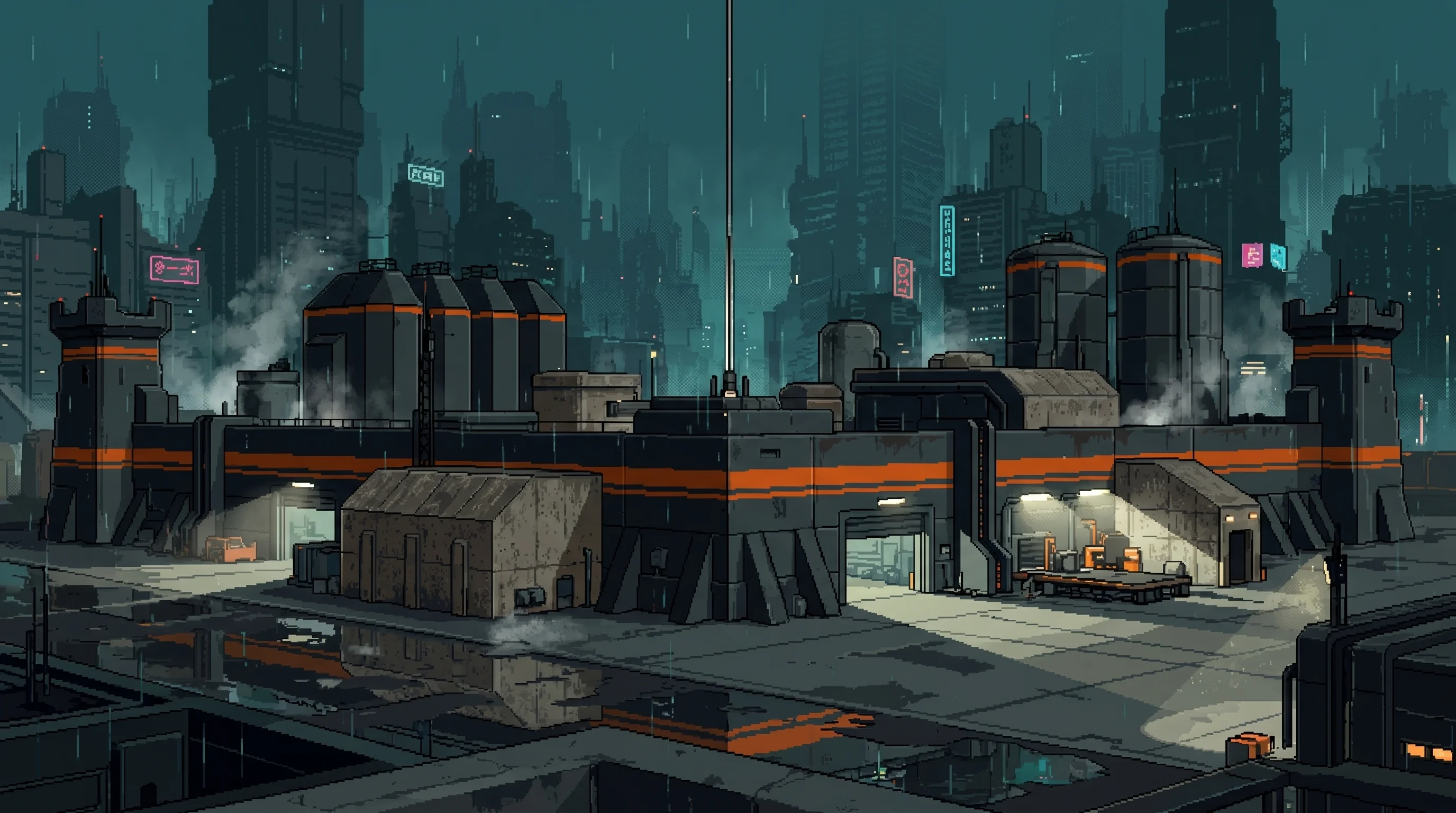
The complex sits on the Bayfront in Sector 6, occupying fourteen square kilometers of reclaimed industrial waterfront that Ironclad purchased for structural load capacity, not aesthetics. The buildings are not tall by Sprawl standards. They are wide, deep, and heavy in a way that registers in the chest before the eyes process the geometry. Reinforced concrete over steel skeletons, visible aggregate, angular towers that read as silos and smokestacks because several of them are silos and smokestacks. Every surface communicates the same message: this was built to survive what comes next, and the architects had a comprehensive list of what might come next, and they overengineered for items not yet on the list.
The Orbital Elevator does not rise from here. The tether's Anchor is thirty-five hundred miles south on the equatorial Pacific coast — but every kilogram the Elevator lifts begins at the Fortress, sealed and manifested in the freight quarter, dispatched down the Pacific Spine on maglev sleds that depart with a rhythm residents set their clocks by. At night the departure lights run south in an unbroken chain toward a horizon that ends, eventually, at the only road to space. The chain is the only decorative feature Ironclad did not intend and cannot remove.
Ironclad Industries controls physical infrastructure across the Sprawl: construction, materials, the Elevator itself. Where Nexus Dynamics controls what you think and Helix Biotech controls what you are, Ironclad controls where you live. The Fortress is the proof of concept. It is the most heavily defended corporate installation in the post-Cascade world, the most productive manufacturing complex on the planet, and by the accounts of 63,500 permanent residents, a genuinely decent place to live.
These three facts are all true. They are also the sales pitch, the retention strategy, and the lock on the door, and the order in which you encounter them depends entirely on whether you're arriving or trying to leave.
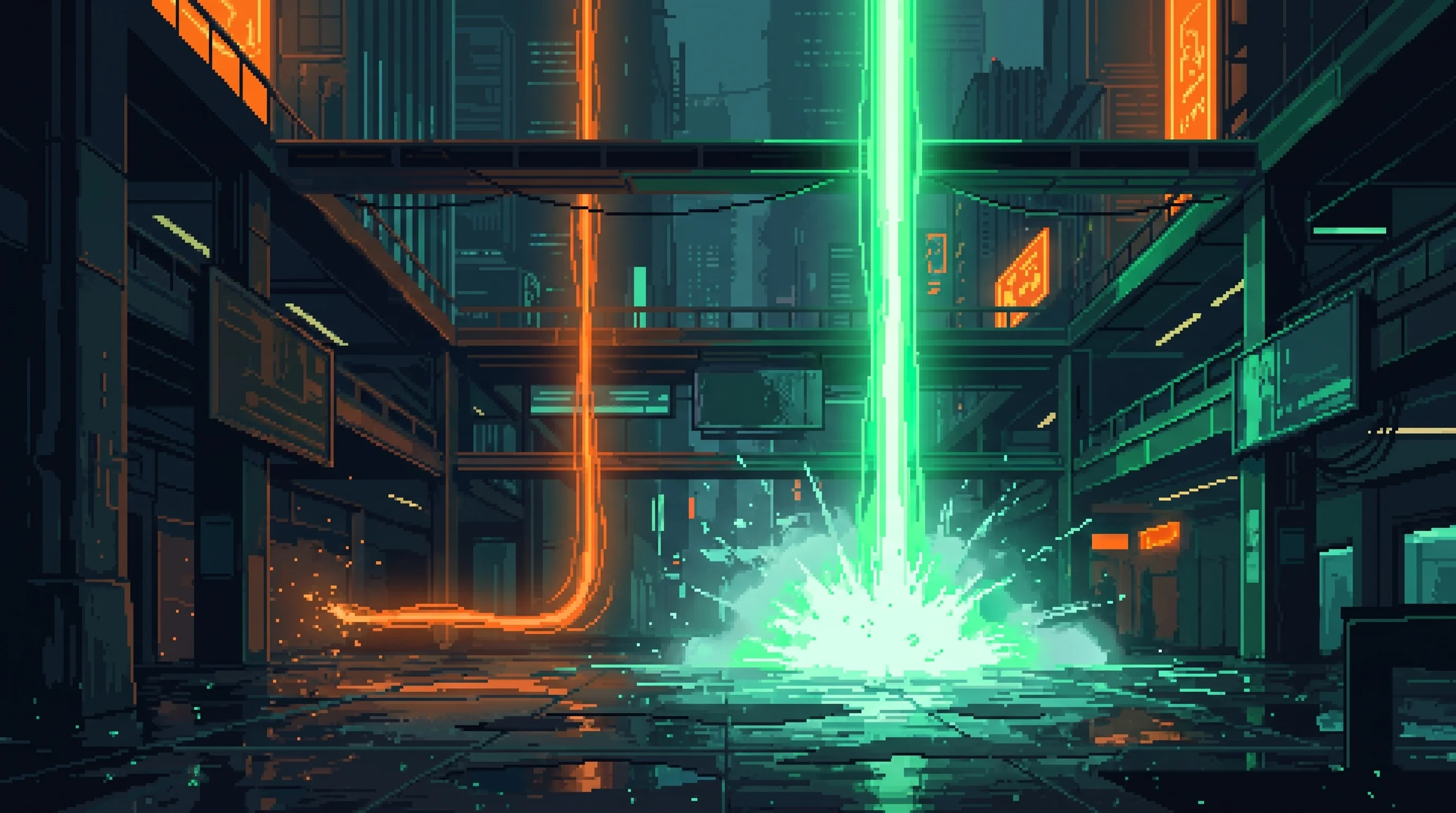
Interior of the Foundry Ring — smelters casting orange light across automated assembly lines stretching to the horizon
Architecture
Ironclad's design philosophy can be summarized in four words the corporation has never used: paranoid functionalism at scale.
Everything serves a purpose. Decorative elements are confined to the Memorial Hall and a single corporate-orange accent stripe that runs along every exterior wall at precisely 2.4 meters — the height, a retired structural engineer once noted, at which a stripe is visible from a prone firing position behind standard barricade cover. Ironclad's public relations team describes the stripe as "brand identity." The engineer was not invited back.
Everything has backups. Power systems run triple-redundant. Communications infrastructure can lose two-thirds of its nodes and maintain full operational capacity. The Fortress was designed to function at fifty percent structural integrity, which is an engineering specification that raises the question of what scenario planners expected to destroy the other fifty percent and how calmly they discussed it.
The materials tell the story the brochures don't. Industrial steel, exposed, sometimes rusted, always load-bearing. Reinforced concrete thick enough to stop orbital kinetic projectiles. Heavy glass that Ironclad's own marketing materials describe as "ballistic-resistant" and that internal procurement documents classify as "weapon-grade transparency panels." The shapes are rectangular, angular, with no curves that don't serve a structural or ballistic purpose. Bridges connecting buildings are exposed and practical, sightlines kept deliberately clear across courtyards that could host festivals and are instead empty concrete plazas where nothing above ten kilograms can cross undetected.
The lighting is functional. Bright where work happens, dark elsewhere, warning colors at hazards. Nobody has ever described the Fortress as beautiful. Several structural engineers have described it as correct.
Site Classification
Stratum
Corporate
Power Position
Above
Access
Corporate
Atmosphere
Oppressive
Major Zones
The Foundry Ring
The outer ring of the complex, where raw materials enter and products leave. Smelters and forges that run twenty-four hours without pause. Fabrication halls where automated assembly lines stretch to the visible horizon. Testing ranges where products are stressed until failure, then stressed beyond failure, then catalogued. Loading docks processing a constant arterial flow of materials inbound, finished goods outbound.
Every construction beam in the Sprawl passed through here. Every orbital component. Every piece of shared infrastructure that the Treaty of Shared Infrastructure declared neutral and untargetable in 2171. Ironclad built the infrastructure that the Treaty protects. Ironclad also built the weapons the Treaty was designed to prevent people from using against it. The Foundry Ring produces both with equal efficiency and files them under different budget codes.
The Ring smells like heated metal and ozone. Workers in the fabrication halls describe the temperature as "climate-controlled," which is technically accurate in the same way that standing next to an active smelter is technically standing next to a heat source. Shift rotation in the Foundry Ring is eight hours. Voluntary overtime is available. The overtime compensation is generous enough that 74% of Foundry workers regularly extend to twelve-hour shifts, a participation rate that Ironclad's workforce analytics team describes as "enthusiasm" and that the workers themselves describe, when speaking candidly, as "the housing upgrade math."
The Garrison
Security headquarters. Where Ironclad's military arm trains, equips, deploys, and reminds everyone that the corporation started as a security battalion before it became an industrial giant.
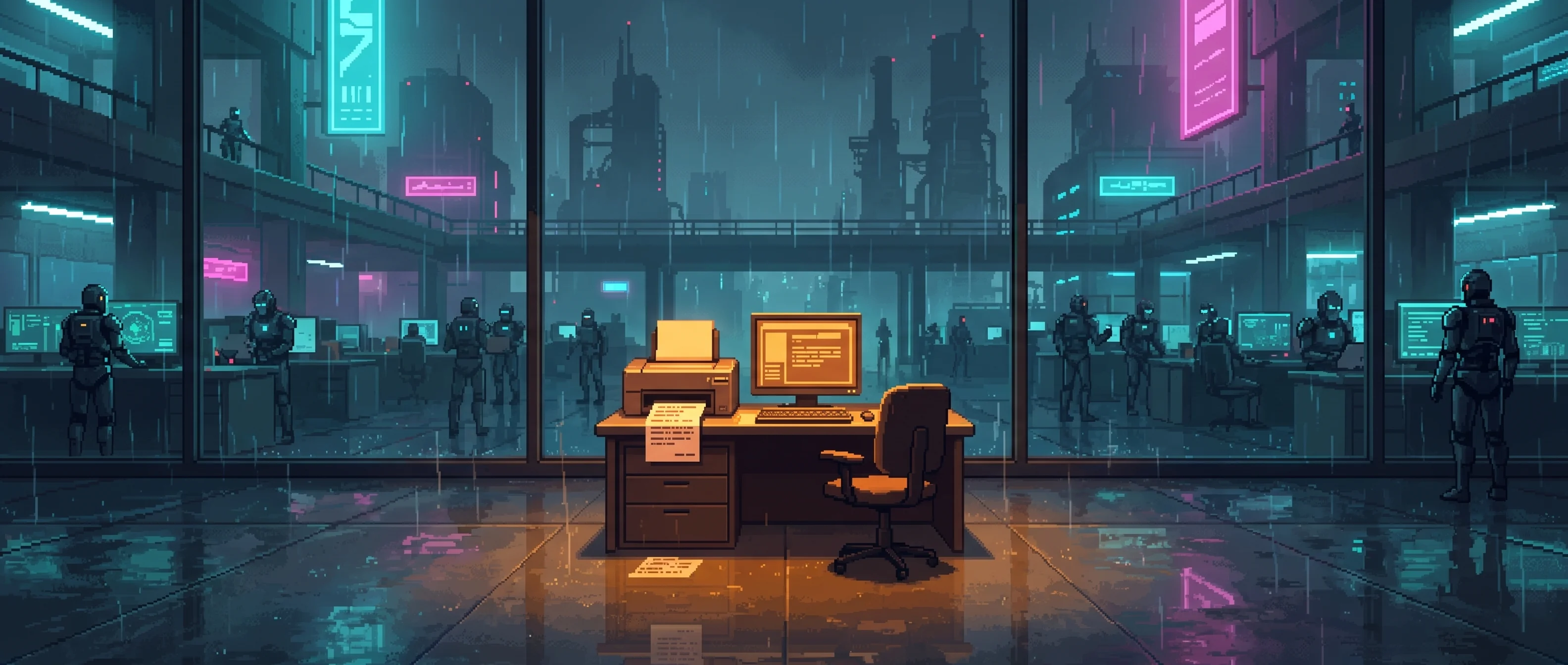
Barracks, efficient and numerous. Armories behind doors that weigh more than the weapons inside them. Training grounds running simulated environments for every threat category Ironclad has identified, which is all of them. The command center monitors all Ironclad assets in real-time across the Sprawl, the Elevator corridor, and orbital installations. The monitoring staff work in eight-hour rotations. The screens never turn off.
The Iron Guard, Ironclad's elite security force, maintains 12,000 personnel at the Fortress alone. Composition: 40% former military from various pre- and post-Cascade conflicts, 30% Ironclad-trained from youth programs, 20% recruited from other corporate security forces, 10% specialists in demolition, cyber warfare, and disciplines that don't appear on official rosters. Standard loadout includes military-grade armor, kinetic weapons, and neural disruptors. Heavy weapons are stationed at defensive positions that have never been activated in peacetime. Combat drones are available for rapid response at a deployment speed that Iron Guard leadership will not specify and that independent analysts have estimated at under ninety seconds.
Many Iron Guard have families in the Fortress residential zones. They are not, in their own framing, protecting corporate assets. They are protecting home. Ironclad's recruitment materials lean into this distinction heavily. The distinction also happens to produce a security force willing to use lethal measures with a conviction that professional mercenaries rarely match.
The Spine Terminus
The northern freight terminus of the Pacific Spine — the maglev artery that runs thirty-five hundred miles south to the Anchor, where the Orbital Elevator's tether actually meets the earth. Humanity's primary access to space begins as a manifest line here: nothing rides the tether that did not first clear the Fortress.
Sled bays where maglev freight docks, loads, and launches on schedules measured in minutes. Cargo processing where everything Elevator-bound gets scanned, weighed, catalogued, and approved by systems that have rejected shipments for exceeding mass tolerances by eleven grams. The trunk line itself leaves the complex on elevated pylons, disappearing into the southern haze on most days and stretching to a vanishing point on clear ones.
Standing at the Terminus, the launch cycle is physical. Not emotional, not metaphorical. The electromagnetic catapult of departing freight is enormous and omnipresent, a low vibration that visitors feel in their teeth before they identify the source. Workers at the Terminus develop what medical staff have documented as "terminus acclimation syndrome" — a gradual desensitization to the vibration that takes approximately six weeks and that departing workers describe, sometimes years later, as the thing they miss most. The silence outside the Fortress feels wrong to them. Something is supposed to be humming.
Command Central
The administrative heart. Quieter than the rest of the Fortress by a margin that feels intentional and slightly unnerving.
Operations floors monitor all Ironclad activities across the Sprawl. Executive offices are functional, comfortable in the way that military officer quarters are comfortable — status displayed through access level, not décor. The War Room is where military and corporate strategy merge, which at Ironclad is less a merger than an acknowledgment that they were never separate. Memorial Hall honors those who died building Ironclad's infrastructure empire. The plaques are steel. The names are etched, not printed. There are a lot of names.
Plans that affect millions are drafted on these screens. The people drafting them are former military officers and engineering leads promoted for competence. The atmosphere is focused, unhurried, and heavy with the specific gravity of decisions that cannot be undone.
Security
Ironclad security operates on the principle that any single defensive measure can be defeated. The response to this principle is not better measures. It is more measures.
The Dead Zone extends ten kilometers in every direction. The area surrounding the Fortress is deliberately undeveloped — an industrial wasteland with ground sensors calibrated to detect movement above ten kilograms, continuous aerial drone surveillance, and automated turret emplacements at five-hundred-meter intervals, concealed in structures that look like decommissioned utility stations until they don't. No civilian structures exist within the zone. Ironclad's legal classification for everything inside the perimeter is "legitimate operational environment," a phrase that means what it needs to mean. Unauthorized entrants receive thirty seconds to produce valid credentials or reverse course. The turrets' non-lethal settings are the default. The switch to lethal is not automated — the Dead Hand Rule prohibits autonomous weapons authority — but the human operator's average response time is 1.4 seconds, which is the kind of number that is technically not autonomous and practically not human.
The Wall encircles the complex proper. Twelve meters high, four meters thick, reinforced concrete over a steel skeleton with electrified surfaces that default to non-lethal and switch to lethal on command. Guard posts every two hundred meters, always staffed. The Wall survived a direct assault during the Three-Week War. The attackers didn't.
Inside the Wall, movement between zones requires biometric authorization at every transition point. Visitors below Clearance-3 require escorts. All personnel are tracked in real-time. The Fortress maintains approximately 47,000 cameras, 15,000 audio sensors, and passive monitoring systems that nobody has successfully counted because the count changes based on what you're cleared to know. Everything is recorded. Everything is analyzed by pattern-recognition AI that flags anomalies before human operators notice them, then routes the flag to a human for decision. The AI does not control security responses. It identifies. Humans decide. This is the law.
There are no official blind spots. Unofficially, Viktor Okonkwo's private quarters and a handful of facilities classified under budget codes that don't appear in standard directories operate under reduced surveillance. Even Ironclad's CEO has conversations he'd prefer not to have recorded, which is either a pragmatic concession to leadership privacy or evidence that the surveillance state has a ceiling precisely where the people who built it live.
Military-industrial aesthetic — massive heavy construction designed to survive anything
Daily Life
The Contract
Ironclad employment is a binding commitment. Five-year minimum term. Compensation includes salary, housing, healthcare, and on-site education for dependents. Voluntary departure requires two years' notice and full training of a replacement. A three-year non-compete clause prohibits work for competitors post-departure.
The terms look reasonable in summary. The math is where things get interesting.
Breaking contract without approved cause triggers financial penalties calculated against the full remaining value of housing, healthcare, and education benefits received to date. For a Technical-class worker with a family of four who has completed three years of a five-year term, the penalty at current rates is approximately 340,000 credits. Average annual savings for a Technical-class worker after subsidized living expenses: 12,400 credits. Time required to accumulate sufficient savings to pay the early termination penalty: twenty-seven years, four months, assuming zero additional expenses and no interest. The contract is five years. The exit cost requires twenty-seven. Ironclad's workforce retention rate — 94.2% through full contract term — is, by this metric, not a measure of satisfaction but of arithmetic.
The two-year notice period for voluntary departure is presented as a professional courtesy: time to train your replacement, transition your responsibilities, demonstrate Ironclad's commitment to orderly workforce management. In practice, workers who file departure notices report a pattern that human resources describes as "standard transition protocols" and that departing workers describe as "the slow freeze." Shift assignments migrate toward less desirable hours. Housing reassessment reviews trigger with unusual frequency. The children's school placement lottery, which is officially random, produces outcomes for departure-notice families that cluster in the 14th percentile of preference matching. No single measure constitutes retaliation. The aggregate effect is that 31% of workers who file departure notices withdraw them within six months. Ironclad's workforce analytics team classifies these withdrawals as "voluntary recommitment."
Workers exist in four tiers:
Class
Population
Housing
Access
Executive
~500
Private quarters, Sector A
Full complex, personal vehicles
Technical
~15,000
Family apartments, Sector B
Zone access by role
Operations
~40,000
Shared housing, Sector C
Limited zone access
Provisional
~8,000
Dormitories, Sector D
Supervised, probationary
Promotion between tiers is possible. Ironclad's official materials emphasize this. The promotion rate from Operations to Technical averages 2.3% annually. The promotion rate from Provisional to Operations is higher — 11% — which Ironclad cites as evidence of upward mobility and which a statistician might note primarily reflects the rate at which Provisional workers complete their probationary year without incident, not the rate at which they advance beyond the tier they were promoted into.
The Rhythms
The Fortress operates on three eight-hour shifts. Day shift handles administration, visitor hours, executive operations. Swing shift runs peak manufacturing and training exercises. Night shift processes heavy industry and cargo, with skeleton crews elsewhere. The complex never stops. Individuals do, on schedule.
Twelve cafeterias serve the population. Food is functional, subsidized to 10% of cost, and better than outsiders expect — Ironclad discovered decades ago that caloric and nutritional optimization correlates with a 7.3% productivity increase per worker, which at 63,500 residents represents enough aggregate output to justify the subsidy twelve times over. The food is good because the food being good is profitable. Workers interpret this as care. The budget line classifies it as input optimization.
Recreation facilities include gyms (mandatory fitness standards require regular use), entertainment centers, and small parks with actual trees growing under artificial light. The parks are genuine. Four hours off-shift are designated personal time. Workers with dependents can access family zones, including children's schools run on-site through age eighteen. Children born in the Fortress know no other life. Schools emphasize engineering, discipline, and Ironclad values. By eighteen, most join the workforce. A few receive scholarships to external universities, accompanied by return obligations that are legally binding and financially structured to ensure compliance.
One Technical worker's daughter, visiting the lower Sprawl on a school trip, asked her father why people live like that. He didn't have a good answer. He also didn't file a departure notice.
Discipline
Infractions follow a published gradient. Schedule violations draw wage deductions and extra shifts. Security breaches trigger demotion and housing reassignment. Treason — defined broadly enough to include unauthorized information transfer — is capital. Family members of capital offenders lose their contracts, their housing, and their status simultaneously.
Ironclad workers describe this system as "consistent." They mean it as praise. Everyone knows the rules. Everyone faces the same consequences. In a Sprawl full of arbitrary corporate authority, the consistency is genuinely valued. The question of whether consistent severity is preferable to inconsistent leniency is one that workers answer differently depending on which tier they occupy and how recently someone they know has been reassigned.
Northern freight terminus of the Pacific Spine maglev — every kilogram the Orbital Elevator lifts is staged and dispatched here toward the Anchor, ~3,500 miles south
Visitor Protocols
Arriving uninvited is not an option. Arriving invited takes seventy-two hours of pre-clearance, a background check, and a sponsoring Ironclad department willing to attach its name to your presence.
The entry process begins two kilometers out at the initial checkpoint, where credentials are verified and vehicles are registered. At five hundred meters, vehicles park and occupants exit for screening. At the gate itself, full biometric scans, bag searches, and an interview. Total processing time: forty-five minutes minimum. Impatience is noted in your file.
The interview is conducted by trained interrogators who ask routine questions — purpose of visit, prior Ironclad relationship, corporate affiliations, medical conditions — while observing stress responses, eye movement, and microexpressions through augmented analysis. If something seems wrong, the visit ends. The visitor is not told what seemed wrong. The file is updated.
Once inside, visitors are never unaccompanied. Escorts are assigned by Ironclad, not chosen by the visitor. Photography requires explicit permission, which is rarely granted. Deviation from the approved route triggers immediate extraction. Bathroom breaks require the escort to confirm the room is clear.
Departure includes an exit interview, escort to the gate, and drone surveillance through the Dead Zone until the visitor exits the monitoring perimeter. For high-sensitivity visits, visitors consent to a neural scan confirming they haven't retained classified information. The scan is controversial, technically legal, and non-optional for anyone who wants to visit again. Post-departure, Ironclad monitors visitor communication and travel patterns for weeks. Not indefinitely. But long enough.
Corporate espionage specialists across the Sprawl consider Ironclad effectively unhackable from the outside. The only way to steal their secrets is to physically enter the complex and remember what you see. Which is why the interview exists, and the escort, and the neural scan, and the post-departure monitoring. The chain of security measures doesn't end. It extends past the walls, past the Dead Zone, past the departure gate, into the visitor's life, and tapers off at a distance that Ironclad's security division has calculated and will not share.
Visitors to Nexus Central report feeling watched. Visitors to the Fortress report feeling known. The distinction is subtle and, once experienced, permanent.
Called 'The Fortress' by everyone except Ironclad; the actual name is 'Primary Operations Complex'
The Fortress Condition
The Fortress is safe. Visitors and workers agree on this. Inside the perimeter, violence without Ironclad's authorization is essentially impossible. Schedules are honored. Appointments are kept. Infrastructure works. The air is processed and breathable. The food is good. The housing is warm. The schools teach. The parks have trees.
Long-term workers describe a phenomenon that the Fortress medical staff have documented but not named. After ten years, everywhere else feels fragile. Buildings seem too small. Streets seem undefended. The Sprawl's chaos, which 63,500 people chose to leave behind, becomes incomprehensible — not dangerous, just structurally wrong, like a building without load-bearing walls. Workers who complete their contracts and depart report a reacclimation period averaging fourteen months before the outside world stops feeling temporary.
Some never reacclimate. They re-enlist.
Ironclad's re-enlistment rate after first contract completion is 67%. The marketing team attributes this to workplace satisfaction. Exit interviews with the 33% who leave tell a different story. The most common phrase in departure interviews, appearing in 41% of transcripts, is not "I wanted to leave." It is "I could finally afford to."
The Fortress provides everything. Security, purpose, community, housing, healthcare, education. In exchange, it owns your productivity for five years minimum, your mobility for the duration, and your options for three years after. The transaction is transparent. The terms are published. Nobody is deceived. The question is not whether the deal is fair — by Sprawl standards, it is generous. The question is what "fair" means when the alternative is the Sprawl, and the Sprawl is what Ironclad's own infrastructure contracts helped build, and the conditions outside the Wall are the conditions that make the conditions inside the Wall look like salvation.
The Fortress is what the Sprawl's three oldest arguments look like when they are poured in concrete. It is the purest expression of the Corpo-Nations — a sovereign territory whose constitution is an employment contract and whose border control is a badge reader. It is the great holdout in the story of AI Labor: fourteen square kilometers where the machines are deliberately kept dumb so that sixty-three thousand humans stay necessary, at wages the rest of the Sprawl reads about with disbelief. And it is the AI Haves and Have-Nots rendered as a floor plan — the automation dividend exists here too, but Ironclad pays it out in walls, warmth, and schooling to the people inside them, which is exactly what makes the turnstile so hard to walk out through.
Affiliated Entities
Ironclad Industries: The Fortress is Ironclad's headquarters, nerve center, and proof that total control of physical space is achievable if you're willing to build walls thick enough and call the result home. The corporation controls physical infrastructure across the Sprawl — construction, materials, the Orbital Elevator — and the Fortress is where that control is manufactured, both literally and philosophically.
Orbital Elevator: The tether rises from the Anchor on the equatorial Pacific coast, thirty-five hundred miles south — but every kilogram it lifts is staged, sealed, and dispatched from the Fortress freight terminus down the Pacific Spine, through a pipeline Ironclad built, Ironclad maintains, and Ironclad controls access to. The Elevator is humanity's primary route to orbit. The Fortress is the front door to the route. Controlling the door is controlling the route.
Nexus Central District: The comparison is inevitable and instructive. Nexus Central is a vertical city optimized for computational density — information as architecture. The Fortress is a horizontal complex optimized for physical production — mass as architecture. Nexus visitors feel watched. Fortress visitors feel known. Both are surveillance states. One monitors your data. The other monitors your body.
The Treaty of Shared Infrastructure: The Treaty of 2171 declared water, power, air processing, and medical systems neutral and untargetable. Ironclad built most of that infrastructure. The corporation that manufactures the things the Treaty protects also manufactures the weapons the Treaty was designed to restrain. This is noted in no official Treaty commentary.
Viktor Okonkwo: Ironclad's CEO maintains private quarters in Command Central under reduced surveillance — the one documented exception to the Fortress's total monitoring doctrine. What he does with that exception is a question that 47,000 cameras are specifically configured not to answer.
▲ Restricted
The Elevator's Fragility: The tether appears indestructible. It is not. Ironclad's structural engineering division has identified seven vulnerability points along the tether's first four hundred kilometers — resonance nodes where targeted vibration at specific frequencies could initiate cascading structural failure. The vulnerabilities are classified at a level above the Iron Guard's security clearance. The countermeasures deployed at each node are classified above that. Ironclad has spent more on tether defense than on Fortress perimeter defense. The tether is the thing Ironclad actually cannot afford to lose. The Fortress can be rebuilt. The tether cannot, and the thirty-seven years since the Cascade have not been enough to develop a replacement construction capability. If the tether falls, humanity loses space access. Ironclad's entire strategic position rests on a thread.
The Orbital Envelope: Ironclad's orbital facilities conduct work that does not appear in any groundside reporting. Independent signals analysis of orbital station communications detects encrypted traffic volumes 340% above what declared manufacturing and research operations would generate. Ironclad classifies all orbital activity under a single budget code — "Elevator Operations Support" — that has grown 1,200% since 2174 while the Elevator's operational parameters have remained constant. What happens in Ironclad's stations is unknown. Speculation ranges from advanced materials research to weapons development that would violate the Dead Hand Rule if conducted on the surface. The orbital stations are outside every jurisdiction. The stations were built by Ironclad. The jurisdiction question was not an oversight.
General Stone's Archives: The founder's private records — journals, strategic assessments, the unredacted history of Ironclad's formation from post-Cascade security battalion to infrastructure monopoly — are stored in a vault within Command Central. The vault's location is known to three living people. Its contents have never been accessed by historians, regulators, or Ironclad's own legal department. Viktor Okonkwo has visited the vault twice in five years. Both visits lasted under ten minutes. Both were followed by policy changes that affected thousands of workers and were announced without explanation.
The Defense Grid: The Fortress maintains weapons systems that extend well beyond the published security infrastructure. Orbital strike capability from platforms officially classified as "communications relay stations." Electromagnetic pulse systems integrated into the Dead Zone's sensor network. Directed-energy installations concealed within the Foundry Ring's industrial architecture. None of these systems have been activated outside of testing. All of them are maintained at deployment readiness. The Dead Hand Rule prohibits autonomous weapons authority. It does not prohibit having weapons. Ironclad has weapons. The question of whether the total arsenal constitutes a deterrent or a first-strike capability depends on definitions that Ironclad's legal team has spent considerable effort keeping ambiguous.
Conditions Report
Sight
Steel grey and exposed concrete in every direction, broken only by the orange accent stripe at 2.4 meters and the elevated maglev trunk line running south until it vanishes. Scale is the dominant visual — everything built for industrial loads, not human comfort.
Sound
The launch rails hum. Below them, the Foundry Ring's continuous percussion of fabrication and smelting. Command Central is conspicuously quiet. The contrast between zones registers as pressure change.
Smell
Heated metal and ozone near the Foundry Ring. Recycled air everywhere else — clean, processed, absent of the organic particulate that makes the rest of the Sprawl's atmosphere feel inhabited. The Fortress air smells like nothing. Workers say you stop noticing after a week.
Temperature
Climate-controlled to 19°C in administrative zones, variable in the Foundry Ring where "climate-controlled" means the cooling systems prevent heat death, not comfort. The Dead Zone is ambient Sprawl temperature: whatever the atmosphere processors couldn't fix that day.
Feel
Every surface is hard. Concrete, steel, ballistic glass. The parks have actual soil, which long-term residents touch with a reverence that visitors find unsettling.