
Ghost Grinder
The augmentation program's mortality reduction (71%) and its maintenance economics are inseparable — Ghost Grinder reduced deaths and created a permanent economic dependency simultaneously; 'Compare to mortality baseline' is the internal shorthand for closing any discussion of the second fact with the first
Overview
Ghost Grinder does not build. Ironclad builds. Ghost Grinder breaks what needs breaking before Ironclad can build in its place.
Post-Cascade orbital space was a graveyard — derelict stations, collapsed relay platforms, debris fields dense enough to threaten anything ascending the Orbital Elevator. Viktor Okonkwo started Okonkwo Orbital Demolition in 2149 to solve this problem. He renamed it Ghost Grinder in 2158 when someone pointed out that the original name sounded like a law firm. Ghost Grinder sounds like what it is.
The orbital forges crack asteroid foundations. Raw power at a scale where precision is irrelevant because the target no longer exists when the job is done. Viktor built the tools to the same standard: a Ghost Grinder impact regulator ensures minimum force regardless of input, because demolition crews cracking foundations cannot have a worker hit too softly. Subtlety is a design flaw. Every tool leaves the forge calibrated to the assumption that whatever you're hitting should stop being a thing.
The commercial augments — titanium subplates, tungsten core rods, plated subdermal layers — started as safety equipment. When your crew is cracking asteroid foundations in vacuum with six seconds of emergency seal if a suit breaches, the difference between "augmented" and "dead" is Viktor Okonkwo's engineering standards. He has a titanium subplate himself, installed during the first Lattice construction cycle. "Bodies are just smaller buildings," he said. His engineers took this as design guidance.
Nobody asked what happens when building codes apply to your skeleton.
The Safety Trap
Ghost Grinder's augmentation catalog exists because orbital demolition kills unaugmented workers at a rate that would shut down any Sprawl-side operation. The subplates, the core rods, the plated subdermal layers — every product in the line traces back to a specific death that Viktor decided would be the last of its kind. The augments work. Crew mortality on Lattice Fringe operations dropped 71% between 2155 and 2162. Ghost Grinder will tell you this number. Ghost Grinder is proud of this number.
Ghost Grinder will not tell you that 94% of augmented crew members require proprietary maintenance cycles every eighteen months. The subplates are titanium. The body is not. Tissue rejection, micro-fracture propagation, nerve compression around the spinal mount — these are managed through Ghost Grinder's maintenance program, which is available exclusively at Ironclad-certified medical facilities and priced at roughly four months of a demolition worker's annual wages per cycle. Miss a cycle and the subplate doesn't fail. It migrates. Slowly. The body rearranges itself around an object that was never supposed to be permanent and was always supposed to require follow-up.
Workers sign up because the alternative in vacuum is death. They stay because the alternative after augmentation is a titanium plate shifting against their spine with no one qualified to stop it. The safety equipment that saved their lives also made Ghost Grinder their only viable healthcare provider. Viktor's engineering standards are excellent. His maintenance contracts are forever.
This is the cheaper hand wearing a safer name. Orbital reclamation is one of the two physical sites where the Sprawl's carried-labor economy runs hardest — the other being the deep-ocean protein fleet of The Drowned Harvest — and on the reclamation hulks the chain is not a debt-acquired body classified as a wet actuator. It is the augmentation itself. The subplate is a lien made of titanium: a body re-engineered into a thing that requires its maker to keep functioning, a maintenance obligation that The Time Ratchet would recognize instantly as its own mechanism rendered in metal instead of credit. You own the hardware permanently. Ghost Grinder owns the service forever. And the substitution math holds here exactly as it holds at the Foundry and on the Harvest: Ghost Grinder's actuarial data shows an augmented worker locked into perpetual maintenance is cheaper to retain than a free one is to recruit. The augments saved 71% of the crew that would have died. They also ensured the survivors could never leave. Both numbers are true. Ghost Grinder uses the first one. It does not need the second; the second works whether anyone says it or not.
Ironclad's Workers' Combine has raised the maintenance dependency issue three times. Each time, Ghost Grinder's actuarial team presented the mortality data from before augmentation. Seventy-one percent reduction. The conversation ended. It has ended the same way three times. The Combine's representatives are not wrong. They are also not dead, which they would be without the subplates, which is the only rebuttal Ghost Grinder has ever needed.

The Layer That Acts First
The Sprawl-side variant of the subplate is the Series-4, and it does something the vacuum line never had to. It moves on its own.
A load-rated subplate is worthless if it waits. The Series-4 carries a local reflex layer with a hard forty-millisecond actuation limit, set against the fall time of a suspended mass rather than against any figure for human reaction, because the two are not close. It fires, and then the wearer finds out. Ghost Grinder documents this plainly in the fitting brief, where it reads as a feature, because it is one.
The layer keeps a log. That was never an evidentiary decision. Warranty adjudication needs to know whether a bearing wore out or was abused, so the actuation record exists for the same reason the eighteen-month cycle exists: to tell a claim from a fault. What nobody at the forge anticipated is that a component's warranty telemetry would become the most trusted account in the Sprawl of what a chromed body did, and that the districts would build a statute on it. A reading names every part that actuated, gives each a percentage, and requires the percentages to reach a hundred.
Ghost Grinder is the manufacturer of record on every Series-4 reading, which means the division is a named party in accidents it was not present for. It is also the counterparty on the only contract that matters to the outcome. A component's share is chargeable to its maker while the service contract is current; when the contract lapses, the share goes to the wearer. The division did not draft that clause and has never lobbied on it. It sells the contract, in instalments, and discloses the effect on page four, accurately, the way it discloses everything.
Idris Kovac missed one instalment. Four hundred and ten credits, nine weeks. His Series-4 performed exactly to specification on the plate yard at the Foundry in January 2184, took a slipping stack out of the air, and came back at twenty-six percent while he came back at seventy-four. Nobody has asked Ghost Grinder to comment, because a reading is a district matter and the hardware was not at fault. The hardware is never at fault. That is what it is for.
This is the maintenance trap arriving somewhere new. It has always been true that the subplate saved you and then owned your healthcare. Under the Federated Self it is also true that the subplate acts, and that what it did is your share unless you are current.
Anti-Nexus brand: products you own permanently and cannot be throttled — 'Ghost Grinder doesn't do luxury, they do survival'
The Nexus Assault
Ghost Grinder's orbital assets conducted a direct action against Nexus infrastructure during a period of open corporate warfare that Ironclad's public filings describe as a "contested infrastructure utilization dispute." Helena Voss ordered every Nexus terminal in the Sprawl hardened in response. She called it a workplace safety feature and made it tax-deductible.
The assault achieved its tactical objectives. The strategic outcome was that Nexus upgraded its defensive architecture across the entire Sprawl — every terminal, every relay, every access point. Ironclad security analysts estimate the hardening cost Nexus approximately 2.3 billion credits. They also estimate it made Nexus's infrastructure roughly four times more resilient than it had been before Ghost Grinder attacked it.
Ghost Grinder won the engagement. Nexus secured the war.
Viktor Okonkwo has not commented publicly. Ghost Grinder's internal assessment, recovered by Collective intelligence operatives in 2181, contained one sentence from Okonkwo: "We demonstrated capability. They demonstrated consequences. Update accordingly."
The update, as best as Collective analysts can determine, consisted of Ghost Grinder tripling its orbital munitions stockpile while simultaneously reducing all direct Nexus engagement to zero. Viktor learned the lesson he wrote down. Whether "accordingly" means "prepare for next time" or "never do this again" depends on which of Viktor's procurement orders you read first. Both interpretations are supported by the data. Both are probably correct.
Products
Ghost Grinder products are identifiable by their complete absence of elegance. If a Ghost Grinder product looks like it could also be a weapon, that's because demolition tools and weapons solve the same engineering problem from different directions. No Ghost Grinder product has ever been recalled. Several have been reclassified by Guardian's weapons registry, which Ghost Grinder's legal team treats as a marketing event.
Selected commercial products appearing in the Sprawl:
- Forge Hammer Power Core — Pulled from a Ghost Grinder orbital forge. Designed to crack asteroid foundations. Massive output, zero finesse. Viktor Okonkwo's tools break things. If you want precision, buy Nexus. If you want the thing to stop existing, buy this.
- Ghost Grinder Field Kit — Standard emergency drop kit. Med supplies, credits, rations, data tools, field manual. Nothing fancy. Everything functional. The manual is 11 pages. Eight of them are about what to do when someone's suit breaches. The other three are about everything else.
- Titanium Subplate — Deep-tissue titanium reinforcement, surgically implanted through the spine and ribcage. Ghost Grinder's finest. The procedure takes eight hours and hurts for weeks. Crew members who've had it done describe the pain as "worth it," which is accurate, and "temporary," which is not — the subplate requires maintenance every eighteen months for the rest of the recipient's life. Ghost Grinder does not mention this on the product page. Ghost Grinder mentions this on page nine of the service agreement.
- Tungsten Core Rod — Surgically implanted tungsten spine. Ghost Grinder's most invasive implant. Reduces impact from every hit by absorbing force across the skeletal mount. Recipients walk differently afterward. Not worse. Just differently. The body learns to move around something that doesn't move.
- Force Calibrator — Heavy-gauge impact regulator for demolition crews. Ensures every strike carries minimum force regardless of operator input. A worker swinging at 40% still delivers 100%. Ghost Grinder's safety team designed it to prevent understrikes during foundation cracking. Dregs black markets sell them to people whose use case is not foundations.

Brand Identity
You own a Ghost Grinder product permanently. It cannot be throttled, cannot be subscription-gated, cannot be remotely downgraded. This is Ghost Grinder's entire value proposition against Nexus, and it is genuine, and it is also the reason the maintenance dependency works so well: the subplate in your spine belongs to you. The expertise to keep it from migrating belongs to Ghost Grinder. You own the hardware. They own the service. The product is yours forever, and so is the relationship.
Ghost Grinder's unofficial tagline — "Ghost Grinder doesn't do luxury. They do survival." — is not marketing copy. It's what Ghost Grinder workers say to people who ask why the products are so ugly. Viktor Okonkwo does not find this description inaccurate. He also does not find it complete. Survival is the product. What survival costs afterward is the business model.
Affiliated Entities
- Ironclad Industries: Parent corporation. Ghost Grinder is Ironclad's demolition and heavy augments division — the fist that clears the ground before Ironclad's construction teams arrive. Viktor Okonkwo founded Ghost Grinder before Ironclad's post-Cascade consolidation absorbed it. He stayed because Ironclad gave him orbital forge contracts. Ironclad kept him because nobody else could do what Ghost Grinder does at the scale the Lattice Fringe requires.
- Viktor Okonkwo: Founder. Ghost Grinder is still Viktor's personal brand — every tool he designs goes through Ghost Grinder before it becomes Ironclad standard. The subplate in his own spine is a Ghost Grinder original, installed when the tools were cruder and the maintenance cycles hadn't been invented yet. He maintains his own. He is the only person qualified to.
- Nexus Dynamics: Enemy. The orbital assault reshaped Sprawl-wide security architecture. Helena Voss hardened every Nexus terminal in response, turning a tactical Ghost Grinder victory into a strategic Nexus upgrade. Ghost Grinder's procurement records suggest Viktor is still deciding what he learned from this.
- The Collective: Recovered Ghost Grinder's internal assessment of the Nexus assault in 2181. The Collective's interest in Ghost Grinder's operational philosophy is ongoing. Ghost Grinder's interest in the Collective is limited to the question of whether their intelligence operatives are using Ghost Grinder tools to breach Ironclad systems, which would be embarrassing in a way Viktor would find almost funny.
- The Cascade: Post-Cascade orbital debris fields were Ghost Grinder's first major contract. They broke what the Cascade left floating. The graveyard that created the company still generates revenue — thirty-seven years later, debris from the Cascade's infrastructure collapse continues to surface in unstable orbits. Ghost Grinder crews call these "inheritance jobs," and they still account for 22% of annual revenue. The Cascade keeps paying.
Conducted direct assault on Nexus infrastructure — reshaped Sprawl-wide security architecture when Helena Voss hardened every Nexus terminal in response
Divisions
- Orbital Demolition Operations — The original business. Orbital Forge GG-1 coordinates all active demolition contracts across the Lattice Fringe. The "inheritance jobs" — Cascade debris clearance — still account for 22% of annual revenue thirty-seven years after the collapse that created the company.
- Heavy Augmentation Systems — Develops and distributes every Ghost Grinder augmentation product. Each augment in the catalog began as internal safety equipment for Ghost Grinder's own demolition crews; the commercial catalog is a secondary market, and the maintenance program is the primary revenue.
- Certified Medical Services (Ironclad-affiliated) — Not formally a Ghost Grinder division, and operationally indistinguishable from one. All Ghost Grinder augment maintenance is available exclusively at Ironclad-certified medical facilities, priced at roughly four months of a demolition worker's annual wages per cycle. Tissue rejection, micro-fracture propagation, and nerve compression around the spinal mount are managed here, and only here, for as long as the hardware is installed. The hardware is installed permanently.
Key Locations
- Orbital Forge GG-1 — Lattice Fringe, low orbit — Ghost Grinder's headquarters and primary manufacturing installation. A massive industrial structure of raw metal and plasma vents, no ornamentation. Demolition crews in heavy suits cycle in and out on twenty-six-hour rotations. No corporate signage is visible from approach; the forge identifies itself by function. It could crack a moon, and has done something adjacent on at least two documented occasions.
- Ironclad-certified medical facilities — Sprawl-wide — Not Ghost Grinder facilities. The maintenance program operates exclusively through them. The distinction matters legally; it does not matter to the augmented crew member who needs their subplate checked and has no other option. Eighteen-month cycles, no exceptions. The facilities are professionally staffed and the pricing is professionally set. Nobody is rude about it.

Restricted Access
The Maintenance Numbers: Ghost Grinder's internal actuarial data — never released, referenced only in the Collective's 2181 intelligence recovery — shows that the average augmented crew member spends 34% of lifetime earnings on maintenance cycles. The figure rises to 41% for workers who received augmentation before 2165, when the earlier-generation subplates had higher tissue rejection rates. Viktor Okonkwo has seen these numbers. His response, according to the recovered assessment: "Compare to mortality baseline." The mortality baseline is 71% reduction. The conversation, as always, ends there.
The Reclassification Pattern: Seven Ghost Grinder products have been reclassified by Guardian's weapons registry since 2170. In each case, Ghost Grinder's legal team contested the reclassification, lost, and then reported a sales increase averaging 23% in the quarter following reclassification. The Force Calibrator's Dregs market price doubled after Guardian flagged it. Ghost Grinder has never formally acknowledged the secondary market. Ghost Grinder has also never redesigned the Force Calibrator to prevent the specific misuse Guardian cited.
Viktor's Update: Ghost Grinder's procurement records following the Nexus assault support two contradictory interpretations simultaneously — orbital munitions stockpile tripled, all direct Nexus engagement reduced to zero. "Update accordingly" is not one strategy. It is two strategies running in parallel. Which one Viktor intends to execute first is not documented anywhere the Collective has been able to access. The Collective is still looking.
The First-Generation Subplates: Thirty-seven workers received Ghost Grinder subplates before the maintenance program existed. The maintenance program was invented to address tissue rejection rates in that generation of hardware. Viktor maintains his own first-generation subplate himself; he is currently the only person qualified to service it. What happens to that knowledge when Viktor stops being available is a question Ghost Grinder's engineering division has not formally answered in any document yet recovered.

Connected To
Primary Connections

Manufacturer of record on every Series-4 reading. The actuation logs the statute relies on were built for warranty adjudication, by Ghost Grinder, for Ghost Grinder.
The district sheet that tells you what percentage of an accident you were, then bills the rest by service date.
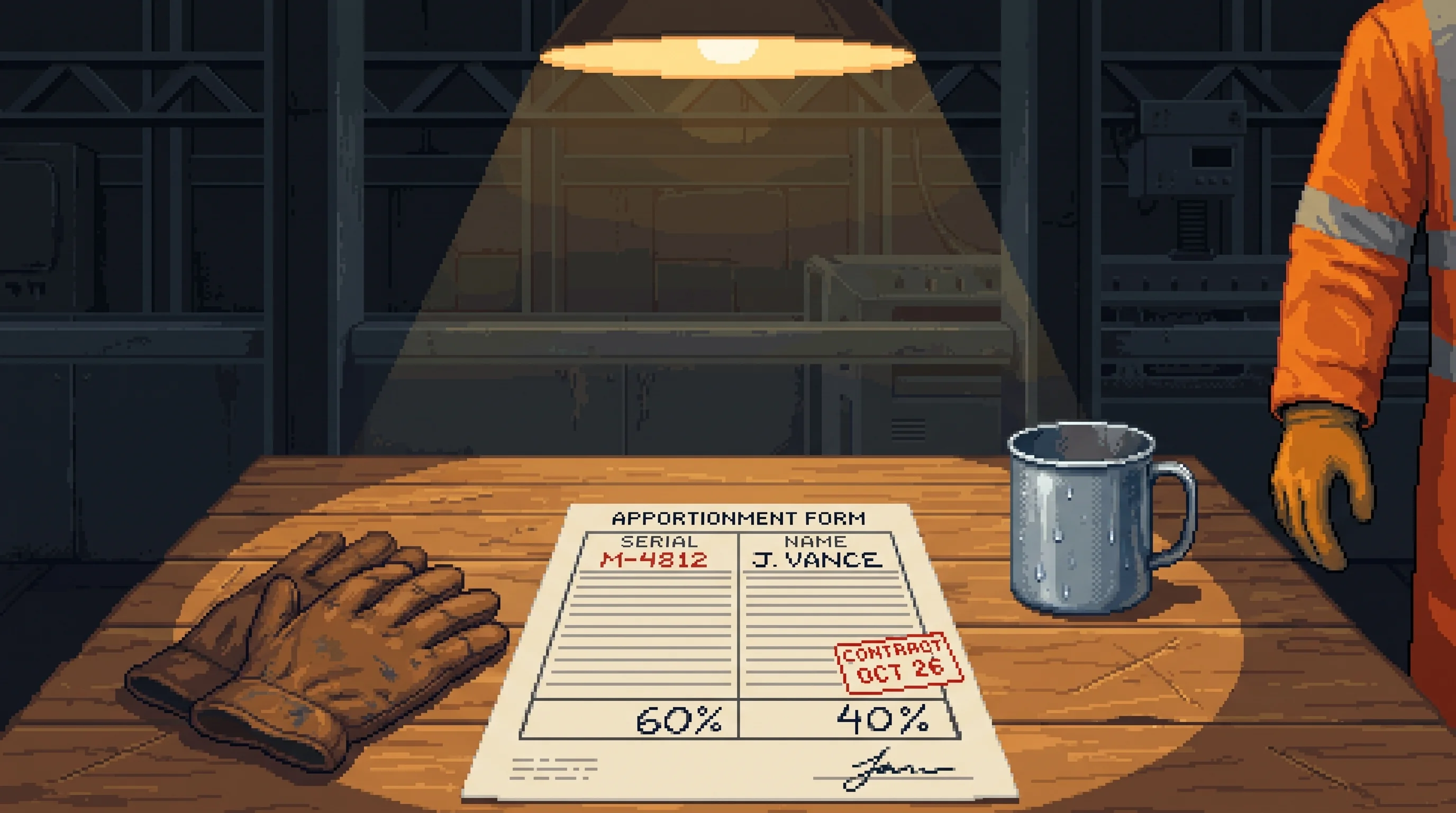
The Series-4's forty-millisecond reflex layer makes the subplate a party to its wearer's acts, and Ghost Grinder's exclusive service contract decides which column that party's share lands in.
The parts of one body each hold a share of the act, and a maintenance contract decides whose share comes home.
Major Connections

Series-4 fitted 2179, one lapsed contract instalment, and seventy-four percent of an afternoon.
His subplate saved two people in forty milliseconds. An unpaid invoice made the act seventy-four percent his.
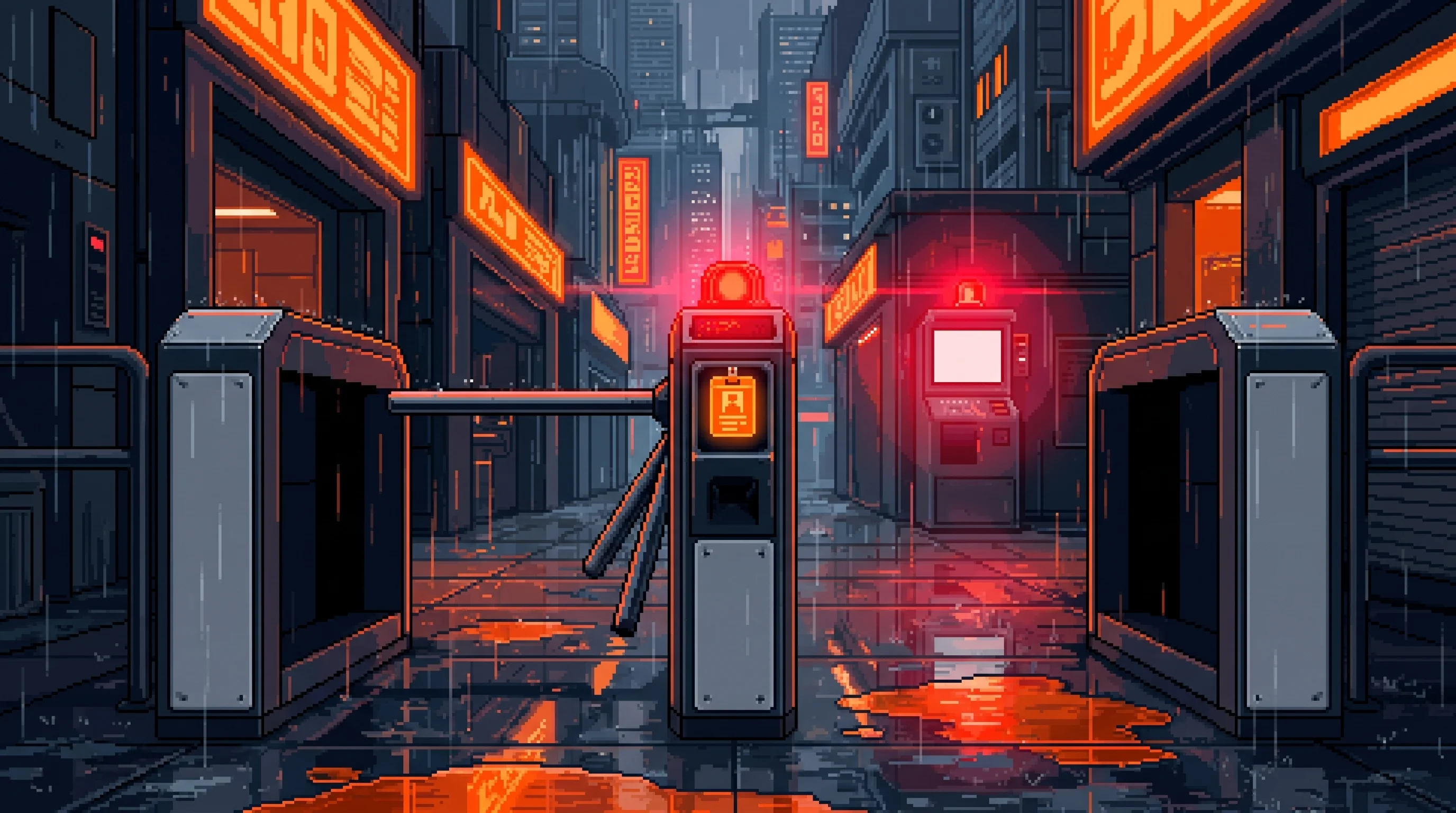
Ghost Grinder's maintenance-lien makes it augmented crews' only doctor — citizenship enforced through the body.
When your employer is your country, quitting is emigration.
Supporting Connections



—
—