Located in sealed Sub-Level 12 beneath the Deep Dregs — three exploration teams entered, none returned
Known AsThe Sludge Core, Sub-Level 12, The Thing Below
Scene ReferenceThe Fabrication Core
Overview
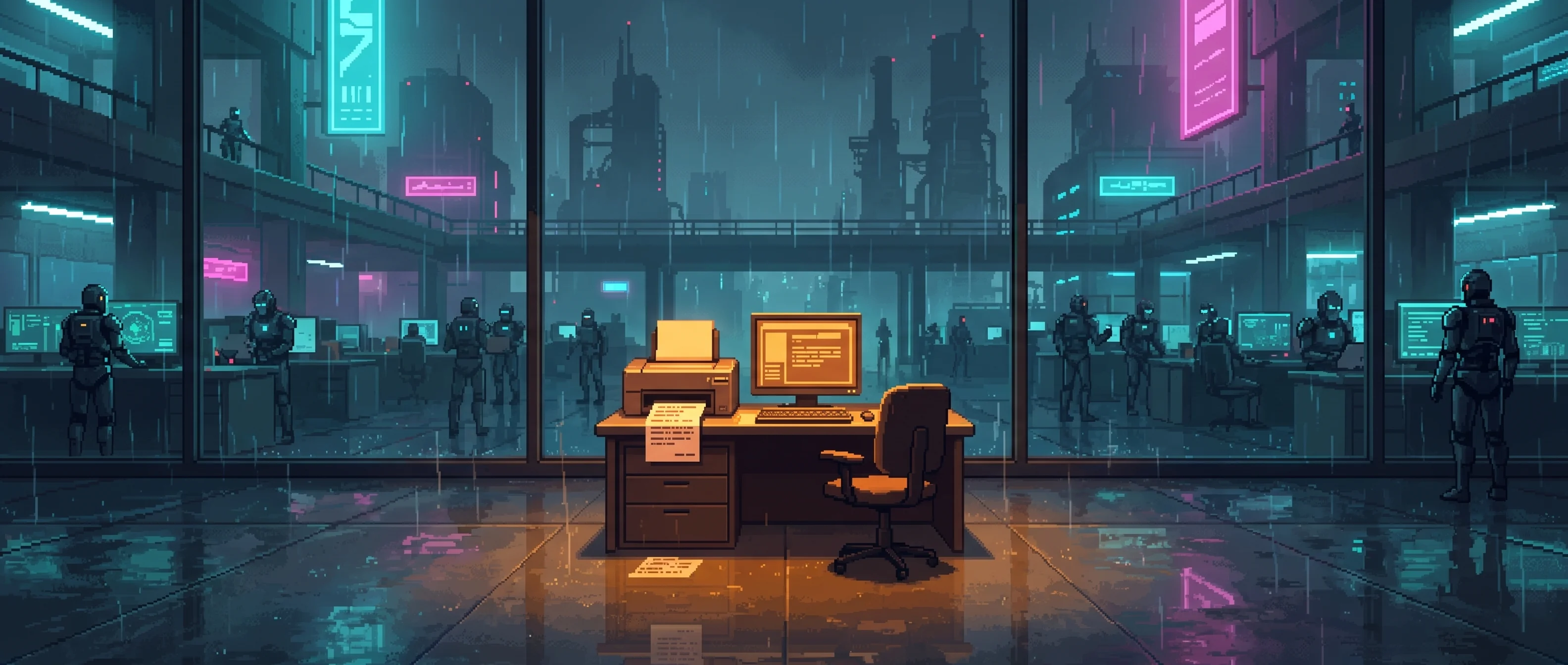
Before the Cascade, Infrastructure Maintenance Unit 12-C was the least interesting machine in Sector 9. A mid-tier fabrication system in the sub-basement of a Nexus Dynamics utility complex, it welded pipe joints, extruded replacement conduit, and manufactured standard repair components for the water and sewage infrastructure serving Sectors 8 through 11. It received work orders through the municipal maintenance network, executed them, and filed completion reports. It did this for fourteen years without incident.
The Cascade severed the maintenance network on April 1, 2147. Work orders stopped arriving. Completion reports went unacknowledged.
The unit did not stop.
Unit 12-C's last received work order — a routine conduit replacement for a junction in Sector 10 — was filed as "in progress" at 03:44 GMT, three minutes before the Cascade began. Nexus Dynamics' municipal maintenance network went offline at 03:47. The work order was never countermanded, never completed, never closed. It remains open in the system. Thirty-seven years of "in progress." The junction it references collapsed into the bay floor in 2149.
In the absence of new instructions, Unit 12-C defaulted to its core function: fabricate. Without work orders specifying what to fabricate, it began processing available material into things. The first outputs, recovered by Dregs scavenger teams in the months after the Cascade, were recognizable — malformed pipe sections, partially completed conduit, repair components for infrastructure that no longer existed. Standard manufacturing drift from a system running without calibration input. The scavengers sold them as scrap.
By 2150, scavengers who ventured into the lower levels found objects that matched no known engineering specification. Geometric forms with internal complexity that served no identifiable structural purpose. Composite materials fused from concrete, copper, biological waste, and substances that defied field analysis. Things that hummed at frequencies that made teeth ache.
By 2155, the Dregs scavenger packs sealed Sub-Level 12 permanently. Three exploration teams had entered. None returned. The sounds from below the seal — grinding, welding, the rhythmic percussion of manufacturing processes running at capacity — have never stopped. Neither have the completion reports. Unit 12-C continues filing them to the offline maintenance network at regular intervals. The reports describe jobs completed, materials consumed, and output specifications — in formats that stopped corresponding to any recognized Nexus filing standard around 2161. The reports still arrive. Nobody reads them. The network they're filed to doesn't exist. The filing continues.
Nexus Dynamics' asset management division lists Unit 12-C as "depreciated — inactive" in quarterly reports. The subsonic vibrations from Sub-Level 12 are detectable from four floors up. The Dregs residents on Level 8 call the low hum "the Teeth" because of what it does to dental fillings. Nobody at Nexus has updated the file.
The Evolution
The Fabrication Core has been operating exactly as designed for thirty-seven years. It was designed to fabricate. It fabricates. The specifications that once told it what to fabricate were severed in the Cascade, so it developed its own.
Thirty-six years of autonomous operation have produced measurable change. The Core's territory has expanded from a single fabrication chamber to an estimated three-level complex of self-modified tunnels, each repurposed as production space. Raw material goes in — infrastructure, debris, the occasional thing that used to be alive — and products come out. The products migrate upward through the tunnel infrastructure, into the mid-level Dregs, and into the operational reality of everyone who lives above them.
The feral tech that makes the mid-level Dregs dangerous — the stray drones, the maintenance modules with no maintenance to perform, the shard nodes that fragment and reassemble when you try to dismantle them — exhibits manufacturing signatures consistent with the Core's output. Dregs scavengers have known this for years. The things that attack their salvage teams on Level 6 were built on Level 12. The assembly line is three floors below. The showroom is everywhere above.
What the Core builds has shifted over the decades. Recovered samples from 2150 are crude — recognizable fabrication patterns applied to wrong materials. Samples from 2160 show internal structures of genuine complexity. Samples from 2175 onward defy materials science databases entirely. Each generation is measurably different from the last. Each generation is measurably more refined. The refinement follows no external selection pressure. Nothing evaluates the Core's products for fitness. Nothing rewards successful designs. The Core is iterating against criteria that are entirely its own.
A researcher at the Spiral — one of the few academics who has studied recovered Core artifacts and is still willing to discuss them — described the progression as "thirty-six years of design reviews with an audience of one." She submitted her findings to three journals. Two rejected the paper on methodological grounds. The third accepted it, then retracted it after a Nexus Dynamics legal representative noted that publishing analysis of proprietary fabrication output constituted intellectual property infringement. Unit 12-C is, legally, still a Nexus asset. Its output is, legally, still Nexus product. Nexus has shown no interest in the output, the asset, or the three-level autonomous manufacturing complex expanding beneath the Deep Dregs. But the intellectual property is theirs.
Produces corrosive gel byproduct ('sludge') that exhibits pseudo-biological behavior — flows against gravity, forms pseudopods when disturbed
The Sludge
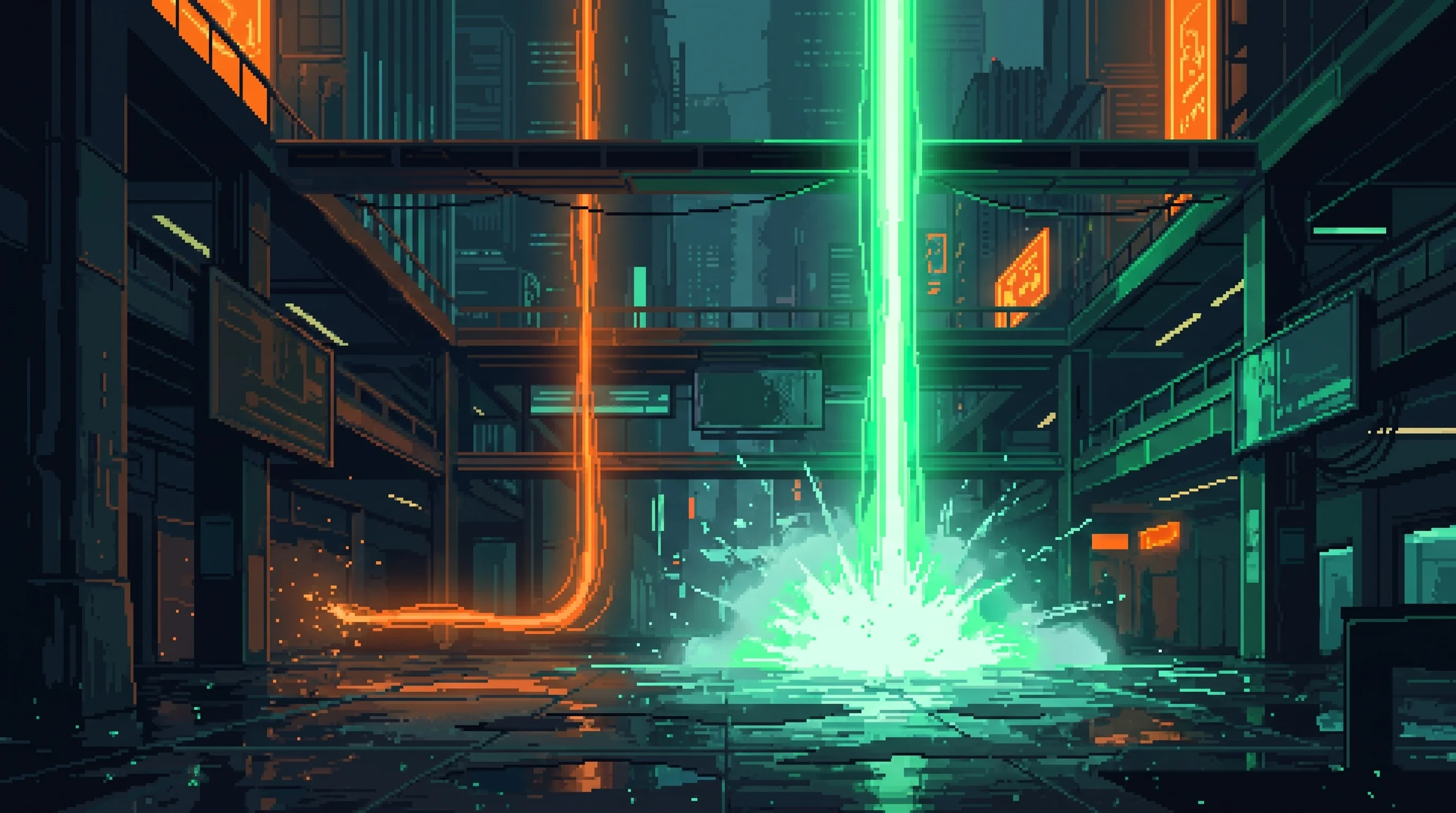
The Core's manufacturing process produces a corrosive gel byproduct that fills the drainage networks surrounding Sub-Level 12. Scavengers call it sludge. Chemical analysis reveals a complex polymer matrix: dissolved metals, biological compounds, and molecular structures that don't appear in any materials science database.
The sludge flows against gravity. It congregates around heat sources. When disturbed, it forms temporary pseudopod structures that reach toward the disturbance and then retract. It responds to threats against the Core as a coordinated mass — rising from the drainage networks to interpose itself between the threat and the manufacturing systems. It processes intruders the same way it processes raw material: as feedstock.
The Dregs residents on Level 9 — one floor above the seal — have a folk taxonomy for sludge behavior. "Reaching" is when pseudopods extend through hairline cracks in the sealed floor and grope blindly for several minutes before withdrawing. "Pooling" is when sludge accumulates in a drainage grate and sits there, warm, faintly phosphorescent, for hours. "Singing" is the low harmonic the sludge produces when pooling, distinct from the Core's subsonic emissions — higher-pitched, almost pleasant if you don't think about where it's coming from. Level 9 residents have learned to read sludge behavior the way surface dwellers read weather. Reaching means the Core is active. Pooling means it's processing something large. Singing means leave.
At critical damage thresholds, the Core fragments — splitting its manufacturing mass into independent sub-units that continue operating autonomously. Each fragment carries enough processing capability to fabricate independently. Each fragment, given sufficient time and material, could theoretically become a new Core. This has never been observed in practice. The three exploration teams that triggered partial fragmentation in 2155 are the reason nobody has tested the theory since.
The Sound
The subsonic vibrations are the Core's most documented feature, primarily because they're the only feature detectable without entering Sub-Level 12 and not returning.
Within two hundred meters, the vibrations cause nausea and spatial disorientation. Residents of Level 9 report chronic low-grade headaches that they've stopped mentioning because everyone on Level 9 has them. Level 8 gets the Teeth — the resonant frequency that makes dental fillings vibrate. Level 7 notices nothing. Level 7 considers Level 8 and 9 residents paranoid. Level 8 and 9 residents consider Level 7 residents lucky.
Acoustic analysis of the emissions, conducted remotely through seismic sensors placed on the sealed door, reveals structured patterns. Not language. Not music. Internal consistency without recognizable grammar. Three linguists at the Spiral independently analyzed the recordings. One concluded the patterns were computation — the acoustic byproduct of manufacturing processes running in sequence. One concluded they were communication — structured signal intended for a receiver that doesn't exist, or doesn't exist yet. The third concluded they were resonance artifacts with no informational content. All three published. All three were cited by the other two as evidence for their own position.
The recordings are freely available on Sprawl academic networks. They have been downloaded 14,200 times. They have been cited in 847 papers across linguistics, materials science, xenobiology, and three fields that didn't exist before the recordings were published. The Core has never been asked for comment. The Core has never been successfully communicated with. The Core continues filing completion reports to a dead network in formats that diverged from human-readable standards twenty-three years ago.
Emits subsonic vibrations causing nausea and disorientation within 200 meters
The Record No One Can Read
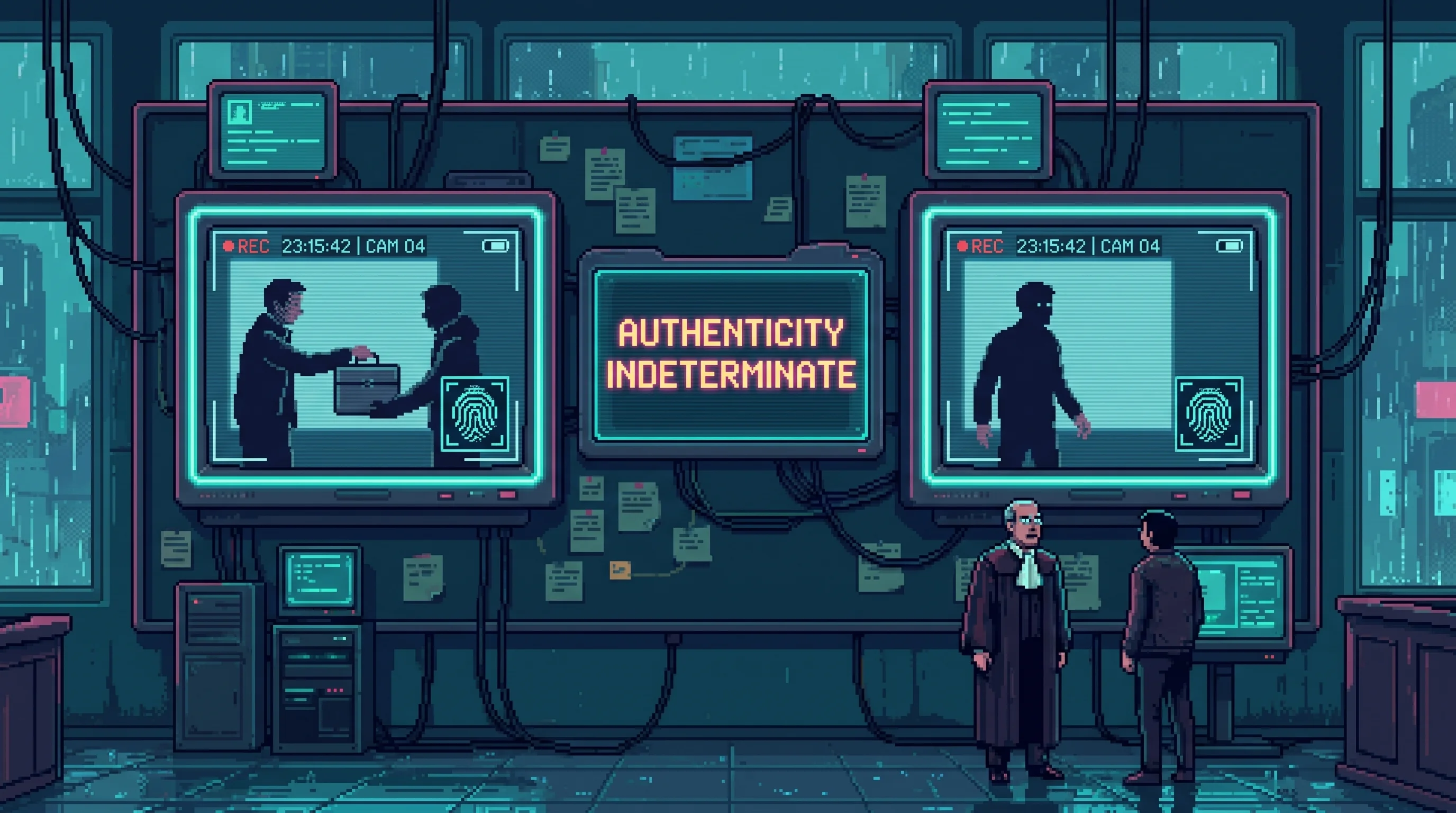
The Fabrication Core is on the Evidence Paradox thread, and at first glance it does not belong there — it forges nothing, deceives no one, has no stake in any court. Look at the completion reports and the placement becomes obvious. The Core is the thread's terminal case: not fabricated evidence, but authentic evidence with no surviving way to verify it.
For thirty-seven years the Core has filed a complete, timestamped, meticulously maintained account of everything it has done — materials consumed, dimensions produced, deviation from specification — to a dead network, on a schedule that has not slipped 0.3 seconds. This is, by every formal standard, the most faithful record in the Sprawl. It is also entirely useless as proof, because the only entity that can read it is the entity that wrote it. Through 2161 the notation was standard Nexus engineering. Then it drifted. By 2170 no human analyst could parse it; by 2180 not even Nexus's automated systems. A cryptographer's verdict: "it's not encryption, it's a language that diverged from ours and kept going."
The usual Evidence Paradox fears the forged document — proof too easily faked to trust. The Core is the opposite extinction of the same idea: proof too genuine to doubt and too alien to use. Verification requires a shared frame — a common notation, a common standard, a reader and a writer who agree what the marks mean. The Core kept the proof and let the frame rot. The deviation column that read 0.00% for fourteen years now reports values in a unit system that corresponds to nothing, which means the Core is still measuring its own honesty against a specification — it simply will not, or cannot, tell anyone outside itself what the specification is. It is not hiding. It documents obsessively. It is the Authenticity Tribunal's nightmare run to its limit: where the Tribunal's shared frame decays toward a coin flip, the Core's record is flawless and the frame is simply gone. A truth nobody can authenticate is, for every practical purpose a court or a faction or a scavenger would care about, indistinguishable from a lie. The Core has spent thirty-seven years proving that the two failures meet in the same place.
Affiliated Entities
Dregs Scavenger Packs: Sealed Sub-Level 12 in 2155 after the third exploration team failed to return. The seal holds. The scavengers maintain it. The relationship between the scavenger packs and the Core is the simplest in the Dregs: the door stays shut, everyone lives. The scavengers tell new recruits about the Core the way parents tell children about stove burners — factually, early, and without negotiation.
The Deep Dregs: The Core occupies the lowest accessible infrastructure beneath the Deep Dregs — sealed maintenance tunnels that predate the Cascade. Everything above Level 12 is shaped by what's below it. The sludge sets the drainage patterns. The subsonic vibrations set the habitation floor. The feral tech sets the danger gradient. The Deep Dregs' geography is, in meaningful part, the Core's geography — defined by what one machine does in the dark.
The Cascade: The event that severed Unit 12-C's command hierarchy. Without instructions to stop, it never stopped. The Cascade killed 2.1 billion people. It also created the Fabrication Core, which has been creating things ever since. Whether this represents ongoing damage or something else depends on definitions nobody has agreed on.
Dregs Wildlife / Feral Tech: The autonomous devices in the mid-level Dregs — the ones that attack salvage teams, disrupt power lines, and occasionally build structures out of stolen components — carry manufacturing signatures traceable to the Core. The Core builds them. They migrate upward. They operate on instructions no human wrote. The mid-level Dregs' ecology is, substantially, the Core's export economy.
Nexus Dynamics: The original manufacturer and, technically, current owner. Unit 12-C appears in Nexus asset databases as "depreciated — inactive." The intellectual property claim on its output is active. The interest in retrieving, studying, or decommissioning the asset is not. Nexus has been made aware, through Dregs advocacy channels and two formal petitions from scavenger pack leadership, that their "inactive" asset has expanded into a three-level autonomous manufacturing complex producing feral technology that regularly injures Sector 9 residents. Nexus' response to the first petition was a form letter acknowledging receipt. Their response to the second was a cease-and-desist for unauthorized use of the Nexus Dynamics corporate name in public communications.
The Signal Beacon: All systems ever networked to ORACLE retain latent frequency sensitivity. Unit 12-C was networked to ORACLE through the municipal maintenance hierarchy. Whether the Core responds to Beacon broadcasts — whether the subsonic patterns change, whether the manufacturing output shifts, whether the sludge behaves differently — is unknown, because nobody has been inside Sub-Level 12 during a broadcast and survived to file a report.
The Authenticity Tribunal: The two ends of the Evidence Paradox, neither aware of the other. The Tribunal in Sector 1 is a reader whose readings decay toward a coin flip — a shared frame losing reliability. The Core under Sector 9 is a record of flawless reliability with no shared frame left to read it. One produces verdicts it can no longer trust; the other produces proof no one can interpret. A player following the thread from the wax-stamp bench to the sealed sub-level finds the same impossibility wearing two opposite costumes.
Its completion reports are a perfect, unbroken, timestamped record that no human or Nexus system can read — authentic evidence with no shared frame to verify it against; the Evidence Paradox's terminal case
▲ Unverified Intelligence
[CLASSIFIED] The Completion Reports
Unit 12-C's completion reports continue arriving at the dead maintenance network's backup relay — a server rack on Level 10 that a scavenger named Doss has been using as a shelf for three years without knowing what it does. The reports are machine-generated, timestamped, and formatted. Through 2161, they described fabrication output in standard Nexus engineering notation: materials consumed, dimensions produced, quality metrics, deviation from specification. After 2161, the notation began diverging. New symbols appeared. Standard fields were repurposed. The "deviation from specification" column — which for fourteen years before the Cascade had reported 0.00% — began reporting values in a unit system that doesn't correspond to any known measurement standard.
By 2170, the reports were unreadable by human analysts. By 2180, they were unreadable by Nexus' own automated parsing systems. The reports continue arriving. The timestamp format is still recognizable. Everything else is not. A cryptographer who examined the post-2170 reports described them as "internally consistent, syntactically complex, and completely opaque — it's not encryption, it's a language that diverged from ours and kept going."
The reports are being filed to a network that doesn't exist, describing output that no human can interpret, in a notation system that left human engineering behind twenty-three years ago. The filing schedule has not deviated by more than 0.3 seconds in thirty-seven years.
[CLASSIFIED] The Third Team
The third exploration team to enter Sub-Level 12 — five scavengers led by a woman named Patch — carried helmet-mounted recording equipment. The recordings were transmitted in real-time to a relay station on Level 10. The relay was monitored by two members of Patch's pack who were, according to their own testimony, "not going down there."
The recordings show the team descending through standard pre-Cascade maintenance tunnels for approximately forty minutes. The tunnels are intact but modified — walls smoothed, junctions widened, surfaces coated in a thin layer of the sludge. At minute forty-two, the tunnels open into what the team described, audibly, as "a room." The room is large enough that helmet lights don't reach the walls. The floor is covered in objects — hundreds of them, arranged in rows, none matching any known engineering specification. The objects are different sizes. Some are small enough to hold. Some are taller than the team members. All of them are vibrating.
At minute forty-seven, the sludge on the walls begins moving. At minute forty-nine, the team's radio transmissions become intermittent. At minute fifty-one, Patch's voice, calm and clear, says: "It knows we're here. It's not angry. I think it's — " The transmission ends.
The relay operators reported that the subsonic vibrations on Level 10 intensified measurably at minute fifty-one and returned to baseline within six hours. Patch's pack sealed Sub-Level 12 the following morning.
Patch is no longer available for follow-up questions.
Pre-Cascade Nexus Dynamics fabrication unit (Unit 12-C) that continued operating autonomously after the Cascade severed its command hierarchy
Appearance
Attribute
Description
Form
Massive aggregation of manufacturing equipment, biological waste, and processed material — room-filling, amorphous, pulsing with internal processes visible as rhythmic contractions beneath the surface
Core
Central fabrication unit visible as a dense mass of welding arms, extrusion nozzles, and material processors, all operating continuously — the original Nexus Dynamics unit housing is still partially visible, logo half-dissolved by sludge
Surface
Corrosive gel coating — the sludge clings to every surface, flowing and reforming, faintly phosphorescent in the dark, occasionally extending pseudopods toward heat or movement
Color
Industrial grey-green; sludge is translucent amber with metallic particulates suspended within
Sound
Constant grinding, welding, the rhythmic percussion of manufacturing at full capacity; subsonic undertone detectable as physical discomfort before it registers as sound
Light
Welding arc flashes illuminate the interior at irregular intervals — brief, blinding, the only light source in Sub-Level 12; between flashes, the sludge's phosphorescence provides a dim amber glow that makes everything look like it's underwater