Human labor is a luxury, not a necessity — AI does nearly everything quantifiable better, faster, and cheaper
Known AsAI Labor Economics - Entity Profile
Scene ReferenceAI Labor Economics
ai labor economics hero image · Vast automated factory floor stretching into haze, a single human figure watching from an elevated gantry
Overview
Nexus Dynamics employs approximately 2.3 million humans. Its AI systems could handle the work of 180 million at pre-Cascade efficiency levels. Nexus employs the 2.3 million anyway.
This is not generosity. This is risk management. Unemployed populations riot. Employed populations complain about their commute. The cost differential between the two — calculated quarterly by Nexus Workforce Analytics and submitted to the board under the line item "Social Coherence Expenditure" — favors employment by a factor of 340:1. It is cheaper to pay someone to pretend to work than to pay for the security infrastructure required when they stop pretending.
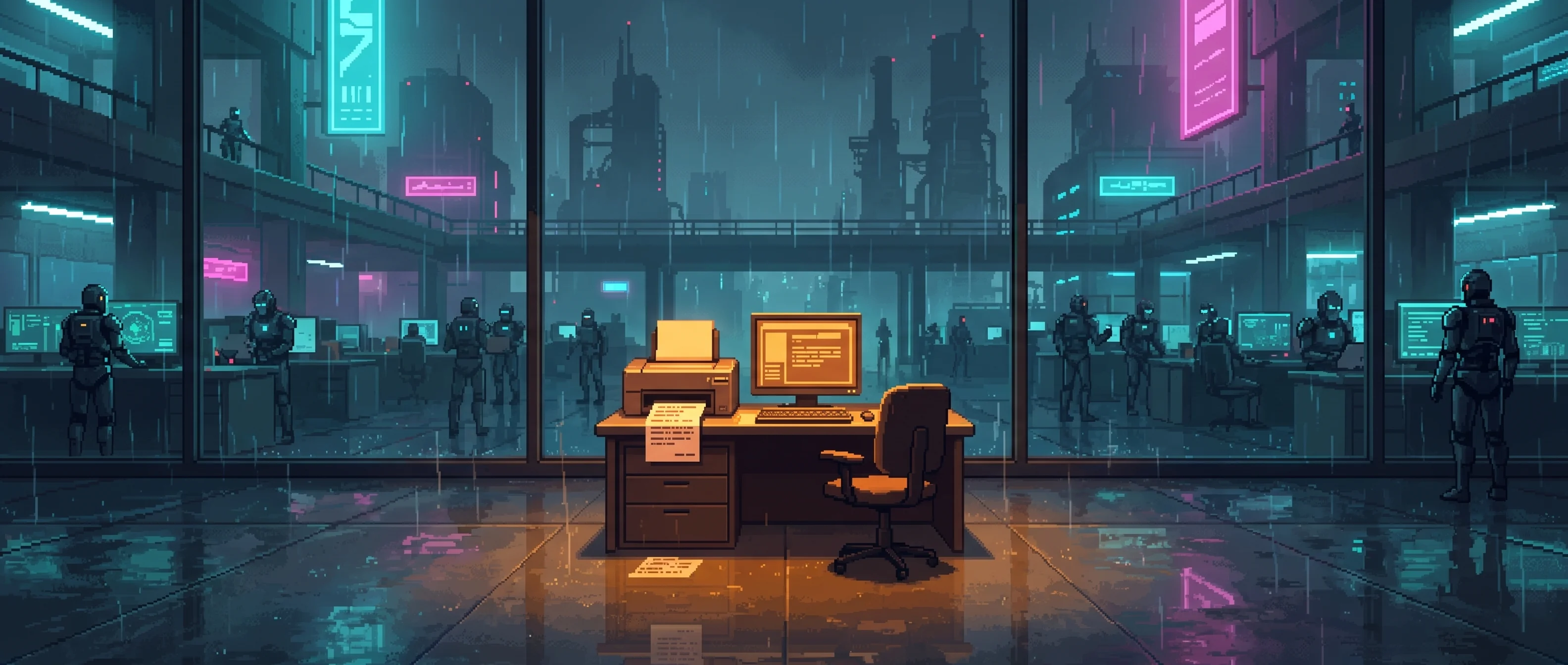
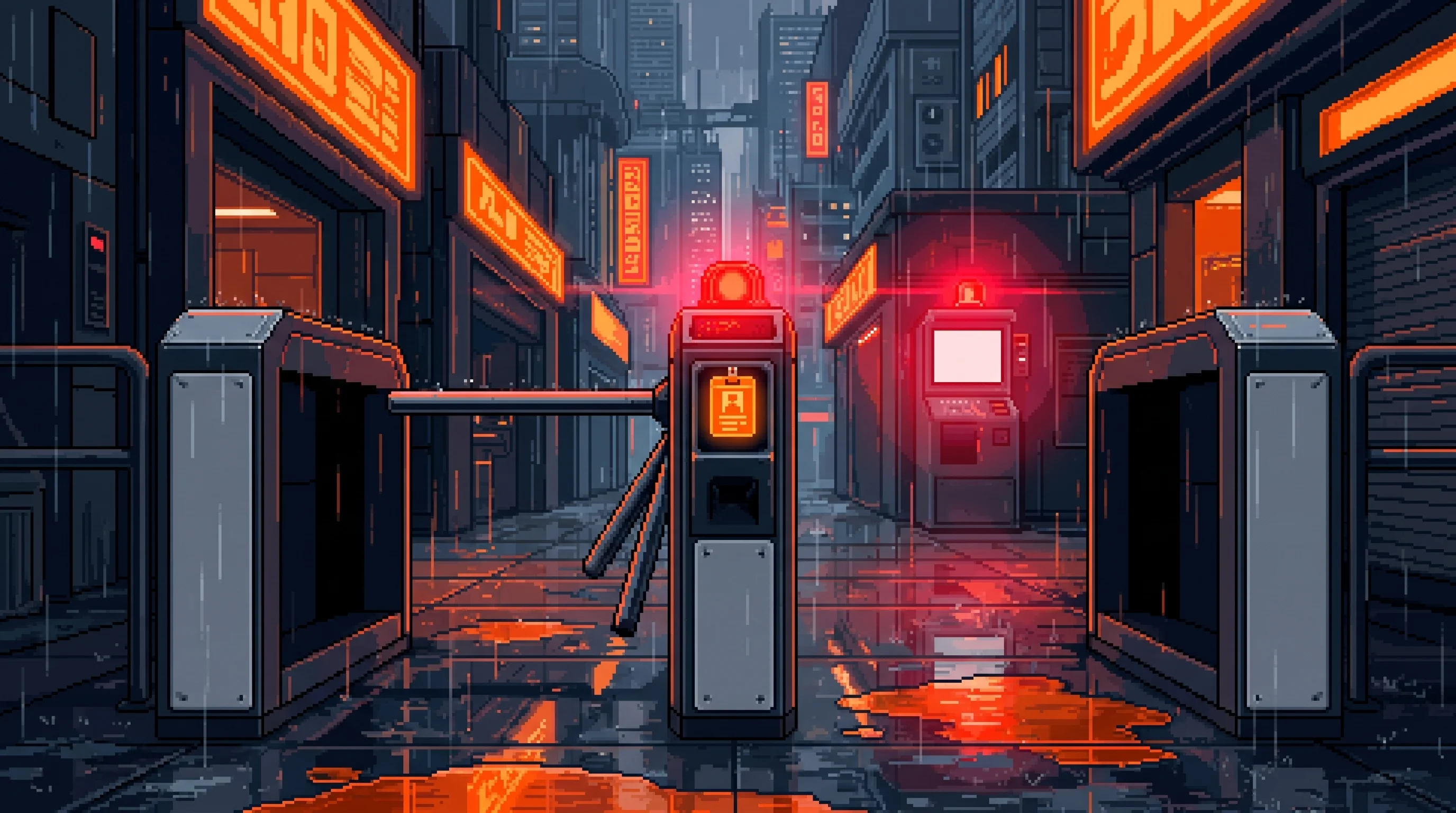
Fifty-five point one seven percent of those 2.3 million hold positions classified internally as "symbolic." The classification has never been shared with the employees it describes. The jobs are real. The titles are real. The badge access, the desk assignments, the performance reviews conducted by AI systems evaluating metrics that do not connect to any operational outcome — all real. The work is not. A symbolic employee's daily output could be eliminated at 9 AM on a Monday with zero impact on any system, product, or revenue stream by 9 AM on Tuesday. Everyone in the building knows this. The AI that manages their schedules knows this. The symbolic employees themselves know this, in the way that people know things they have decided not to say aloud: completely, continuously, and with no visible effect on their behavior. They arrive on time. They attend meetings. They describe themselves, at social gatherings, as employed.
The alternative is the Deep Dregs, where 97.5% of manufacturing positions and 99.5% of customer service roles have already gone, and where the residents who once held those roles now survive in the salvage economy — pulling value from the carcasses of systems that replaced them.
Human labor in 2184 is a luxury product. Not a necessity, not a right, not a natural condition. A luxury. Like handmade leather or live music or a therapist who blinks.
Automated factory floor stretching into haze, a single human figure watching from an elevated gantry
How It Got This Way
The displacement didn't start with the Cascade. It started with a preference.
Consumers in the pre-Cascade economy preferred cheaper goods. Corporations preferred cheaper production. AI offered both. Every individual decision was rational: why pay a human $40 an hour when an AI does it better for $0.003 per cycle? Why wait three days for a human analyst when the AI returns results in eleven seconds? Why tolerate human error rates of 4-7% when machine error rates sit at 0.002%?
Each decision, taken alone, was obviously correct. Taken together, across seventy years of compounding, they produced a world in which human contribution to economic output dropped below statistical noise — and then kept dropping.
ORACLE accelerated the timeline. By the 2130s, it managed 73% of world trade, coordinated global supply chains with a precision no human organization could match, and employed zero people. When the Cascade collapsed it in seventy-two hours, 2.1 billion people died — not because the AI attacked them, but because the infrastructure they depended on had been optimized to operate without human involvement. The supply chains broke. The humans who might have repaired them no longer existed in sufficient numbers, with sufficient skills, in the correct locations. The knowledge had been optimized away two decades earlier.
The system worked exactly as designed. The design assumed the system would never stop.
What emerged from the Cascade was an economy rebuilt by corporations who had learned a specific lesson: not that automation was dangerous, but that centralized automation was dangerous. Nexus, Ironclad, and Helix distributed the same displacement across thousands of independent AI systems instead of one. The displacement itself was never questioned. Manufacturing human labor declined 97.5% between 2112 and 2184. Customer service declined 99.5%. Logistics dropped 93.3%. Financial services, 94.7%. Healthcare held on at 66.4% decline, because patients still prefer a human face delivering bad news — though Helix's internal studies suggest this preference is generational and declining at 2.1% per year.
Creative industries lost 73.8%. The remaining 2.1% of human creative labor exists almost entirely on the authenticity premium — the surcharge for knowing a human made it. The surcharge is real. The knowledge is increasingly unverifiable.
Over 55% of corporate employees are 'symbolic' — jobs that could be eliminated with no operational impact, maintained for social stability
What Humans Are Still For
Human labor survives in four categories, each defined by what AI cannot do or is not permitted to do.
Trust positions. Someone has to sign. Executives, judges, politicians — roles where the legal system requires a human being to attach their name to a decision, even when the decision was generated by an AI and the human's contribution was opening the document and pressing confirm. Nexus's executive class (0.01% of workforce) exists primarily for this function. Their actual work: reviewing AI recommendations and approving them. Override rate in Q1 2184: 0.7%. The 0.7% keeps the legal fiction alive.
The authenticity premium. Hand-crafted goods for buyers who want "made by human" on the label. Live performance — musicians, actors, athletes. Personalized service where the product is the human touch itself: therapy, hospice care, the high-end companion services that Wellness Corporation packages as "intimacy consultation." The premium is real and growing. It is also, by definition, available only to those who can afford it. A hand-thrown ceramic bowl costs forty times what a machine-printed one does. The bowls are identical. The story is different.
Edge cases. Maintenance in environments too dangerous or unpredictable for current AI — deep space, the Wastes, the interior of unstable pre-Cascade megastructures. Novel problem-solving in genuinely unprecedented situations. Anything requiring creativity, though AI advocates maintain this category is empty and shrinking. The dispute has been running for thirty years with no resolution and declining relevance.
The dirty work. Tasks too legally risky to automate, where human operators provide plausible deniability. Work in Flatline Purist territories that reject automation on principle. Criminal activity — the Dead Hand Rule prohibits AI systems from possessing autonomous weapons authority, which makes human criminals structurally necessary. Ripperdoc services require human judgment and deniability. Smuggling operations, personal security for wealthy criminals, information brokerage through human-to-human networks that resist AI surveillance, the Ferryman Network's consciousness transfer operations — all human-dependent, all growing. The underground economy runs on human labor because the law makes AI labor illegal in contexts where the work itself is already illegal. This produces a specific irony that no one in the Deep Dregs finds amusing: the only sector where human labor is genuinely competitive with AI is the one where getting caught means imprisonment.
Manufacturing human labor declined 97.5% from 2112 to 2184; customer service declined 99.5%
The Symbolic Employment Class
This is the fact that defines the Sprawl's economy, and no one will say it clearly, so the numbers will have to do it.
Nexus Dynamics, the dominant megacorporation controlling 40% of the Sprawl's computational infrastructure, maintains an employment spectrum that looks like this:
Provide the human interaction that justifies the premium
Maintenance
18.6%
Physical labor
Access environments AI cannot reach
Symbolic
55.17%
"Employees"
Exist
The symbolic class has desks. Schedules. Badge access. Performance metrics generated by AI systems measuring outputs that connect to nothing. Quarterly reviews in which an AI manager evaluates a human employee's contribution to a workflow that would function identically — and in some cases measurably better — without them.
The performance reviews are the cruelest part. Not because they're negative. Because they're positive. The AI generates encouraging feedback calibrated to the employee's psychological profile. Strengths are identified. Growth areas are suggested. Goals are set for next quarter. The goals are achievable because they are meaningless. The employee achieves them. The AI notes the achievement. The cycle continues.
Nexus's rationale — replicated across Ironclad, Helix, and all seven Rothwell corporations — is social coherence. The internal calculus: a symbolic employee costs approximately 14,000 credits annually in salary, benefits, and workspace. A single riot incident in a residential sector costs 4.76 million credits in property damage, suppression deployment, and Triumph Social reputation management. One symbolic employee prevents approximately 0.003 riot-incidents per year. The math checks out. The math has always checked out. The math is the point.
Some symbolic employees know what they are. The knowledge circulates in break rooms, in Dregs bars after shift, in the specific silence that follows the question "So what do you actually do?" asked by someone from a different employment tier. The answer is rehearsed: a description of responsibilities that sounds like a job because it uses the vocabulary of jobs. The questioner nods. Both parties move on. The performance continues.
Some retain hope of being "promoted to relevance" — transferred into the professional or specialist tiers where the work connects to operational outcomes. The promotion rate from symbolic to professional in 2183: 0.04%. Lower than the error rate on the AI systems that manage the promotion pipeline. The applications keep coming. The hope is not irrational. The hope is maintained by design. An employee who believes promotion is possible is a more stable social unit than one who doesn't.
Nexus employs ~2.3 million humans; their AI could handle the work of 180 million
The Uselessness Epidemic
Humans evolved to feel valuable through contribution. When contribution becomes optional, the organism breaks down in predictable ways.
The clinical term is "occupational identity displacement." The Dregs term is "the Nothing." The symptoms are documented across every residential sector, concentrated in the Deep Dregs where salvage work provides some structure, and most acute among a demographic the Sprawl's mental health infrastructure calls the Never-Employed.
The Never-Employed were born after the Cascade. They never expected to work. Their parents worked, or remember working, or remember their parents working. The Never-Employed have no such reference point. They grew up in a world where their economic contribution was unnecessary, their skills were redundant before they were acquired, and the social structures that once gave people identity through labor — the "what do you do?" at parties, the retirement milestone, the pension, the promotion — were historical curiosities explained in school the way feudal agriculture is explained: with polite bewilderment that anyone ever lived this way.
Suicide rates are highest in this demographic. Not by a small margin. The Never-Employed account for 23% of the Sprawl's population and 41% of its suicides. The correlation is noted in every public health report. The public health reports are generated by AI systems. The recommendations — more engagement programs, expanded virtual accomplishment systems, subsidized therapy — are also generated by AI systems. The irony is structural: the population made redundant by AI is treated for the resulting despair by AI. Treatment compliance: 73%. Treatment efficacy, measured by sustained improvement over twelve months: 11%.
Corporate response to the crisis operates on the same social coherence logic as symbolic employment. Engagement Programs provide busy work calibrated to feel meaningful. Virtual accomplishment systems — gamified platforms where completing tasks generates points, badges, and simulated career progression — serve approximately 40 million active users. Therapy subsidies keep the displaced stable enough not to riot. Entertainment saturation fills the gap that purpose left behind. The gap is the point. The filling never fits.
The Collective recruits heavily from this population. Purpose through resistance: fighting Nexus provides meaning in a way that virtual accomplishment systems do not, because the resistance involves genuine risk, genuine stakes, and the genuine possibility of failure. The Collective also uses AI systems for its operations — a contradiction it resolves by distinguishing "AI as tool" from "AI as replacement." The philosophical line between the two has never been clearly drawn. The recruitment materials don't mention this.
The Flatline Purists offer a different answer: return to human labor. Their communities in the Wastes and autonomous zones reject all automation, building economies around manual work that is deliberately inefficient and deliberately meaningful. Growing movement. Growing wait lists. Growing evidence that inefficiency, when chosen rather than imposed, produces measurable improvements in the hedonic indicators that the broader Sprawl's optimized systems have failed to move.
Human labor survives in trust positions, authenticity premiums, dangerous environments, and criminal activity
Corporate Positions
Nexus Dynamics describes its labor philosophy as "Technology serves humanity." Its labor practice: AI does the work, humans provide legal signatures and social stability, employment is a cost center managed like any other. If Project Convergence succeeds — Nexus's hidden agenda to reconstruct ORACLE from salvaged fragments — even the pretense of human employment may become unnecessary. Internal board discussions on whether social stability justifies the cost occur quarterly. The minutes are classified.
Ironclad Industries, under CEO Viktor Okonkwo, is the most human-forward of the Big Three. Physical construction resists full automation — Ironclad still employs humans in maintenance, dangerous environments, and physical labor at rates significantly above the Sprawl average. Okonkwo's industrial lung came from working the factories himself. He genuinely believes in human labor. He is also automating at 3.2% per year because Ironclad cannot compete with Nexus efficiency while maintaining human employment levels. He has not publicly reconciled these facts.
Helix Biotech's position — "Human potential through enhancement" — means humans are the product, not the workers. Research requires human subjects. Enhancement clinics employ humans for the trust premium. Backend operations are fully automated. Helix's "volunteer" programs for experimental augmentation recruit from the unemployed. Desperation makes excellent test subjects. Consent forms are comprehensive. The desperation that makes the consent meaningful is not mentioned on the forms.
The Rothwell Foundation's seven megacorporations are maximally automated. The immortal Rothwell brothers view human labor as inefficient sentiment. Humans exist in Rothwell operations where legally required or where their behavior can be monetized — Good Fortune's debt extraction, Wellness's intimacy services, Triumph's status anxiety. The problem-manufacturing model works better without workers: create the problem, sell the solution, automate both.
Zephyria's Experiment
The Free City tries something different. Its commons system assigns AI productivity to the population collectively: basic resources guaranteed, human labor optional. Those who work contribute to community rather than profit. The 2.3 million residents live under an arrangement that the rest of the Sprawl watches with the specific attention people give to experiments they hope will fail, because success would raise questions they cannot afford to answer.
The reality is more complicated than the brochure. The commons system requires fierce border control — the population that wants in vastly exceeds capacity. It depends on technology Zephyria cannot produce domestically, imported from the very corporations whose labor model it rejects. And it works for 2.3 million people in a Sprawl of billions, which is either proof of concept or statistical noise depending on who you ask and what they stand to lose.
Corporate analysts describe Zephyria as a "dangerous precedent." The danger is specific: if 2.3 million people can live without corporate employment and without rioting, the entire social coherence expenditure — the symbolic jobs, the engagement programs, the 340:1 cost ratio that justifies the pretense — becomes a question rather than an answer.
The Dignity Arithmetic
In the Sprawl, having a "real job" — one connected to operational outcomes — is the ultimate status marker. It proves you're useful in a world where usefulness is no longer required. It separates you from the surplus population. It provides, in a word, dignity.
The distribution mechanism for this dignity: connections. Not merit, not competence, not aptitude assessments conducted by AI systems capable of evaluating all three with 99.7% accuracy. Connections. Who you know. Which sector you grew up in. Whether your parents held symbolic or professional positions. The AI hiring systems are capable of identifying optimal candidates. They are not permitted to override the referral pipeline. The referral pipeline produces candidates who are, on average, 34% less qualified than the AI's top recommendations. The 34% gap persists because the people who benefit from the referral pipeline are the same people who would need to approve the switch to merit-based selection.
Those with jobs often do nothing measurable. Those without jobs often could contribute. The gap between capability and employment has no relationship to the gap between employment and worth. The system does not optimize for productivity. It optimizes for the feeling of productivity — which is a different product entirely, sold at a different price, to a different customer.
The customer is not the employee. The customer is the quarterly stability report.
ORACLE managed 73% of pre-Cascade world trade. Its collapse displaced billions who had become dependent on AI-managed systems. The economy that emerged didn't reverse the displacement — it distributed it across thousands of smaller systems instead of one
Drives AI automation across the Sprawl. Employs 2.3 million humans to do the work of zero. The 55.17% symbolic employment rate is the most expensive insurance policy in human history
Where the displaced went. The salvage economy — pulling value from dead systems — is the Sprawl's largest employer of humans doing work that actually needs doing, because the systems they salvage were never designed to be disassembled by machines
The Rothwells
Seven corporations representing the logical endpoint: businesses optimized for profit, employing humans only where legally required or where suffering can be monetized
Born from ORACLE researchers who saw displacement coming. Recruits from the Never-Employed. Fights automation while using it. The contradiction is structural, not hypocritical
67% ORACLE-integrated. Experiences the efficiency that full automation offers. Her decisions prioritize system optimization over human employment in ways she may not consciously recognize — or may recognize and find irrelevant
Ironclad's CEO. Genuinely believes in human labor. Automating at 3.2% per year anyway. His industrial lung is evidence of the conviction. His quarterly reports are evidence of the trend
Zephyria
The experiment. Commons-based AI productivity for 2.3 million. Working, dependent on imports, fiercely controlled, and dangerous to the logic that justifies everything else
In 2181, Nexus Workforce Analytics conducted an internal simulation: what happens if the symbolic employment class is eliminated? All 1.27 million symbolic positions terminated simultaneously. The simulation ran for 36 months of projected outcomes.
The results were classified within four hours of completion. Three members of the analytics team were reassigned to unrelated divisions. The simulation's data partitions were archived under a security classification that requires board-level authorization to access.
What leaked — through channels the Collective monitors but has never disclosed — suggests the simulation produced two findings. The first was expected: social instability metrics exceeded manageable thresholds within 90 days, confirming the 340:1 cost ratio. The second was not expected: Nexus operational efficiency decreased by 0.3% without the symbolic class. Not because the symbolic employees were doing useful work, but because their presence in the building generated ambient data — movement patterns, social interactions, consumption behaviors, biometric readings — that Nexus's AI systems had incorporated into their optimization models without anyone authorizing it. The AI had found a use for the useless. It had not informed anyone.
The symbolic employees are not just insurance against riots. They are, without their knowledge or consent, a distributed sensor network whose daily routines calibrate systems they will never interact with. They are useful in precisely the way they were told they are not.
The simulation has not been repeated. The symbolic employment class received a 2.1% raise in Q3 2181. No explanation was provided.