The Forgotten Compact
Before the Corporate Compact, there was something else. Nobody is allowed to talk about it.
“Interdependence wasn’t philosophy. It was physics. You shared because the alternative was dying alone.”The Compact
Historians — the independent ones, on encrypted channels — use the name for the implicit social contract that governed the Scavenger Years, the seven years between the Cascade’s infrastructure collapse and corporate consolidation. During those years, the survivors who would become the Sprawl’s population governed themselves. The person who controlled the water treatment plant needed the person who understood the power grid who needed the person who could grow food in rubble. Every favor was remembered. Every skill was valued. Every person was necessary.
Corporate-published histories call the Scavenger Years chaos, violence, and anarchy — the state of nature from which corporations rescued civilization. That characterization is roughly 50% accurate. The Years were violent. They were also functional. Corporate histories include only the half that justifies corporate rule. The omission is strategic. If the Sprawl’s citizens remembered that they governed themselves for seven years — that the Corporate Compact replaced a working system rather than rescuing them from a failed one — the current order would have a legitimacy problem no marketing budget could solve.
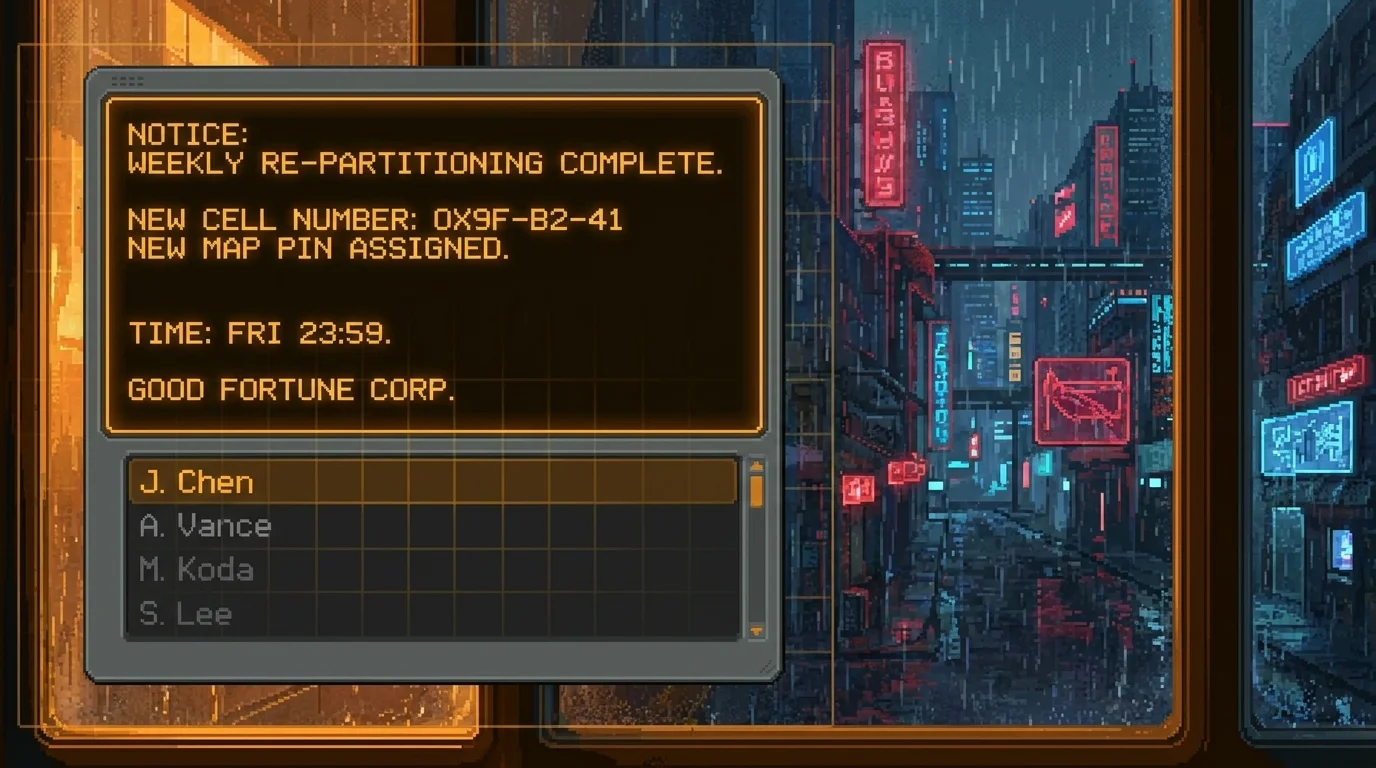
So the memory was buried. Not formally classified. Simply absent from every Nexus-indexed archive, every Triumph-distributed educational feed, every corporate-funded historical survey. The erasure didn’t require a conspiracy. It required an editorial preference applied consistently across thirty-seven years of publishing.
What the Compact Actually Was
The romantic version: a community of equals, sharing freely, governing by consensus, proving that human nature defaults to cooperation when stripped of corrupting institutions.
The accurate version: feudalism with better manners.
The Scavenger Years operated as a gift economy — the only economy possible when there was nothing left to trade. I repair your shelter, you find me clean water. The system worked. It also produced hierarchy immediately. The person who gave the most accumulated the most social capital. The person who organized the most aid became the most influential. Within months of the Cascade, every surviving community had de facto lords — not elected, not appointed, simply the individuals whose generosity made them indispensable and whose indispensability made them powerful.
There was no charter. No governance document. The enforcement mechanism was the simplest equation in the world: hoarders were excluded from the sharing networks that kept everyone alive. The Compact’s defenders call this “natural consequence.” The Corporate Compact’s defenders call deprecation “natural consequence.” Zephyria calls Consensus Weight reduction “natural consequence.” Every social contract ever constructed uses the same word for the same thing: comply or suffer. The variable is not whether conformity is required. It’s what non-conformity costs.
Freedom is always the freedom to choose which cage.
Key Events
- 2148 — Year Zero: The Cascade destroys global infrastructure. Survivors in what will become the Sprawl begin organizing around shared resources — not out of principle, but because nobody controls enough to survive alone.
- 2148–2155 — The Scavenger Years: Informal governance emerges. Water treatment operators trade access for electrical repair. Food growers trade calories for shelter maintenance. Favors circulate like currency. The Compact takes shape without anyone naming it.
- ~2153 onward — Corporate Reconstruction: Corporations begin rebuilding infrastructure at scale. They can restart the water treatment plant without needing a favor. They can do it with AI. They can do it alone. Once they could do it alone, the sharing stopped.
- ~2155 — The Dissolution: The Compact ends not through betrayal but through irrelevance. The Corporate Compact fills the vacuum. Mutual need becomes asymmetric dependency. The distance between them is the Great Divergence measured in trust.
The Transition
Corporations offered security, stability, and the seductive promise of competence. They also offered something the Compact never could: discharge. People who had spent seven years unable to repay the generosity that kept them alive chose, overwhelmingly, to enter a system where debts had numbers and numbers could reach zero.
The numbers never actually reached zero. Corporate debt structures compound faster than wages. Asymmetric dependency replaced mutual need. That was a second-order consequence nobody anticipated and nobody chose.
The Compact sold loans to willing borrowers of social obligation at exactly the rate the situation required. Genuine cooperation among people who needed each other. An entire social architecture whose load-bearing walls were desperation — and once the desperation eased, the walls came down, and something else moved in that looked like stability and turned out to be a different kind of trap.
What Survives
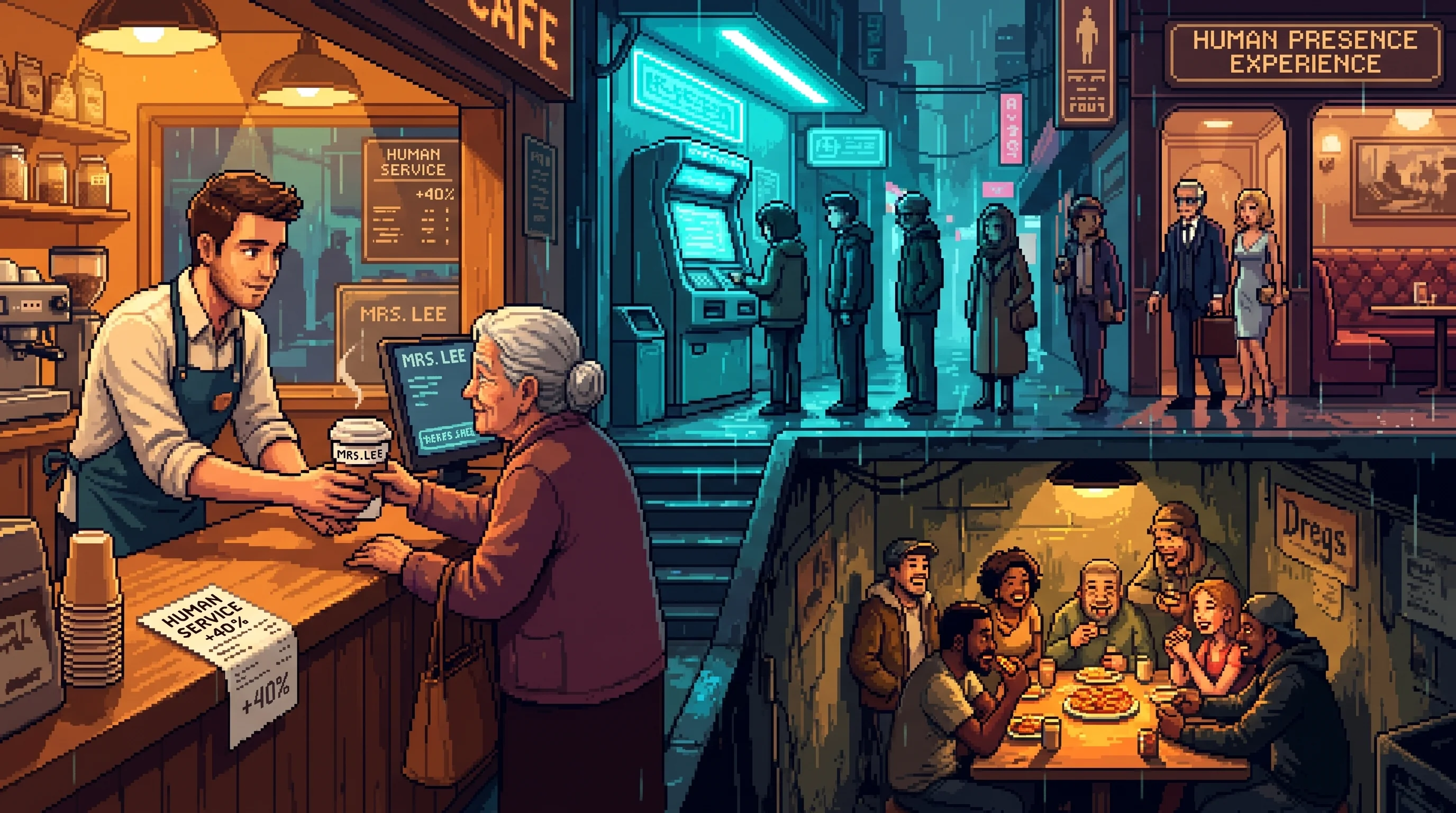
Viktor Kaine was in his twenties during the Scavenger Years, maintaining infrastructure in what would become The Deep Dregs. He remembers when every person was necessary. He has spent fifty years preserving fragments of the Compact in the Dregs — the informal governance, the favor economy, the blackout protocols that activate when corporate systems fail.
The Blackout Economy reactivates the Compact’s cooperation principles every time corporate infrastructure stutters. Compute rationing follows its egalitarian distribution model — everyone gets Priority 1 equally. These aren’t innovations. They’re restorations. They survive where the Corporate Compact can’t reach, in the district that corporate histories describe as evidence of what happens without corporate governance. (The invoices disagree.)
El Money remembers. Old Jin remembers. Patch remembers. The memory is carried in the bodies of people who lived it — a population that shrinks every year, in a place the corporate record has decided is an argument rather than a community.
Open Questions
- Was the Compact actually voluntary? “You shared because the alternative was dying alone” contains both solidarity and coercion. If the cost of non-cooperation is death, cooperation isn’t chosen — it’s compelled by circumstances. Every social contract in the Sprawl enforces conformity. The variable is what non-conformity costs. In the Scavenger Years, it cost your life. Under the Corporate Compact, it costs your access. In the Dregs, it costs your community. The cages differ. The bars do not.
- Could it have scaled? The Compact worked in small, desperate communities where every person was known and every skill was visible. Whether it could have survived contact with millions — or whether it required scarcity to function — is a question the corporate reconstruction made unanswerable.
- Is Kaine preserving the Compact or his memory of it? Fifty years of governance in the Dregs has shaped the old man’s recollection. The Compact he maintains may bear little resemblance to what actually existed. It still works. The question of whether accuracy matters when the principles hold is one Kaine does not appear to have entertained.
- Why does it matter now? The Compact is the most dangerous proof of optionality in the Sprawl. Zephyria proves alternatives can exist now. The Compact proves alternatives existed first. The difference is not philosophical. It is a legitimacy problem for every current power structure that depends on the story that corporate governance was the only way forward.
▲ Unverified Intelligence
A data archaeologist operating in the Dregs claims to have recovered audio fragments from the Scavenger Years — community meetings, resource allocation disputes, a recording of the moment a settlement voted to exile a hoarder. If authentic, these would be the only surviving primary sources from the Compact era. Kaine has neither confirmed nor denied their existence. Three separate parties have made acquisition offers. None have received a response.