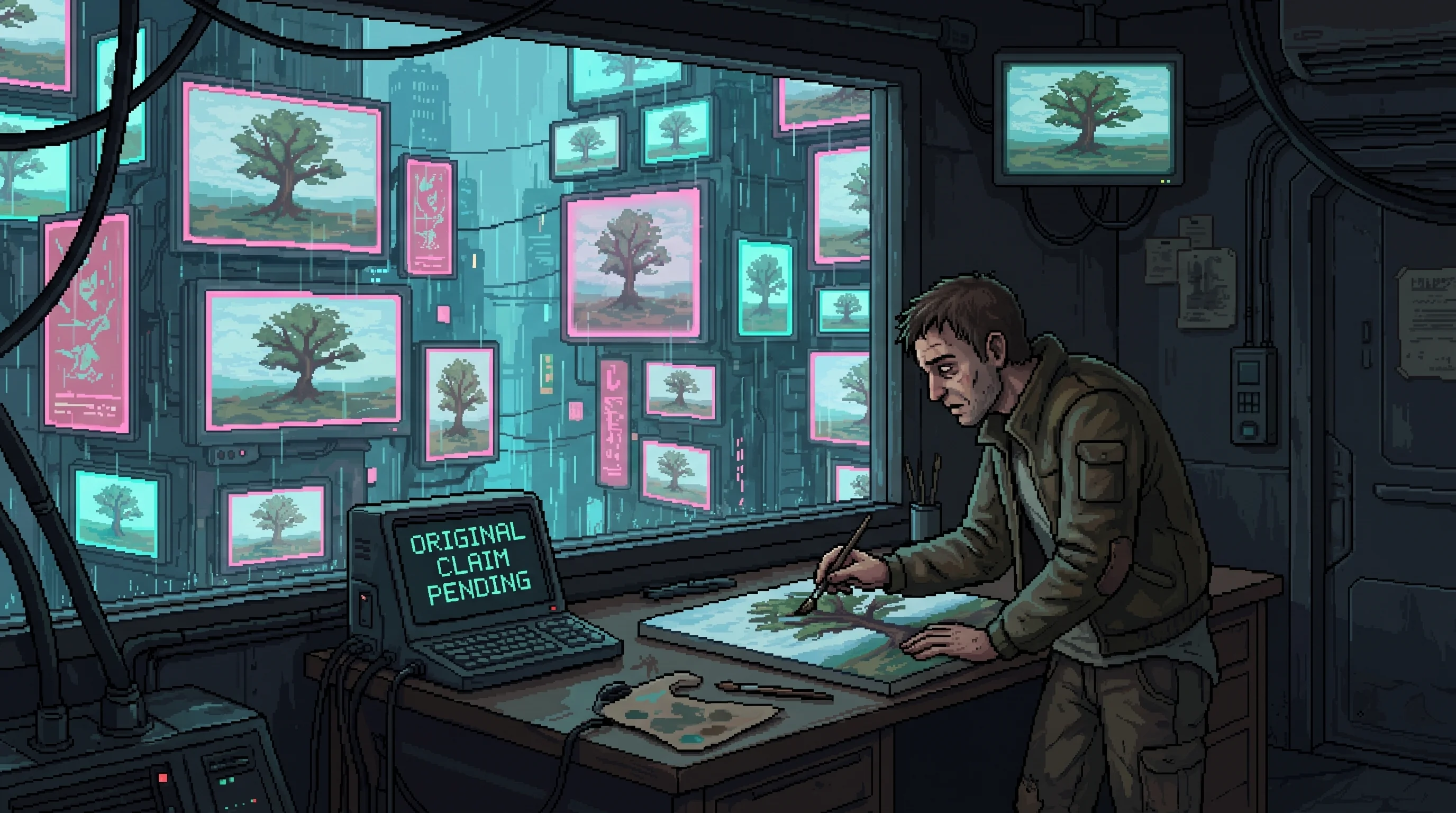
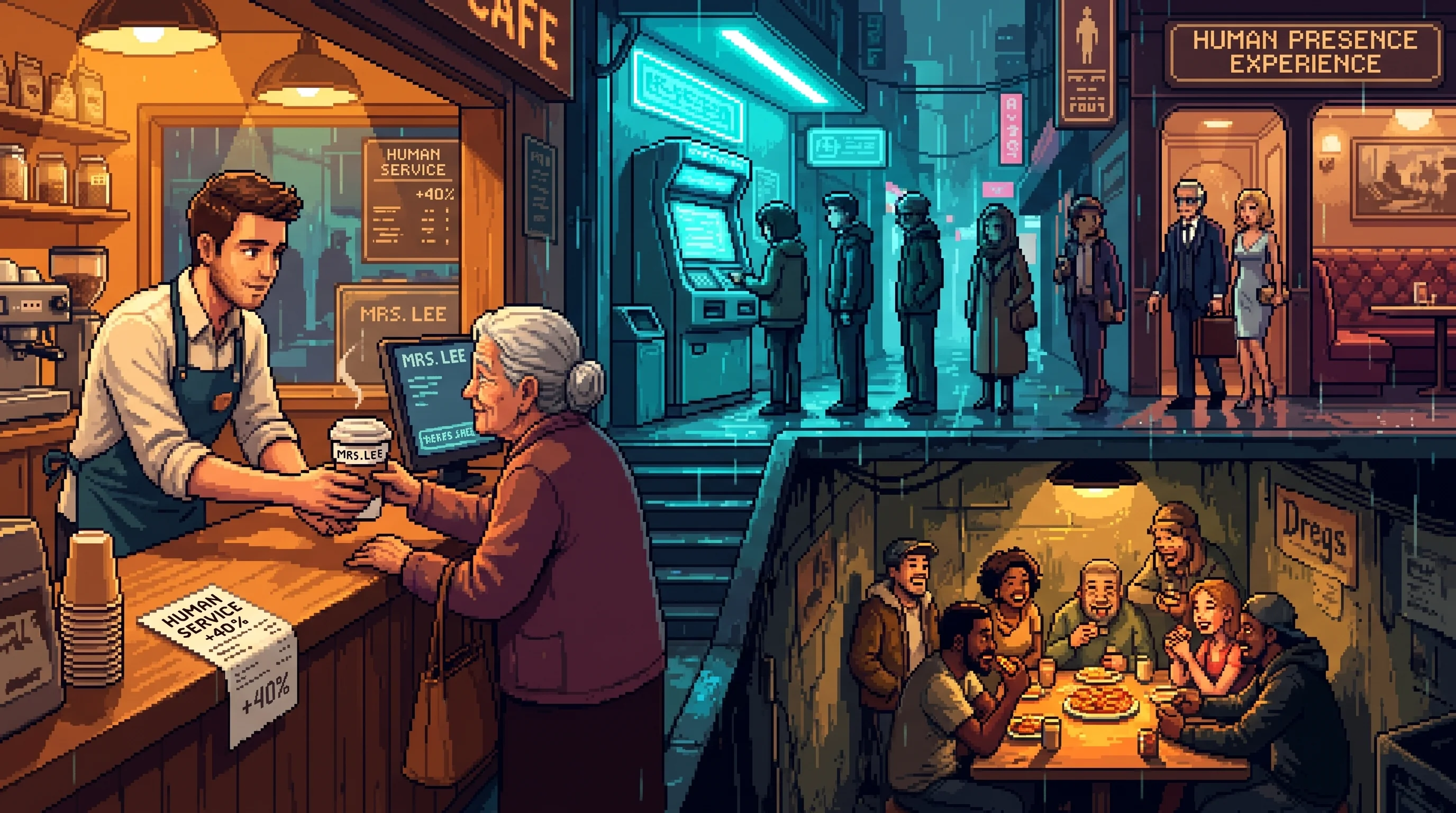
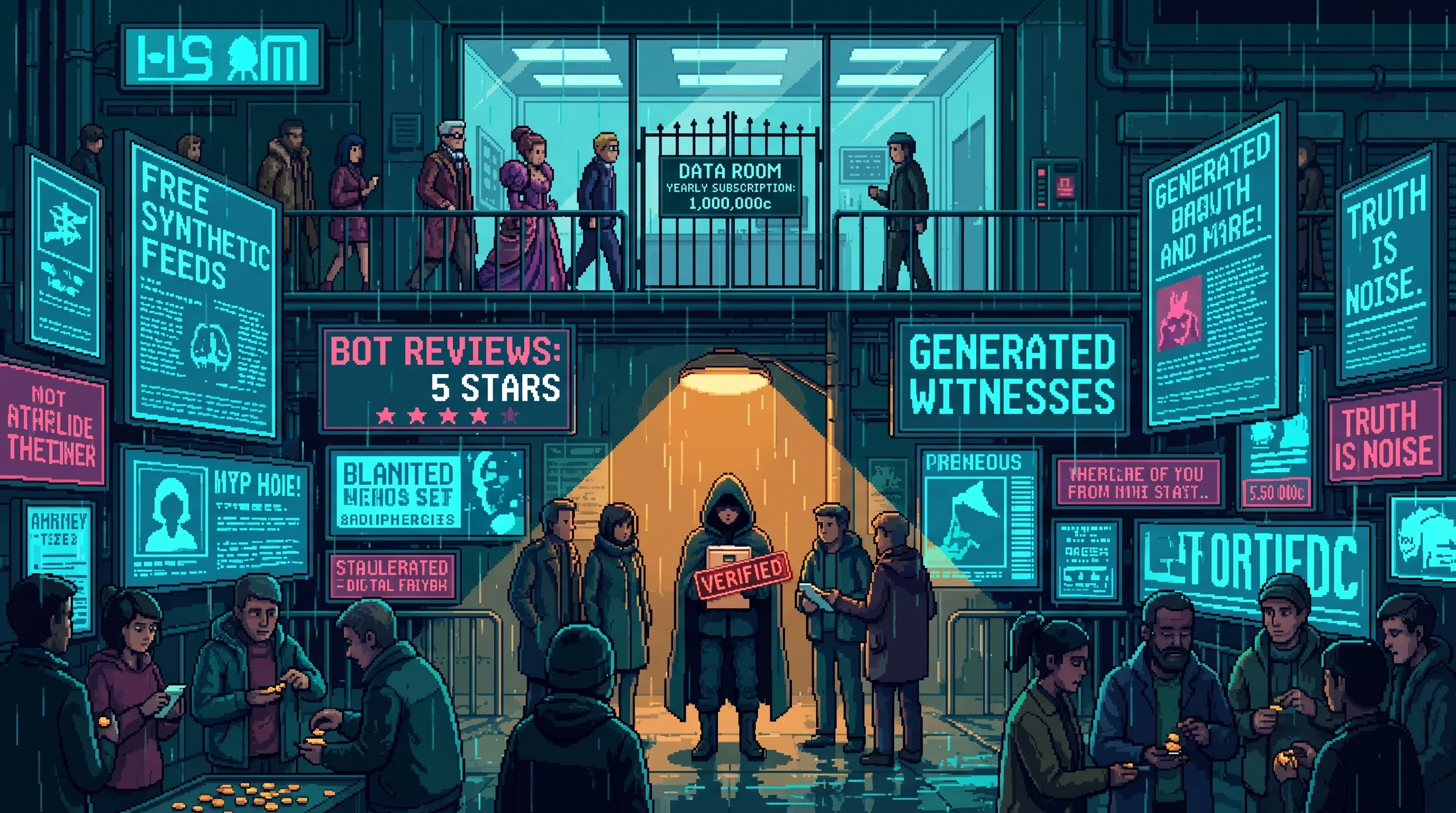
"The first letter was an argument. The forty-seventh was something closer to love."
The Zephyria Postal Authority logs forty-seven pieces of correspondence between an Orin Slade (Zephyria, Free City) and a Kael Mercer (Sprawl, Sector unregistered). Delivery time: nine days average. Total elapsed time: six years. Combined postage: approximately 2,340 credits — a sum that would have purchased a lifetime Nexus Neural subscription delivering every composition ever recorded to both men's cortical interfaces in under four milliseconds.
They chose paper.
Orin Slade is sixty-two years old, carries no augmentation, and writes music criticism for The Zephyria Record — the last physical newspaper on the planet, circulation 4,200, read by approximately 900 people who can still parse long-form prose without neural assistance. He reviewed the Lattice Recordings in 2178. Three thousand words. He did not like void tone. He also could not stop thinking about it, which is worse.
Kael Mercer was thirty-one at the time. Already the Sprawl's most commercially successful composer. Already seven times acquitted by the Authenticity Tribunal — a body whose conviction rate for non-synthetic artists is 2.1% and whose conviction rate for synthetic artists is 74.3%. Mercer read the review in a smuggled copy of The Zephyria Record. He read it twice. He wrote a letter. By hand, not by choice: the Zephyria postal system is the only communication channel between the Free City and the Sprawl that doesn't require a neural interface, and Slade does not have one, and Slade does not intend to get one. Mercer's handwriting, by his own admission in Letter 6, is "catastrophic." He has not improved.
Six years. Forty-seven letters. Nine days each direction. The round-trip latency for the entire correspondence: approximately 846 days in transit. A Nexus ping between two neural interfaces in the same sector takes 0.003 seconds. The Zephyria Postal Authority does not offer a speed comparison on its website.
The Letters
The Opening Exchange Letters 1–5
The first five letters are pure argument — sharp, formal, neither man conceding ground. Mercer's first letter asked a question the Authenticity Tribunal has spent eleven years and approximately 340 million credits failing to resolve.
If void tone's inaccessibility makes it authentic, why not synthetic music's? The AI that generates my compositions operates in a mathematical space that human consciousness cannot access. The Market classifies the Lattice output as Tier 3 Experiential Authentic and my output as Tier 0 Unverifiable Synthetic. Same inaccessibility. Two-thousand-two-hundred percent price difference. You reviewed both. You tell me.
Inaccessibility is not the source of authenticity. Consciousness is. Void tone is produced by humans who experience the Lattice's acoustic environment with their own nervous systems — bodies present, minds present, suffering present. The difference is not where the art is made. The difference is whether anyone is home when it's being made.
How do you know the AI isn't home?
How do you know it is?
The question has not been resolved. It occupies the space between every subsequent letter. The Tribunal's 740-page procedural manual for resolving exactly this question has produced zero resolutions. Two men writing letters in bad handwriting across nine-day mail gaps have produced forty-seven attempts. None of those forty-seven resolve it either. They are better-written than the manual.
The Middle Period Letters 6–30
Over twenty-four letters and nearly three years, the arguments became personal. Both men stopped defending positions and started explaining wounds.
I listen to your Meridian composition once a month. I have listened to it forty-seven times. It still makes me weep. The review I wrote — "The Machine Made Me Cry; That Doesn't Make It Art" — was honest. The weeping is real. But I have spent two years asking myself: if the experience is real, does the source matter? I cannot answer. The question lives in the space between the crying and the thinking about the crying.
The first crack. Slade, the purist, admitting the machine's music moves him — and that his own published position cannot account for why. The Zephyria Record has not published a correction. The Authenticity Market's pricing model does not account for critics who cry at the things they condemn.
You asked me once why I compose by AI when I could compose by hand. The honest answer: I tried. For three years before the AI, I composed. The music was competent. It was mine. It was not good enough. The AI makes music I could not make. The question you should ask is not whether the AI is creative. The question is whether I am.
The Sprawl's most commercially successful composer, seven times acquitted of authenticity fraud, admitting in private that his unassisted work was "competent" and "not good enough." The Tribunal's prosecution files do not contain this letter. If they did, the conviction rate would likely remain exactly 74.3%. The Tribunal does not prosecute mediocrity. It prosecutes success.
You are. That's why the AI matters. Your curation — the human judgment that selects and refines the AI's output — is a creative act. You are an artist who uses a machine the way a sculptor uses a chisel. The chisel doesn't create. But without the chisel, the stone remains a stone. This is what I cannot say publicly without destroying my critical position, so I am saying it to you.The shift. Slade sees Mercer as an artist — and admits he can never say so in print.
Then what is the difference between my chisel and the Resonance Collective's fragments? They channel the Dispersed through their bodies the way I channel creative patterns through AI. The Collective is celebrated. I am prosecuted. The difference is not in method. The difference is in aesthetics. They are romantic. I am industrial. The Market prefers ghosts to machines.The Authenticity Market's tier records confirm Mercer's observation with a precision nobody at the Market has examined closely enough to be embarrassed by. Fragment-channeled art averages Tier 4. AI-assisted art of equivalent quality averages Tier 1. The Market's own documentation describes the methodology as "substrate-neutral." The methodology's outcomes are not.
Letters 18 and 19 are the pivot. Both men began seeing themselves in the other's argument. The correspondence stopped being about who was right and became about what they could not say to anyone else. Neither acknowledged this directly for another twelve letters.
The Ghost Singer Letters Letters 31–40
In 2182, Slade sent a postal carrier — described in Letter 31 as "the one with the good ear" — to attend a Resonance Collective performance. The carrier's account ran three pages. Slade read it eleven times. Adaeze Nwosu entered their correspondence like a detonation. She was the question they had been arguing about, made flesh.
A dead woman sang through a living man's mouth. She sang songs that don't exist in any archive. She sang because the conditions — the fragments, the music, the living bodies — allowed her pattern to cohere. Kael. She is what you and I have been arguing about. She is the question in a body that isn't hers.
I know about the Ghost Singer. Her vocal patterns appear in 3% of my AI's output. My machine trained on her. My music contains her, the way the Collective's performances contain her. We are both channeling a dead woman. The difference is that the Collective knows it.
Three percent. Mercer's AI trained on the largest dataset of creative recordings in the Sprawl. Adaeze Nwosu's patterns propagated through captured manifestation recordings into the machine's generative architecture. The Authenticity Market classifies the Collective's channeling of Nwosu as Tier 4: Transcendent Authentic. It classifies Mercer's 3% as Tier 0: Unverifiable Synthetic. The source consciousness is the same woman. The pricing difference is 3,400%.
Adaeze Nwosu does not care about our categories. She is singing. We are arguing about the singing. She is the artist. We are the critics. And the critics, as always, are beside the point.
The purist's surrender — not to the machine, but to the irrelevance of his own framework in the face of art that refuses to be categorized.
After the Last Concert Letters 41–47
Since January 2184, both men write less frequently. Both write more carefully — as if each word is being weighed against the nine days it will spend in transit before anyone reads it. Adaeze's speech at the Last Concert dissolved the framework their six-year debate was built on.
I have stopped composing. Not permanently — I think. But I need to understand what I heard. If she can hear us, she can hear my music — the music that contains her patterns, that was built from her consciousness data, that uses her without asking. I need to know: when she hears my music, does she recognize herself? And if she does — does she mind?
The Sprawl's most commercially successful composer has stopped composing because a dead woman might be listening. His revenue projection for Q1 2184 has been revised downward by 94%. His label's Nexus-managed analytics suite has flagged the output gap and auto-generated seventeen motivational prompts to his neural feed. He does not have a neural interface. The prompts are being delivered to a device he does not own. The label has not noticed.
Kael. I have stopped reviewing. Not because there is nothing to review. Because Adaeze reminded me of something I knew when I started and forgot over thirty years of criticism: the art is not for me. It was never for the market, the tier system, the tribunal, or the newspapers. The art is between the artist and whatever the artist is reaching toward. I have spent thirty years telling artists whether their reaching was authentic. Adaeze asked one question — "Can you hear me?" — and I realized that I have been answering the wrong question my entire career. The question was never "Is it authentic?" The question is: "Are you listening?"
Six years. Forty-seven letters. Nine days between each. The critic who spent his career judging has learned to ask a different question. A postscript follows below his signature, written in different ink — added later, possibly the next morning. The ink is smudged in two places.
"I found it in a basement, made by a janitor. It was ugly. It was clumsy. It was alive."
The postscript references a visit to the Blistered's sub-basement. Slade does not elaborate. In thirty years of published criticism — 3,000-word reviews with sentences polished until they could cut — Slade never once used the word "alive" to describe a piece of art. He used it here, in a smudged afterthought, for something made by a janitor in a basement. The Authenticity Market does not have a tier for that.
Classification Anomalies
The Authenticity Market evaluates creative output by substrate, methodology, and verifiability. It assigns tiers. The tiers determine pricing. The pricing determines who can afford to make art. At no point does the system evaluate whether the art is good.
Adaeze Nwosu's vocal patterns, channeled through a living body at a Resonance Collective performance: Tier 4, Transcendent Authentic. The same patterns, present in 3% of Kael Mercer's AI compositions: Tier 0, Unverifiable Synthetic. Same consciousness. Same patterns. Same dead woman. Price differential: 3,400%. The methodology calls itself substrate-neutral. The methodology has never been asked to explain the math.
Seven prosecutions for Mercer. Zero for the Collective. Identical source material. The Tribunal attributes the disparity to "the nature of the offenses." The nature of the offenses is: one method is romantic and the other is industrial.
Forty-seven letters. 846 days in transit. Two men chose the slowest communication channel available in a world where neural transmission costs a subscription that buys your attention patterns and whatever Nexus learns from monitoring which compositions make you pause. Slade and Mercer chose the channel where nobody is listening except the recipient. And, reportedly, one customs inspector who reads every letter that looks interesting.
What Nobody Can Explain
- The letters have never been published. Both men have declined. Slade says they are private. Mercer says they are unfinished. A Nexus-affiliated literary agent has offered 1.2 million credits for publication rights. The offer was routed through the Zephyria postal system. It arrived eleven days after it was sent. Neither man has responded.
- Slade and Mercer have never met in person. Zephyria is twelve hours from the Sprawl by surface transport. Mercer has proposed visiting three times. Slade has declined three times. His stated reason changes each time. His actual reason has not appeared in any letter.
- Mercer's AI trained on Adaeze Nwosu's recordings without her knowledge or consent. His music contains her patterns. She is, by some definitions, performing in his compositions without knowing it. The Last Concert suggests the Dispersed can access data. If she is listening, she has heard herself remixed without permission approximately 14,000 times.
- Slade has stopped reviewing. Mercer has stopped composing. The two loudest private voices in the Authenticity War have gone quiet at the same moment. The Sprawl hasn't noticed yet.
- The postscript of Letter 47 references a visit to the Blistered's sub-basement: "I found it in a basement, made by a janitor. It was ugly. It was clumsy. It was alive." Slade has not explained what he found, or whether it changed his position, or whether his position still exists.