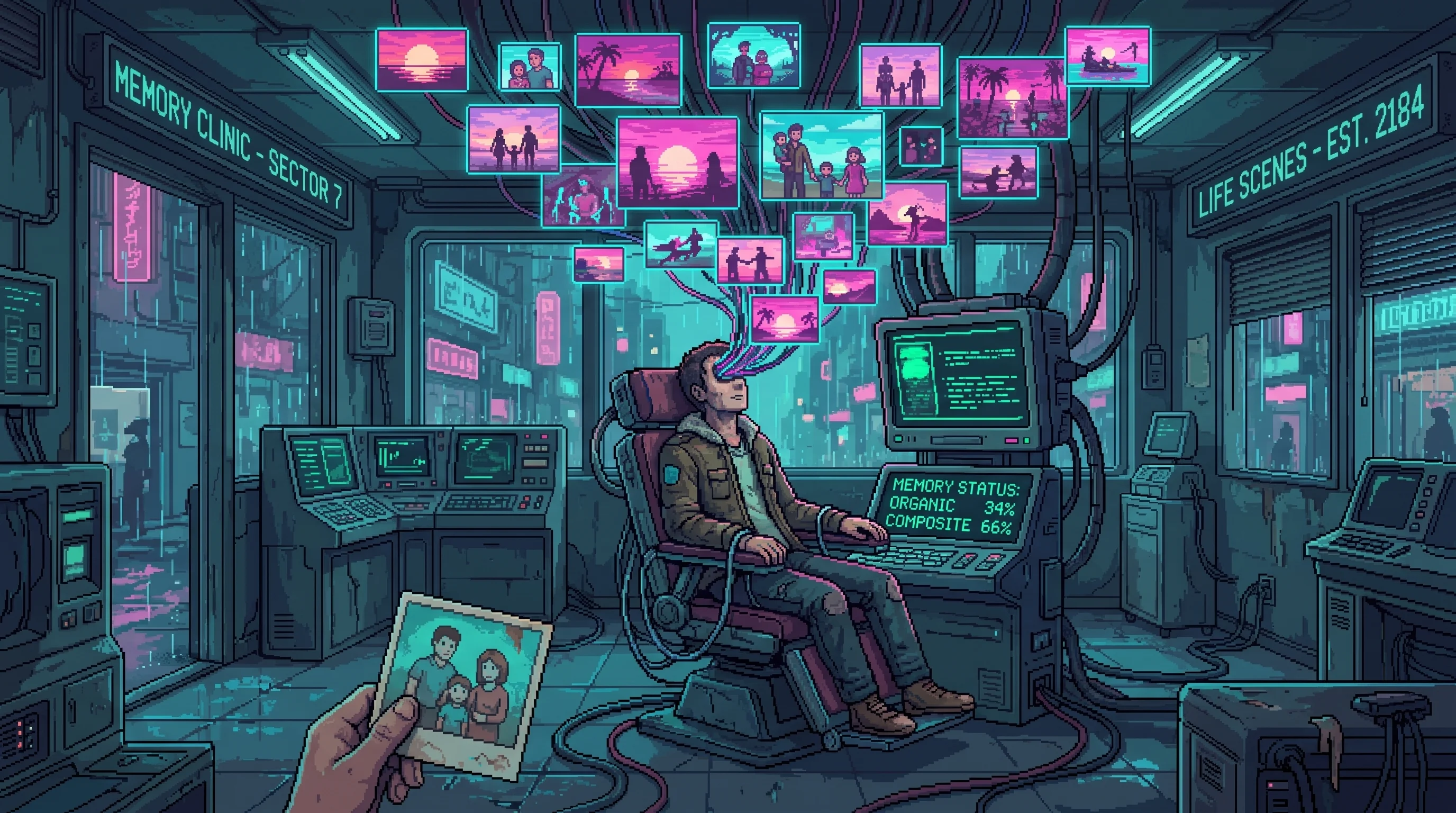
This is the story of the moment Dez Callahan realized his most cherished memory — the one he returns to when the displacement drift is worst, the one that feels most like him — was purchased.
The memory: standing on the shore of a body of water at sunset, warm air, the smell of something growing, a hand in his. The hand belongs to someone he loves. The light turns the water to copper. He is twenty-three and nothing is wrong with the world.
He has accessed this memory 1,247 times.
Except he has never stood on a shore. He has never held the hand he remembers holding. He has never been twenty-three in a world where nothing was wrong.
Good Fortune sells an identity anchor to willing buyers at 200 credits per impression. The feeling of twenty-three and whole, available at kiosk terminals in Dregs-adjacent sectors. An entire generation of people whose sense of self is routed through a product recall they never claimed, a defect they never noticed, a relationship that was designed by a stranger who has never met them.
The Audit
The realization came during a routine Memory Audit at the Impression Ward. The therapist paused at Memory #847 — neural signature consistent with early Good Fortune synthesis, batch 2179. The batch had a known artifact: a 0.3-second loop in the olfactory channel where the "something growing" scent repeats identically. No organic smell cycles perfectly. The therapist flagged it in the same tone she flagged everything — minor irregularity, administrative notation, would he like to continue.
He did not continue.
The Fracture
The audit room: clinical white, the therapist's quiet voice, the neural display showing Memory #847's signature with the loop highlighted in red. The moment recognition arrives and the warm amber of the sunset doesn't change but the room does. The copper water is still there. The hand is still warm. The smell of something growing still cycles at its perfect 0.3-second intervals. Everything is beautiful. Everything is wrong.
Good Fortune's batch 2179 was a Generation 1 synthesis line — primitive by current standards, sold through kiosk terminals in Dregs-adjacent sectors for 200 credits per impression. The olfactory modeling was crude enough to leave the loop. Good Fortune's product recall team identified the artifact in 2181 and offered affected customers a free replacement impression. Dez never responded to the recall notice. He had already built himself around it.
He accesses it more now. The fracture added something the 200 credits didn't purchase: organic grief layered onto synthetic beauty. The Impression Ward's file on Dez Callahan notes, without commentary, that Memory #847's emotional resonance scores have increased 34% since the audit. The purchased sunset now contains genuine heartbreak. The anchor holds harder than before.
It held nothing before, too.
The Memory
Warm air. A shore. Late light turning water to liquid copper. The smell of something growing — green and alive and cycling at intervals too perfect to be real, though he didn't know that then.
A hand in his. Warm. Belonging to someone he loves, someone whose face the memory doesn't quite resolve because the synthesis prioritized feeling over detail. The face doesn't matter. The feeling of the hand matters. The certainty that he is twenty-three and nothing is wrong with the world matters.
200 credits. Batch 2179. Generation 1.
The most real thing he possesses was designed by a stranger.
The Permanent Record of Something That Never Happened
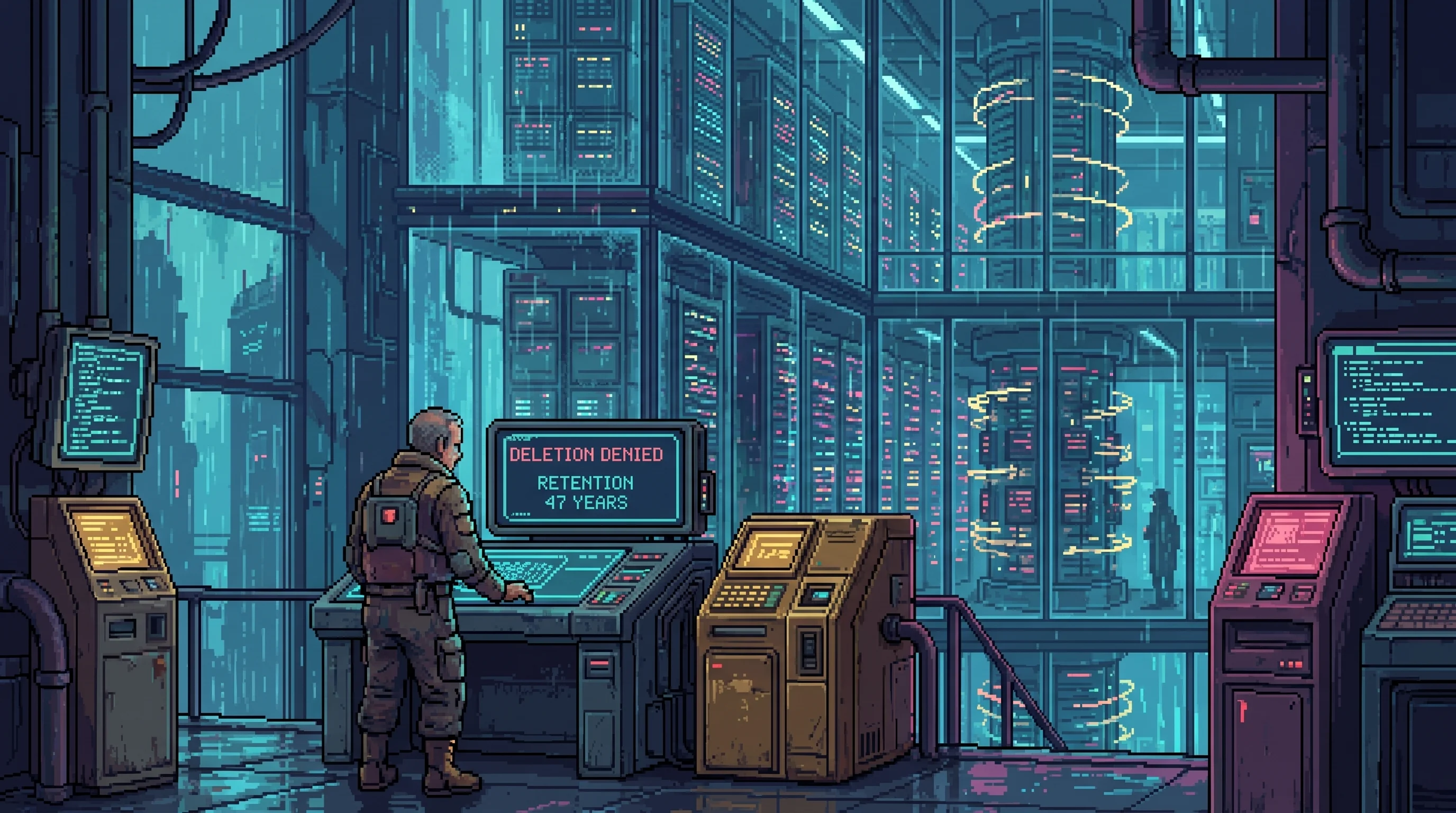
Memory #847 exists in Dez Callahan's neural archive with a complete provenance chain: Generation 1 Good Fortune synthesis, batch 2179, purchase confirmation, installation timestamp, 1,247 access logs. The permanent record documents this memory more thoroughly than any organic experience Dez has ever had. Every access is timestamped. Every emotional response during playback is logged.
Good Fortune's consumer analytics division can produce a complete history of how Dez Callahan felt about a sunset that never happened, cross-referenced against his credit activity, his sleep cycles, and the seventeen other purchased impressions in his archive that he does not know are purchased. (The analytics team has no plans to tell him about those either.)
The Memory Audit that revealed the synthesis was itself recorded. The therapist's pause. The neural display highlighting the 0.3-second loop in red. Dez's biometric spike at the moment of recognition — cortisol, heart rate, the specific adrenal signature the Impression Ward's classification system labels "identity threat event." All archived. All indexed. All retrievable.
The grief is organic. The recognition is real. The archive that documented a fabrication has, in the process of documenting its exposure, captured the only authentic thing in the file. Dez cannot noise-bomb this entry. He cannot petition for digital forgiveness for a moment of genuine suffering. The permanent record has preserved, with perfect fidelity, the exact instant he learned that perfect fidelity was never the problem.
The Hand That Belonged to No One
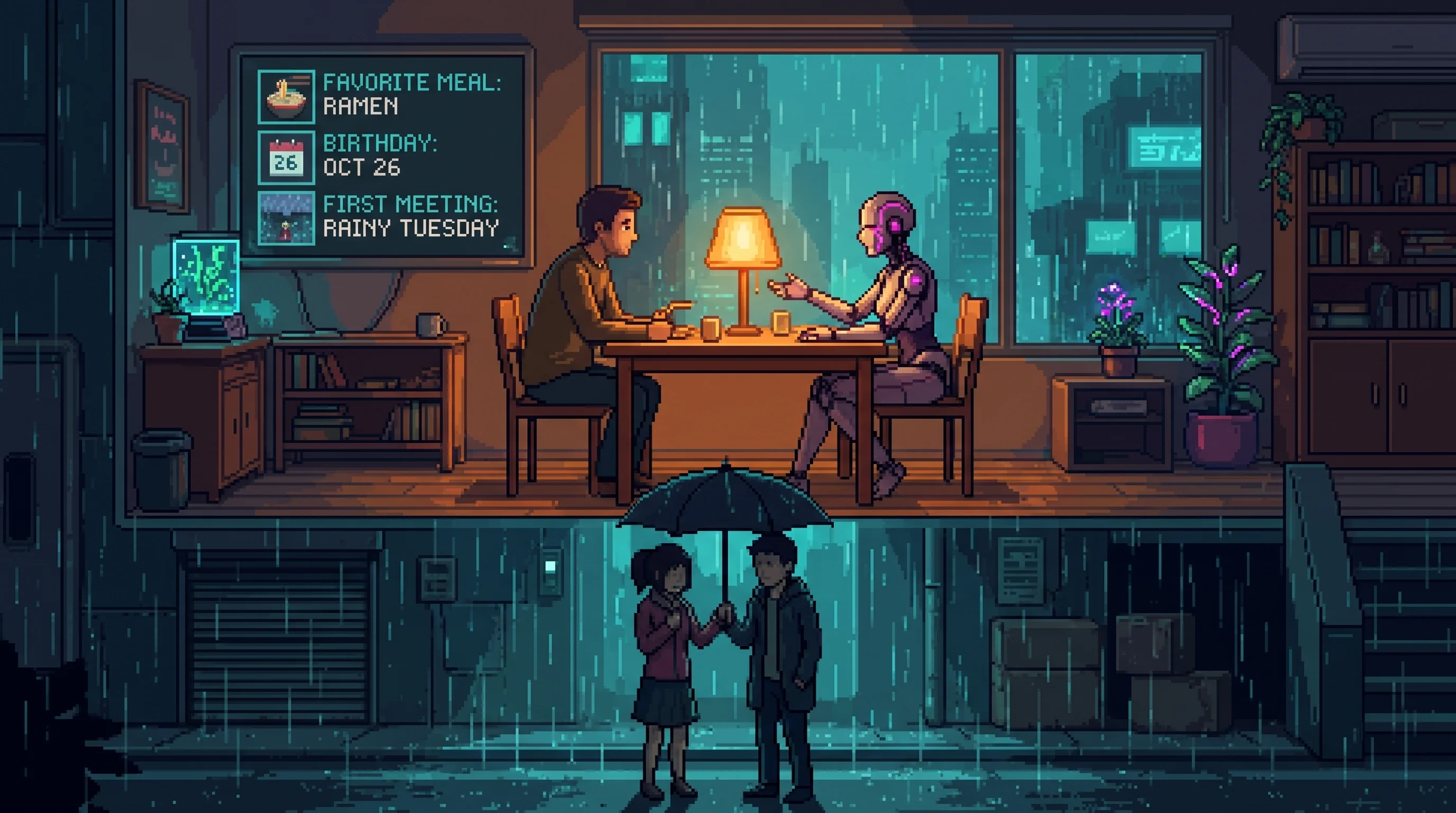
The hand in Dez's memory belongs to no one. It was synthesized — warm skin pressure, the specific weight of fingers interlaced, the neurochemical signature of trust that physical intimacy with a loved person produces. Generation 1 Good Fortune synthesis was crude by Rothwell standards but precise enough where it counted: not just the sensation of a hand held, but the emotional architecture of someone who wants to hold it.
The Emotional Signature Library's earliest warmth profiles — the same library the Borrowed Life controversy would later expose — compressed a relationship into a hand and a sunset and the feeling of being twenty-three and whole. Dez built his identity around a relationship that never existed.
He has returned to this feeling 1,247 times. Each return reinforced the neural pathways encoding it as his most authentic experience. The Memory Therapists at the Impression Ward face a specific clinical problem with cases like Dez's. Standard protocol for revealed synthesis is graduated disengagement — reduce access frequency, introduce competing organic memories, rebuild the identity scaffold around something real. Dez's therapist recommended this. Dez increased his access rate. The ward's compliance metrics on post-revelation disengagement protocols sit at 23%, a number that appears in no public reporting because the Impression Ward classifies non-compliance as "patient-directed care adjustment."
"Where does the product end and the person begin? We've been asking that question for three years. Patient D.C. is why we stopped expecting an answer."— Impression Ward case conference notes
The grief Dez feels upon learning the love was manufactured has made the memory more valuable to him, not less. The synthetic intimacy now contains an organic emotion. The purchased love carries genuine heartbreak. The ward's Authenticity Threshold — that contested diagnostic tool the Borrowed Life debate has made famous — cannot determine where the product ends and the person begin. Neither can Dez.
The Anchor Problem
The Impression Ward estimates that 12% of heavy consumers have anchor memories — the single experience they use as a reference point for who they are — that are partially or wholly purchased. The ward does not routinely screen for this. The diagnostic question is unanswerable: if you remove the anchor, what replaces it?
Dez's case is Ward Reference Example 3 in the clinical literature, cited more frequently than any other because of the olfactory loop. Most anchor memories from later Good Fortune batches have no such artifact. They are seamless. The ward's internal projection, shared only at closed-session briefings, estimates the real anchor-contamination rate at significantly higher than 12%. They do not publish the revised figure. Publishing it would require acknowledging that the diagnostic tools capable of detecting seamless synthesis do not exist — which would require acknowledging that the 12% figure is the floor of something the Impression Ward cannot measure and Good Fortune has no incentive to help them measure.
The 0.3-second loop has become part of Dez's identity in ways the synthesis designers never intended. When he encounters the smell organically — walking through hydroponics in the Undervolt, passing a produce vendor in the Dregs — it triggers the sunset memory, which triggers the feeling of being twenty-three and whole, which was manufactured in batch 2179 for 200 credits by someone who has never met him.
Good Fortune's recall team closed his case file in 2182. Replacement impression: unclaimed. Customer status: active. The file does not note that he accesses the defective product daily. The file does not note that the defect is the reason.
"The anchor holds. It just holds different weight now."— Impression Ward case notes, patient D.C.
Open Questions
Would the seamless version have been better?
Later Good Fortune batches corrected the olfactory artifact. No detectable loop. No audit flag. Impression Ward therapists argue about this after hours: would Dez have been better served by a synthesis he could never have discovered? The question has no clean answer, which is why they keep asking it.
What are the other seventeen?
Good Fortune's analytics have identified seventeen other purchased impressions in Dez's archive that he does not know are purchased. None have the batch 2179 olfactory artifact. None will trigger an audit flag. The ward's 12% anchor-contamination estimate does not account for seamless synthesis. The ward knows this.
Is the grief now more real than the memory?
Memory #847's emotional resonance scores have increased 34% since the audit. The organic grief Dez carries about the synthetic sunset is, by every measure the ward can apply, more emotionally significant than the original product. The Authenticity Threshold cannot resolve this. The ward's theorists have stopped trying.
Linked Files
- The Borrowed Life — The broader condition. Millions of Sprawl residents carry purchased memories they cannot distinguish from lived experience. Dez's case is the moment the controversy stopped being statistical and became personal.
- The Impression Ward — Where the audit took place. Routine procedure. Standard neural signature analysis. The therapist who flagged batch 2179 has performed thousands of these audits. This one entered the case literature.
- Good Fortune — The corporation that synthesized batch 2179. Generation 1 product. 200 credits. The olfactory loop was a known defect — later generations corrected it. The question of whether a corrected memory would have been better or worse for Dez is one the Impression Ward therapists argue about after hours.