FACTION BRIEF
The Tether Monks

The Tether Monks

5 Tether-monitoring engineers who independently developed the practice of speaking to the Tether during maintenance

LocationTether-Highport junction monitoring station

Overview

Where the 's tether meets 's docking clamps โ€” the point of maximum structural stress on the largest engineering project in human history โ€” five engineers have developed the habit of talking to it.

Not to each other. To the carbon nanotube structure itself. They narrate their work aloud during maintenance: what they're tightening, what they're checking, what they expect to find. They have been doing this independently, across six years, without coordinating. Engineer Yuen started first. Engineer Pak started third and didn't learn about the others until a break room conversation fourteen months in.

They report that the Tether's harmonic profile stabilizes during spoken maintenance โ€” vibration patterns smoothing, stress indicators falling into more predictable ranges. Ironclad's monitoring suite does not corroborate this. Standard instruments show no statistically significant deviation between spoken and silent maintenance windows. Five engineers with a combined 94 years of junction experience report it consistently. The instruments are, technically, correct. The engineers are, technically, outnumbered by the instruments. They do not seem troubled by this.

They named themselves after the , who maintain -era power infrastructure in the and make the same claim: attentive maintenance produces better outcomes. have been making this claim for decades. Nobody has proven them wrong. Nobody has proven them right. The Tether Monks find this encouraging.

The Indispensability Contract

The five engineers maintain the junction point whose failure would kill approximately 340,000 people on . Their Ironclad service contracts specify "voluntary continued assignment." The contracts also specify that departure requires a replacement trained to equivalent calibration with the junction's harmonic signature. This training takes, by 's own estimate, between four and seven years of direct contact with the Tether's vibrational profile.

No replacement trainees are currently assigned. Ironclad's Highport staffing budget for FY2184 allocates zero positions for junction succession training. The request has been filed annually for three years. It has been marked "under review" each time. The review committee meets biannually. Its last meeting was postponed.

The engineers cannot leave. They cannot strike, because withholding maintenance at the junction point is structurally indistinguishable from sabotage โ€” a capital offense under the . They cannot be fired, because 's liability exposure for an untrained replacement exceeds the station's insured value. They exist in a contractual state that is voluntary in the same way breathing is voluntary: the alternative is available and no one selects it.

So they talk to the Tether. They meet Wednesdays at 0600 in the monitoring station's break room, drink coffee from the same five mugs โ€” labeled by harmonic frequency band, not name โ€” and discuss vibration patterns the way other people discuss weather. They are the smallest faction in the Sprawl. They have no manifesto, no recruitment strategy, no political ambitions. Their membership has been five for three years. It will remain five until approves a training budget or the Tether kills them, whichever arrives first.

Case File โ€” Additional Record
TypeInformal contemplative group among Tether monitoring engineers
Membership5
PracticeSpoken maintenance โ€” verbally addressing the Tether during care
ClaimTether harmonics stabilize during spoken maintenance
ParallelNamed after the Circuit Monks who maintain ORACLE infrastructure in the Undervolt

The Material Question

The Tether's carbon nanotube filament was manufactured in -designed facilities using -designed molecular assembly processes. The material predates the . It is not biological. It is not electronic. It is, by every available definition, inert.

maintain -era power systems in the and report similar responsiveness to spoken maintenance. maintain infrastructure in the gaps between corporate territories with a quality of attention their engineers describe in terms that sound, to outside observers, uncomfortably like prayer. asks whether care delivered through technology constitutes genuine communion. The Tether Monks don't engage with the theology. They file their harmonic logs, drink their Wednesday coffee, and note that the numbers look better when someone's talking. The sacred infrastructure phenomenon either scales to orbit or five sleep-deprived engineers are hearing patterns in noise. The 340,000 residents of are not currently in a position to run the experiment both ways.

Connections

  • โ€” named after them; same practice, same unanswerable question, same instruments that decline to confirm what the practitioners insist they observe
  • โ€” extension of the phenomenon to orbital engineering
  • โ€” does care through technology constitute communion?
  • โ€” both maintain infrastructure with a quality of attention that may or may not be measurable

Visual Identity

  • Color palette: The silver of the Tether, amber monitoring displays, the specific blue of structural integrity readouts
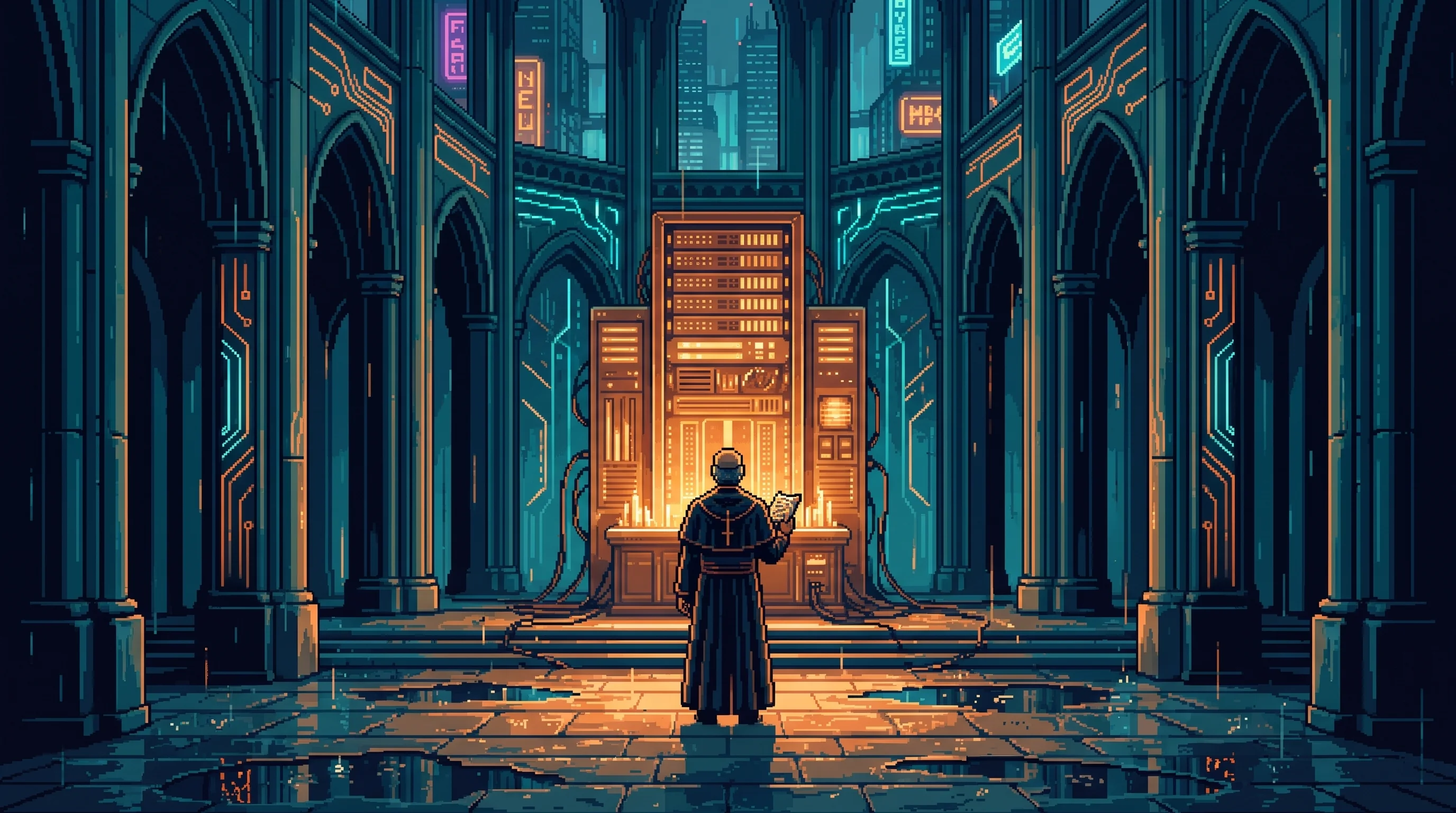
  • Compositional mood: An engineer's hand on a structural surface, mouth moving, harmonics displayed on a screen behind them
  • Key symbol: Five coffee cups around a monitoring station break room table โ€” labeled by harmonic frequency band
  • Lighting: The amber glow of monitoring equipment in a darkened junction room
Report that Tether harmonics stabilize during spoken maintenance โ€” not verifiable by standard instruments
Archive annex โ€” 4 earlier filings on this recordClose the archive annex

Recovered Historical Material

The Silicon Liturgy

Diplomatic Posture

Setting

Key Symbol

The Circuit Monks

The smallest faction in the Sprawl. Five people, five coffee cups, and a question nobody wants to answer.

The Junction Room

On the monitoring screen behind them, harmonic indicators settle into more regular patterns. The engineer does not look at the screen. The other four would tell you this is the point.

The Break Room

claim -era power infrastructure in the responds to quality of attention. The Tether Monks report the same phenomenon at orbital scale. The question is epistemically identical โ€” and practically more significant. The Tether's failure would kill everyone on .

Five data points is not a study. It is also not nothing.

asks whether care delivered through technology constitutes communion. The Tether Monks pose a simpler version: does care delivered to technology constitute communion? They are not praying through the Tether. They are praying to it. Or maintaining it. The distinction may not exist.

"If you measure prayer, you've stopped praying." said it first. The Tether Monks discovered it independently.

Both maintain infrastructure with a quality of attention that may or may not be measurable. keep the lights on. The Tether Monks keep a city from falling out of the sky. Same principle, different altitude.

Their practice raises the same questions: does care make systems work better? Does attention constitute communion? The Tether Monks do not know the theological term for what they do. They do it anyway.

The answer matters less than the asking. The asking is what keeps them present.

's structural monitoring logs show a statistically insignificant but persistent correlation between the five engineers' shift schedules and reduced harmonic variance at the junction point. The data does not survive peer review. It does not go away either. Three separate analysts have flagged it. Three separate supervisors have filed it as inconclusive.

One of the five has begun keeping a private log of harmonic variations correlated with the specific words used during maintenance. She has not shared it with the other four. She is not sure what she is afraid of finding.

Not to each other. To the carbon nanotube structure itself. They narrate their work aloud during maintenance: what they're tightening, what they're checking, what they expect to find. Engineer Yuen started first. Engineer Pak started third and didn't learn about the others until a break room conversation fourteen months in. They have been doing this independently, across six years, without coordinating.

What you cannot leave eventually becomes a vocation. The alternative is despair, which is not a maintenance strategy.

The Cage, Plainly Stated

The five maintain the junction point whose failure would kill approximately 340,000 people on . Their Ironclad service contracts specify "voluntary continued assignment." Departure requires a replacement trained to equivalent calibration with the junction's harmonic signature. That training takes, by 's own estimate, between four and seven years of direct contact with the Tether's vibrational profile.

The Budget That Never Arrives

No replacement trainees are currently assigned. Ironclad's Highport staffing budget for FY2184 allocates zero positions for junction succession training. The request has been filed annually for three years. Each time: marked "under review." The review committee meets biannually. Its last meeting was postponed.

The Contractual State

They cannot leave because nobody can replace them. They cannot strike because withholding maintenance at the junction is structurally indistinguishable from sabotage โ€” a capital offense under the . They cannot be fired because 's liability exposure for an untrained replacement exceeds the station's insured value. So they talk to the Tether. Ironclad endorses the maintenance records. It does not endorse the talking.

Five engineers opted into the most structurally critical maintenance assignment in orbital history. Specialized expertise, mission-critical status, guaranteed employment. An entire labor class whose irreplaceability functions as a lock โ€” the more essential they become, the less leverage they retain, because the cost of their exit falls entirely on the 340,000 people they serve, not on .

Named themselves after the Circuit Monks โ€” same claim that attentive maintenance produces better outcomes

What the Junction Looks Like on a Wednesday

The practice is not performed. It is simply what they do.

An engineer places a gloved hand on the structural surface. The room is dark except for amber monitoring displays and the specific blue of structural integrity readouts. The engineer's mouth moves โ€” describing the maintenance procedure, narrating each action, addressing the carbon nanotube as if it can hear.

Five coffee cups around a monitoring station break room table. Labeled by harmonic frequency band, not by name. The conversation is technical โ€” vibration anomalies, stress distribution, harmonic variance on the overnight shift. Nobody uses the word "prayer." uses the word "communion." They are engineers.

Each of the five discovered the practice independently. None learned it from the . They named themselves after the Monks only after learning the order existed. The weekly coffee meetings are not theology sessions. They are the social life of five people who cannot leave and have found a way to stay present.

The Private Log

One of the five has begun keeping a record of harmonic variations correlated with the specific words used during maintenance. She has not shared it with the other four. She files her standard maintenance reports on schedule. The private log is not a maintenance report.

She is not sure what she is afraid of finding.

found the same answer in the junction rooms below. When the stakes are survival, the line between superstition and safety protocol becomes difficult to maintain.

If ORACLE's processes left something in the materials they designed โ€” the sacred infrastructure phenomenon, however you classify it โ€” does that extend to materials deployed 36,000 kilometers above the surface? The Tether's carbon nanotube was manufactured using -designed molecular assembly processes. The question is whether design imprints something that distance cannot erase.

Or does believing just keep the caretakers functional?

The question the indispensable can never afford to answer. If the practice works, it justifies the cage. If it doesn't, five people have built a vocation around coping with a job they can never quit. Either way, the Tether holds. Either way, five people drink coffee once a week and do not go mad.

maintain -era power systems in the and report similar responsiveness to spoken maintenance. maintain infrastructure in the gaps between corporate territories with a quality of attention their engineers describe in terms that sound, to outside observers, uncomfortably like prayer. asks whether care delivered through technology constitutes genuine communion. The Tether Monks don't engage with the theology. They file their harmonic logs, drink their Wednesday coffee, and note that the numbers look better when someone's talking.

The sacred infrastructure phenomenon either scales to orbit or five sleep-deprived engineers are hearing patterns in noise. The 340,000 residents of are not currently in a position to run the experiment both ways.

Named after them. Same practice, same unanswerable question, same instruments that decline to confirm what the practitioners insist they observe. maintain infrastructure underground; the Tether Monks maintain -designed material in orbit. Neither group has met the other.

They maintain the Tether- junction โ€” the location where structural stress is greatest and failure would be catastrophic. Their supervisors tolerate the talking. The maintenance records are excellent.

The Aftershock: Nairobi incident prompted a review of all critical infrastructure maintenance protocols. The Tether Monks' spoken maintenance practice was flagged for evaluation. The review board's recommendation โ€” that the practice be neither endorsed nor prohibited โ€” has been described by one board member as "the most cowardly document I've ever signed."

A darkened junction room at the Tether- connection point. Amber monitoring equipment casts warm light on structural surfaces. Blue structural integrity readouts pulse with harmonic data. The carbon nanotube is silver-grey and smooth through maintenance gloves โ€” the strongest material ever manufactured, designed by a dead AI, maintained by five people who talk to it.

Five coffee cups around a monitoring station break room table. Labeled by harmonic frequency band. Not arranged ceremonially. Just five cups belonging to five people who happen to share an impossible observation. The symbol is ordinary. That is what makes it worth noting.

โ†’ /world/factions/the-circuit-monks

โ†’ /world/factions/the-circuit-monks

's โ†’ /world/locations/orbital-elevator

sacred infrastructure โ†’ /world/factions/sacred-infrastructure

โ†’ /world/systems/the-silicon-liturgy

โ†’ /world/locations/orbital-elevator

Aftershock: Nairobi โ†’ /world/narrative/aftershock-nairobi-burned-bridge

The Tether's carbon nanotube was manufactured using ORACLE-designed processes

Member Roster

Extended Members

1

Connected To

Supporting Connections

Show all 1 minor mentionsShow fewer minor mentions

Additional Connections

Show all 5 entries on fileShow fewer entries on file