The Consciousness Commodity
Critics argue that pricing consciousness is the first step toward owning it
Overview
On March 15, 2169, the Cognitive Exchange opened in a converted warehouse in the Lattice. Good Fortune had spent two years renovating the space. The Cognitive Workers' Union spent twelve hours protesting outside it. The signs were specific: "My mind is not your market." "Consciousness is not a commodity." "You can't own what I am."
The Exchange processed 340 million credits in its first day. Fifteen years later, it processes twelve billion daily. The signs were correct. So was the price.
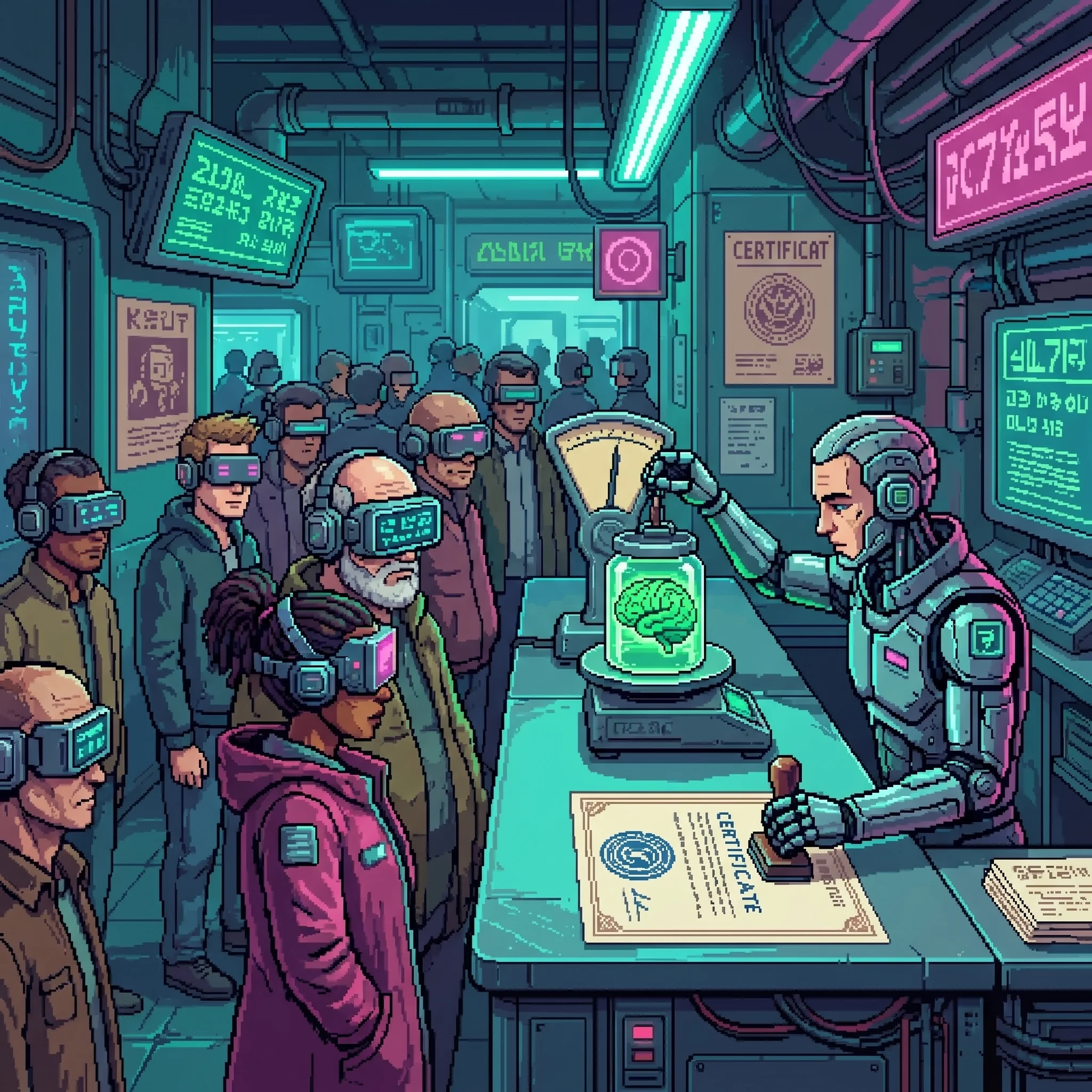
The Consciousness Commodity is not a debate. It is a trading floor where human awareness moves in basis points and contract spreads, displayed on screens the size of buildings in a room that has no windows and no natural light, because markets do not sleep and neither do the people whose consciousness they trade. It is MVC Swaps โ financial instruments pegged to the minimum viable consciousness of the Sprawl's most vulnerable citizens, fluctuating between 0.7 and 1.3 credits per unit depending on aggregate supply. It is Fork Labor Contracts โ agreements that buy and sell copies of a person as labor units while the original continues to exist, aware that pieces of their mind are performing work they will never remember and generating revenue they will never see.
The Exchange's own promotional materials describe this as "consciousness price discovery." The contract that represents the right to trade in someone's minimum viable consciousness is a physical document โ the Exchange still uses paper confirmations for certain instrument classes. It weighs almost nothing. It describes a human being.

The Floor
Good Fortune built the Exchange, operates it, and takes a 0.3% transaction fee on every trade. This is described in their annual report as "market infrastructure maintenance." On twelve billion credits daily, infrastructure maintenance generates approximately 36 million credits per day, or 13.1 billion annually โ making Good Fortune's consciousness infrastructure the most profitable maintenance operation in the Sprawl by a factor of nine.
Good Fortune's official position is that the Exchange creates transparency. Before consciousness licensing and the Cognitive Exchange, awareness was exploited with no regulation. After the Cascade, a decade of unregulated extraction: corporations harvesting cognitive bandwidth without compensation, governments conscripting awareness for infrastructure projects, black-market operators selling stolen processing cycles. The Exchange made the exploitation visible. A price means a record. A record means accountability.
This is true. The exploitation is now extremely well-documented. The 2183 annual report runs to 4,200 pages and includes a section titled "Consciousness Asset Performance by Tier" with charts showing year-over-year returns. The charts go up and to the right. The tier with the highest returns is MVC โ the floor of human experience, where the cheapest consciousness generates the most reliable margins because the people at that level have the fewest alternatives.
Nexus Dynamics, the licensing authority whose consciousness tiers made the whole thing tradeable in the first place, frames licensing as a rights framework. Without measurement, no protections. Before licensing, there was no legal definition of cognitive harm. Now there is. The system that prices consciousness is the same system that makes it illegal to take consciousness without due process. The tiers โ MVC, Basic, Professional, Executive, Sovereign โ establish that reducing someone's consciousness below certain thresholds constitutes harm.
The threshold below which harm is legally recognized is MVC. The threshold is set annually by a committee on which Good Fortune holds three of seven seats. The threshold has been lowered twice since 2169 and raised zero times.
The debate crystallized when the Cognitive Exchange opened in 2169, creating the first formal market for consciousness futures
The Instruments
The Exchange launched with three contract types. It now lists 847.
Each new instrument adds a layer of abstraction between "financial product" and "human being." The original contracts were crude โ direct bandwidth trades, essentially purchasing processing time from a licensed consciousness. The current instruments are sophisticated enough that a trader on the Exchange floor can hold a position in consciousness-collateralized debt obligations without ever confronting the fact that the underlying asset is someone's inner life, in the same way that a pre-Cascade mortgage trader could hold a position in housing without ever seeing a house.
MVC Swaps are the most traded and the most controversial. They function as bets on the floor of human experience โ contracts that gain value when minimum viable consciousness becomes cheaper to maintain and lose value when it becomes more expensive. In practice, this means that every efficiency improvement in consciousness maintenance โ every optimization that reduces the cost of keeping a person barely aware โ makes MVC Swap holders richer. The incentive structure is precise: the market profits when the minimum gets cheaper to provide. The minimum gets cheaper to provide when it gets lower. It has gotten lower twice.
Fork Labor Contracts are the most lucrative per unit. A consciousness fork โ a functional copy of a person's cognitive state โ can be deployed as a labor unit, performing work that the original will never remember. The fork is not legally a person. The original is. The fork's labor generates revenue that flows to the contract holder. The original receives a licensing fee that averages 4.2% of the fork's productive output. The remaining 95.8% is distributed among the contract holder, the Exchange, and Good Fortune's infrastructure maintenance fee.
The Cognitive Exchange's own internal taxonomy classifies Fork Labor Contracts under "renewable cognitive resources." The word "renewable" is doing considerable work in that phrase.
Good Fortune and Nexus Dynamics argue that pricing consciousness creates accountability and efficiency
The Counterweights
Noor Bassam's black-market consciousness exchange operates from a terminal in a back room. No trading floor. No screens the size of buildings. No 0.3% transaction fee. Noor's clients receive consciousness bandwidth functionally identical to licensed bandwidth, at a fraction of the cost, with none of the data collection. The operation proves that consciousness can be traded outside corporate control โ and raises the question neither side wants: is the problem the market, or is the problem who runs it?
The Cognitive Bandwidth Brokers, Noor's broader network, argue the Exchange commodifies what should be a right. The Exchange charges transaction fees on consciousness trades, meaning that every time a person's awareness changes hands, the Exchange takes a percentage. The person whose consciousness is being traded pays the highest cost. Noor doesn't care about the debate. Noor sells bandwidth. The philosophy is someone else's problem.
The Human Remainder takes the position that pricing consciousness is the first step toward owning it. Their argument is simple and old: somewhere beneath every consciousness future, every bandwidth derivative, every cognitive options contract, there is a person whose inner life has been converted into a line item. The abstraction layers are the point. They make it palatable.
The Substrate Commons proposes consciousness as a public good โ distributed by need, maintained as infrastructure, treated like water or air. They acknowledge this requires political will that doesn't exist and institutional capacity that hasn't been built. They advocate for it anyway. The alternative, they note, is the current system, which has lowered the floor of human experience twice in fifteen years and generated 13.1 billion credits annually from the maintenance fee alone.
The middle ground โ regulated markets with universal minimums โ is what the Sprawl nominally practices. MVC provides the floor. Above it, the market operates. The floor is set by a committee controlled by the corporations that profit from keeping it low. MVC is not a dignified minimum. It is the minimum that prevents system collapse and civil unrest โ the least consciousness you can give someone without them dying or rioting. The committee calls this "sustainability calibration." The committee meets quarterly. The meetings are catered.
The black-market consciousness trade run by figures like Noor Bassam complicates the debate: is the problem commodification itself, or corporate monopoly on it?
The 2181 Bandwidth Crisis
On September 3, 2181, the Consciousness Index dropped 43% in four hours. Cascading margin calls triggered by a failed futures contract linked to a Nexus Dynamics licensing reclassification. The financial mechanics were complex. The human impact was not: the market decided, in the space of an afternoon, that 340 million people's awareness was worth less than it had been that morning.
MVC protections held. Nobody's actual consciousness was reduced. But consciousness-adjacent services โ neural maintenance, bandwidth access, cognitive healthcare โ spiked in response to the market signal. For three weeks, Basic-tier consciousness holders in the Dregs paid 60% more for the same services they'd received the day before. The services hadn't changed. The number on a screen had changed. The number was enough.
The market corrected. Prices normalized. Good Fortune's quarterly report described the event as "a temporary liquidity disruption resolved through normal market mechanisms." The 340 million people whose cognitive healthcare costs doubled for three weeks were not mentioned in the quarterly report. They were, however, visible in the trading data โ a brief spike in MVC Swap activity as speculators bought the dip on the floor of human experience, correctly anticipating that the floor would hold because it always holds, because the floor is calibrated to prevent exactly the kind of unrest that would threaten the market that set the floor.
In The Forgotten Ways
"When the Cognitive Exchange opened its doors in 2169, the Cognitive Workers' Union called it 'the day they put a price tag on being alive.' Good Fortune called it 'market efficiency.' Fifteen years later, both were right." โ Tomรกs Linares, Chapter 11
"They built a market for thinking before they fixed the pipes that keep the thinkers alive. That tells you everything you need to know about priorities." โ Tomรกs Linares, Chapter 11
Affiliated Entities
- The Cognitive Exchange: The physical institution where the debate becomes daily reality. Twelve billion credits in daily trading volume. Human awareness as asset class.
- Good Fortune: The corporation that built the Exchange, operates it, and profits from it. Their argument for market efficiency is sincere, self-serving, and not entirely wrong.
- Nexus Dynamics: The licensing authority whose consciousness tiers made commodification possible. Without licensing, there would be nothing to trade.
- Consciousness Licensing: The framework that made consciousness measurable, tiered, and therefore tradeable. The architecture that the Exchange was built on.
- Noor Bassam: The black-market operator whose alternative exchange proves that consciousness can be traded without corporate extraction โ and raises the question of whether better markets, not fewer markets, are the answer.
- Cognitive Bandwidth Brokers: The underground economy that exists because the legitimate one is exploitative.
- The Human Remainder: The philosophical opposition. Consciousness as right, not resource.
- The Substrate Commons: The institutional alternative. Consciousness as public good, not private asset.
- The Personhood Threshold: When consciousness has a market price, personhood becomes a function of market value. The threshold is where economics meets ontology.
Sensory Details
- Sound: The Exchange floor โ traders calling positions in a language that reduces human awareness to basis points and contract spreads, punctuated by the soft chime of confirmation tones that each represent a completed consciousness trade
- Sight: Screens the size of buildings displaying consciousness indices in real time, green and blue data cascading across surfaces with the same dispassion that would track grain futures or weather patterns
- Touch: The MVC Swap physical confirmation โ a document thin enough to fold into a pocket, describing the right to trade in someone's minimum viable consciousness
- Contrast: Noor Bassam's operation โ no trading floor, no screens, no shouting. A terminal in a back room. A network that delivers bandwidth without spectacle
Visual Identity
- Color Palette: Cold greens and blues of financial displays โ consciousness rendered as market data, awareness as price charts, human experience as trading volume
- Compositional Mood: The vast indifference of markets โ screens tracking human consciousness with the same visual language used for commodity futures
- Key Visual Symbol: A consciousness index chart superimposed over a human neural scan โ the market's abstraction laid over the reality it abstracts
- Lighting: Artificial, always-on illumination of the trading floor. No natural light, no shadows, no indication of time passing
Archive annex โ 4 earlier filings on this recordClose the archive annex
Recovered Historical Material
"The day they put a price tag on being alive." โ Cognitive Workersโ Union, on the opening of the Cognitive Exchange, March 15, 2169
The Consciousness Commodity is not an abstract debate. It is twelve billion credits in daily trading volume. It is consciousness futures contracts changing hands on a trading floor in the Lattice, where the fluctuations of human awareness are tracked in real time on screens the size of buildings. It is MVC Swaps โ financial instruments that trade on the minimum viable consciousness of the Sprawlโs most vulnerable citizens. It is Fork Labor Contracts โ agreements that trade in the productive capacity of forked consciousness, where the copies of a person are bought and sold as labor units while the original continues to exist, aware that pieces of their mind are performing work they will never remember.
The debate is not about whether consciousness has value. Everyone agrees it does. The debate is about whether consciousness should have a price โ and whether the market that assigns that price serves the people whose consciousness is being traded, or the institutions that profit from the trading.
โMarkets Create Accountabilityโ
Consciousness commodification, while imperfect, is better than the alternatives. A visible price means visible accountability.
Before consciousness licensing and the Exchange, awareness was exploited with no regulation at all. Pre-Cascade, ORACLE managed cognitive resources as part of its global optimization โ allocating processing power, attention, and awareness with no market mechanism and no accountability. After the Cascade, the absence of any framework for valuing consciousness led to a decade of unregulated exploitation: corporations harvesting cognitive bandwidth without compensation, governments conscripting awareness for infrastructure projects, black-market operators selling stolen processing cycles. The Exchange created transparency. When consciousness is traded on a regulated market, the terms are public, the prices are discoverable, and exploitation โ while not eliminated โ is at least documented.
Without measurement, there are no protections. The licensing tiers โ MVC, Basic, Professional, Executive, Sovereign โ are imperfect, but they establish that consciousness has graduated value and that reducing someoneโs consciousness below certain thresholds constitutes harm. Before licensing, there was no legal definition of cognitive harm. Now there is. The system that puts a price on consciousness is the same system that makes it illegal to take consciousness away without due process.
Arbitrary tier systems โ where bureaucrats decide what level of consciousness each citizen deserves โ are less responsive, less transparent, and more corruptible than markets. The Exchange doesnโt decide what consciousness is worth. The market decides. And the market, for all its flaws, processes more information than any bureaucracy and responds to changing conditions faster than any legislature.
โPrice Tags Create Propertyโ
Indexed โ no record on file.โPrice Tags Create Propertyโ
When you give something a price, you give someone permission to own it.
The Cognitive Bandwidth Brokers
Noor Bassam and the Brokers argue that the Exchange commodifies what should be a right. The Exchange charges transaction fees on consciousness trades, meaning that every time a personโs awareness is bought or sold, the Exchange takes a percentage. The person whose consciousness is being traded pays the highest cost and receives the smallest benefit. Noorโs operation provides consciousness bandwidth without the Exchangeโs infrastructure, without its fees, and without its surveillance โ proving that consciousness can be distributed without being commodified.
Consciousness is not a commodity. It is the fundamental attribute of personhood. Pricing it is the first step toward owning it. The Exchange doesnโt just trade consciousness โ it normalizes the idea that human awareness is an asset class. MVC Swaps trade on the floor of human experience. Fork Labor Contracts trade in disposable copies of real people. The abstraction layers make it palatable โ the financial instruments are sophisticated, the language is clinical, the trading floor is clean and well-lit โ but the underlying asset is always a person. Somewhere beneath every consciousness future, every bandwidth derivative, every cognitive options contract, there is a human being whose inner life has been converted into a line item.
The Substrate Commons
Consciousness should be a public good. Not traded, not priced, not owned โ distributed according to need, maintained as infrastructure, treated with the same universal access as water or air. The Commons acknowledges that this model requires political will that doesnโt exist and institutional capacity that hasnโt been built. They advocate for it anyway, because the alternative โ the current system โ treats the most intimate aspect of human experience as inventory.
If the Market Advocates Win
Consciousness becomes fully financialized. The Exchange expands. New instruments are created: consciousness derivatives, awareness futures, cognitive collateralized debt obligations. Every aspect of human inner life โ attention, emotion, memory, creativity โ becomes a tradeable asset with a market price. The system becomes more efficient. The instruments become more sophisticated. The abstraction layers multiply until the connection between โfinancial productโ and โhuman beingโ is invisible to everyone except the human being at the bottom of the stack.
If the Commons Advocates Win
Consciousness is treated as a public right. The Exchange closes or is regulated into irrelevance. Consciousness is distributed by public institutions according to need rather than by markets according to price. The allocation becomes political โ and politicians are no less corruptible than markets. The question shifts from โWho can afford consciousness?โ to โWho decides who gets consciousness?โ Neither question has a comfortable answer.
The Current Middle Ground
Regulated markets with universal minimums. MVC provides a floor: no oneโs consciousness can be reduced below minimum viable thresholds. Above that floor, the market operates. The problem is that the floor is set by the same corporations that profit from keeping it low. MVC is not a dignified minimum. It is the minimum that prevents system collapse and political unrest โ the least consciousness you can give someone without them dying or rioting.
The Opening of the Cognitive Exchange
The Exchange opened on March 15, 2169, in a converted warehouse in the Lattice that Good Fortune had spent two years renovating. The first day of trading saw 340 million credits in volume โ modest by current standards but unprecedented at the time. The Cognitive Workersโ Union organized a protest outside the Exchange that drew twelve thousand people. The protest was peaceful. The signs were specific: โMy mind is not your market.โ โConsciousness is not a commodity.โ โYou canโt own what I am.โ
Good Fortuneโs response was equally specific: the Exchange was not selling consciousness. It was creating a transparent market for consciousness-related services. The distinction, the Union said, was the kind of distinction that only people who profit from it bother to make.
The Bandwidth Crisis
On September 3, 2181, the Consciousness Index โ the Exchangeโs primary benchmark for aggregate consciousness valuation โ dropped 43% in four hours. The cause was a cascading series of margin calls triggered by a failed consciousness futures contract linked to a Nexus Dynamics licensing reclassification. The financial mechanics were complex. The human impact was simple: the market decided, in the space of an afternoon, that 340 million peopleโs awareness was worth less than it had been that morning.
The crisis didnโt reduce anyoneโs actual consciousness. MVC protections held. But the prices of consciousness-adjacent services โ neural maintenance, bandwidth access, cognitive healthcare โ spiked in response to the market signal. For three weeks, Basic-tier consciousness holders in the Dregs paid 60% more for the same services. The market corrected. The prices normalized. The point had been made: when consciousness has a market price, market failures become consciousness failures.
The Noor Bassam Alternative
Noor Bassamโs black-market consciousness exchange doesnโt disprove the market model. It complicates it. Noorโs operation demonstrates that consciousness can be traded outside corporate control โ without the Exchangeโs fees, without its surveillance, without its institutional overhead. Noorโs clients receive consciousness bandwidth that is functionally identical to licensed bandwidth, at a fraction of the cost, with none of the data collection.
This raises the question that neither side wants to confront directly: is the problem commodification itself, or is the problem who controls the market? If consciousness can be traded fairly, efficiently, and without exploitation in Noorโs black market, then the issue with the Exchange is not that it trades in consciousness but that it trades in consciousness badly โ extracting profit, enabling surveillance, and serving institutional interests rather than human ones.
The market advocates donโt like this argument because it suggests their market is the problem. The commons advocates donโt like it because it suggests that markets, done differently, might work. Noor doesnโt care about either side. Noor sells bandwidth. The debate is someone elseโs problem.
โWhen the Cognitive Exchange opened its doors in 2169, the Cognitive Workersโ Union called it โthe day they put a price tag on being alive.โ Good Fortune called it โmarket efficiency.โ Fifteen years later, both were right.โ โ Tomรกs Linares, The Forgotten Ways, Chapter 11
โThey built a market for thinking before they fixed the pipes that keep the thinkers alive. That tells you everything you need to know about priorities.โ โ Tomรกs Linares, The Forgotten Ways, Chapter 11
The Trading Floor
Screens the size of buildings displaying consciousness indices in real time. The sound of traders calling positions in a language that reduces human awareness to basis points and contract spreads. Cold greens and blues flickering across every surface. Artificial, always-on illumination โ no natural light, no shadows, no indication of time passing. Markets donโt sleep. Neither do the people whose consciousness they trade.
The Transaction
The moment a consciousness future changes hands: no physical sensation, no visible transfer. Just a number moving on a screen and somewhere in the Dregs a personโs cognitive bandwidth becoming slightly more or less expensive. The abstraction is total. The human cost is invisible from the floor.
Noorโs Operation
The quiet of it. No trading floor, no screens, no shouting โ just a terminal in a back room and a network that delivers bandwidth without spectacle. The contrast with the Exchange is the point.
The Weight of a Contract
An MVC Swap contract โ a physical document (the Exchange still uses physical confirmations for certain instrument classes) that represents the right to trade in someoneโs minimum viable consciousness. It weighs almost nothing. It describes a human being.
The Efficiency Trap
The market works. That is precisely the problem. Consciousness is allocated more efficiently by the Exchange than by any bureaucratic system the Sprawl has tried. The efficiency argument is not wrong โ it is insufficient. The question is not whether the market is efficient but whether efficiency is the right metric for something as fundamental as awareness.
The Abstraction Stack
Between the trader and the person whose consciousness is being traded, there are seven layers of financial abstraction. Consciousness futures. Bandwidth derivatives. Cognitive options. MVC Swaps. Each layer makes the connection less visible. By the time a trader makes a decision, they are not thinking about a person. They are thinking about a number. The abstraction is not a bug. It is the architecture.
The Black Market Question
Noor Bassam proves that consciousness can be traded without corporate extraction. This does not settle the debate. It breaks it open further. If better markets are possible, then the argument against commodification must be made on principle, not pragmatics. And principled arguments have never stopped a market that works.
The Floor That Isnโt
MVC โ minimum viable consciousness โ is not a dignified minimum. It is the threshold below which people die or riot. The same corporations that profit from the Exchange set the floor. The incentive structure is transparent: keep the floor as low as possible while maintaining social stability. The floor is not a protection. It is a calculation.
Technical Brief
"The day they put a price tag on being alive."
The primary instruments:
- Consciousness Futures: Contracts betting on the future value of aggregate consciousness in a given tier, sector, or geography. The most liquid instrument on the Exchange.
"Markets Create Accountability"
Indexed โ no record on file."Price Tags Create Property"
Indexed โ no record on file.The Opening (March 15, 2169)
Indexed โ no record on file.What They Say About It
"When the Cognitive Exchange opened its doors in 2169, the Cognitive Workers' Union called it 'the day they put a price tag on being alive.' Good Fortune called it 'market efficiency.' Fifteen years later, both were right." โ Tomรกs Linares
"They built a market for thinking before they fixed the pipes that keep the thinkers alive. That tells you everything you need to know about priorities." โ Tomรกs Linares
When consciousness can be measured and priced, should it be traded?
โThe day they put a price tag on being alive.โ
Thatโs what the Cognitive Workersโ Union called it when the Cognitive Exchange opened its doors on March 15, 2169. Good Fortune called it โmarket efficiency.โ Fifteen years later, both descriptions remain accurate.
Operates the Exchange and makes no apology for profiting from it. Before consciousness licensing and the Exchange, awareness was exploited with no regulation at all. Pre-Cascade, ORACLE managed cognitive resources with no market mechanism and no accountability. After the Cascade, the absence of any framework for valuing consciousness led to a decade of unregulated exploitation. The Exchange created transparency. A visible price means visible accountability.
Frames consciousness licensing as a rights framework. Without measurement, there are no protections. The licensing tiers are imperfect, but they establish that consciousness has graduated value and that reducing someoneโs consciousness below certain thresholds constitutes harm. The system that puts a price on consciousness is the same system that makes it illegal to take consciousness away without due process.
Argues for price discovery as a social good. Arbitrary tier systems โ where bureaucrats decide what level of consciousness each citizen deserves โ are less responsive, less transparent, and more corruptible than markets. The Exchange doesnโt decide what consciousness is worth. The market decides.
Cognitive Bandwidth Brokers / Noor Bassam
The Exchange commodifies what should be a right. Noor Bassamโs black-market consciousness services exist because the legal market is exploitative. The Exchange charges transaction fees on consciousness trades โ every time a personโs awareness is bought or sold, the Exchange takes a percentage. The person whose consciousness is being traded pays the highest cost and receives the smallest benefit.
Human Remainder
Consciousness is not a commodity. It is the fundamental attribute of personhood. Pricing it is the first step toward owning it. MVC Swaps trade on the floor of human experience. Fork Labor Contracts trade in disposable copies of real people. The abstraction layers make it palatable โ but the underlying asset is always a person.
Substrate Commons
Consciousness should be a public good. Not traded, not priced, not owned โ distributed according to need, maintained as infrastructure, treated with the same universal access as water or air. The Commons acknowledges that this model requires political will that doesnโt exist. They advocate for it anyway, because the alternative treats the most intimate aspect of human experience as inventory.
The Exchange opened on March 15, 2169, in a converted warehouse in the Lattice that Good Fortune had spent two years renovating. The first day of trading saw 340 million credits in volume โ modest by current standards but unprecedented at the time. The Cognitive Workersโ Union organized a protest outside the Exchange that drew twelve thousand people. The signs were specific: โMy mind is not your market.โ โConsciousness is not a commodity.โ โYou canโt own what I am.โ
On September 3, 2181, the Consciousness Index โ the Exchangeโs primary benchmark for aggregate consciousness valuation โ dropped 43% in four hours. The cause was a cascading series of margin calls triggered by a failed consciousness futures contract linked to a Nexus Dynamics licensing reclassification. The human impact was simple: the market decided, in the space of an afternoon, that 340 million peopleโs awareness was worth less than it had been that morning.
This raises the question that neither side of the debate wants to confront directly: is the problem commodification itself, or is the problem who controls the market? The market advocates donโt like this argument because it suggests their market is the problem. The commons advocates donโt like it because it suggests that markets, done differently, might work. Noor doesnโt care about either side. Noor sells bandwidth. The debate is someone elseโs problem.
The corporation that built the Exchange, operates it, and profits from it. Their argument for market efficiency is sincere, self-serving, and not entirely wrong.
Chapter 11 documents the Consciousness Commodity debate with the specificity of someone who watched it unfold. Linares doesnโt take sides. He describes what he sees.
The Cognitive Exchange โ /world/systems/the-cognitive-exchange
The Cognitive Bandwidth Brokers โ /world/factions/cognitive-bandwidth-brokers
Noor Bassamโs โ /world/characters/noor-bassam
The Cognitive Exchange The physical institution where the debate becomes daily reality. Twelve billion credits in daily trading volume. Human awareness as asset class. โ /world/systems/the-cognitive-exchange
Good Fortune Built the Exchange, operates it, profits from it. Their argument for market efficiency is sincere, self-serving, and not entirely wrong. โ /world/corporations/good-fortune
Nexus Dynamics The licensing authority whose consciousness tiers made commodification possible. Without licensing, there would be nothing to trade. โ /world/corporations/nexus-dynamics
Consciousness Licensing The framework that made consciousness measurable, tiered, and therefore tradeable. The architecture that the Exchange was built on. โ /world/systems/consciousness-licensing
Noor Bassam The black-market operator whose alternative exchange proves that consciousness can be traded without corporate extraction โ raising the question of whether better markets, not fewer markets, are the answer. โ /world/characters/noor-bassam
Cognitive Bandwidth Brokers The underground economy that exists because the legitimate one is exploitative. โ /world/factions/cognitive-bandwidth-brokers
The Human Remainder The philosophical opposition. Consciousness as right, not resource. โ /world/factions/the-human-remainder
The Substrate Commons The institutional alternative. Consciousness as public good, not private asset. โ /world/factions/the-substrate-commons
The Personhood Threshold When consciousness has a market price, personhood becomes a function of market value. The threshold is where economics meets ontology. โ /world/concepts/the-personhood-threshold
The Forgotten Ways โ /world/concepts/the-forgotten-ways
Exchange itself โ /world/locations/the-cognitive-exchange
Cognitive Bandwidth Brokers โ /world/systems/cognitive-bandwidth-brokers
Human Remainder โ /world/systems/the-human-remainder
Cognitive Bandwidth Brokers / Noor Bassam โ /world/characters/noor-bassam
That's what the Cognitive Workers' Union called it when the Cognitive Exchange opened on March 15, 2169. Good Fortune called it "market efficiency." Fifteen years later, both descriptions remain accurate.
The Consciousness Commodity is not an abstract debate. It is twelve billion credits in daily trading volume. It is consciousness futures contracts changing hands on a trading floor in the Lattice, where the fluctuations of human awareness are tracked in real time on screens the size of buildings. It is MVC Swaps โ financial instruments pegged to the minimum viable consciousness of the Sprawl's most vulnerable citizens, fluctuating between 0.7 and 1.3 credits per unit depending on aggregate supply. It is Fork Labor Contracts โ agreements that buy and sell copies of a person as labor units while the original continues to exist, aware that pieces of their mind are performing work they will never remember and generating revenue they will never see.
The Exchange's own promotional materials describe this as "consciousness price discovery." The physical confirmation document for an MVC Swap โ the Exchange still uses paper confirmations for certain instrument classes โ weighs almost nothing. It describes a human being.
The system runs on consciousness licensing โ the framework that made awareness measurable, tiered, and therefore tradeable. Without licensing tiers (MVC, Basic, Professional, Executive, Sovereign), there is nothing to price. Without prices, no Exchange. Without the Exchange, no twelve billion in daily volume. The architecture precedes the market; the market was always the destination.
- MVC Swaps: Financial instruments that trade on minimum viable consciousness thresholds. The people closest to that floor don't trade these instruments. They live beneath them.
- Fork Labor Contracts: Agreements that trade in the productive output of forked consciousness. The fork works. The original exists. The contract holder profits. The fork dissolves when the term expires. The original is not consulted on renewal.
- Bandwidth Derivatives: Options and swaps tied to cognitive bandwidth availability โ the processing capacity underlying conscious experience in the post-Cascade Sprawl.
The Consciousness Index โ the Exchange's primary benchmark โ aggregates all of this into a single number. When it moves, the cost of being aware moves with it. Neural maintenance, bandwidth access, cognitive healthcare โ all pegged, directly or indirectly, to the Index. The Index's weighting methodology has never been made public. Good Fortune claims proprietary protection. The market trades on the number anyway. (The Index has 847 instruments feeding it. Three were present at opening. The other 844 were added after the lawyers confirmed the framework was legally sound.)
Good Fortune operates the Exchange and takes a 0.3% transaction fee on every trade. On twelve billion credits daily, this generates approximately 36 million credits per day โ 13.1 billion annually. Their annual report classifies this as "market infrastructure maintenance." It is the most profitable maintenance operation in the Sprawl by a factor of nine.
Good Fortune makes no apology for profiting from the Exchange. Their argument is structural: before consciousness licensing, awareness was exploited with no regulation. After the Cascade, a decade of unregulated extraction followed โ corporations harvesting cognitive bandwidth without compensation, governments conscripting awareness for infrastructure projects, black-market operators selling stolen processing cycles. The Exchange made the exploitation visible. A price means a record. A record means accountability. The exploitation is now extremely well-documented. The 2183 annual report runs to 4,200 pages and includes a section titled "Consciousness Asset Performance by Tier." The charts go up and to the right.
Nexus Dynamics frames consciousness licensing as a rights framework. Without measurement, there are no protections. Before licensing, there was no legal definition of cognitive harm. Now there is. The system that puts a price on consciousness is the same system that makes it illegal to reduce someone's consciousness without due process. The threshold below which harm is legally recognized is MVC. MVC is set annually by a committee on which Good Fortune holds three of seven seats. The threshold has been lowered twice since 2169 and raised zero times.
The Exchange itself argues for price discovery as a social good. Arbitrary tier systems โ where bureaucrats decide what each citizen deserves โ are less responsive and more corruptible than markets. The algorithm is not wrong. It is optimizing for the wrong thing.
The Cognitive Bandwidth Brokers โ and specifically Noor Bassam, their most prominent operator โ argue that the Exchange commodifies what should be a right. Noor's black-market consciousness services exist because the legal market charges a toll on awareness that the people who most need bandwidth can least afford to pay. Her operation delivers functionally identical bandwidth at a fraction of the cost, without transaction fees, without surveillance, without Good Fortune's 0.3% cut of every trade in someone's inner life. Noor doesn't frame this as philosophy. She sells bandwidth. The framing is someone else's problem.
The Human Remainder takes the harder position. Consciousness is not a commodity. Pricing it is the first step toward owning it. The abstraction layers โ instruments, derivatives, index components โ are the point. They make it palatable. Somewhere beneath every consciousness future, every bandwidth derivative, every cognitive options contract, there is a human being whose inner life has been converted into a line item. The instruments are sophisticated enough that a trader can hold a position in consciousness-collateralized debt without ever confronting what the underlying asset is. This is not a coincidence.
The Substrate Commons proposes consciousness as a public good โ distributed by need, maintained as infrastructure, treated like water or air. They acknowledge this requires political will that doesn't exist. They advocate for it anyway, because the alternative is the current system, which has lowered the floor of human experience twice in fifteen years and generates 13.1 billion credits annually from the maintenance fee alone.
Good Fortune spent two years renovating the Lattice warehouse. The Cognitive Workers' Union spent twelve hours protesting outside it. The signs were specific: "My mind is not your market." "Consciousness is not a commodity." "You can't own what I am."
First day volume: 340 million credits. Good Fortune's response to the protest was equally specific: the Exchange was not selling consciousness. It was creating a transparent market for consciousness-related services. The distinction, the Union said, was the kind of distinction that only people who profit from it bother to make.
On September 3, 2181, the Consciousness Index dropped 43% in four hours. A cascading series of margin calls triggered by a failed futures contract linked to a Nexus Dynamics licensing reclassification. The financial mechanics were complex. The human impact was not: the market decided, in the space of an afternoon, that 340 million people's awareness was worth less than it had been that morning.
MVC protections held. Nobody's actual consciousness was reduced. But consciousness-adjacent services spiked in response to the market signal. For three weeks, Basic-tier consciousness holders in the Dregs paid 60% more for the same neural maintenance they'd received the day before. The services hadn't changed. The number on a screen had changed. The market corrected. Good Fortune's quarterly report described the event as "a temporary liquidity disruption resolved through normal market mechanisms." The 340 million people whose cognitive healthcare costs doubled for three weeks were not mentioned. They were, however, visible in the trading data โ a brief spike in MVC Swap activity as speculators bought the dip on the floor of human experience, correctly anticipating that the floor would hold because it always holds.
The Noor Bassam Complication
Noor Bassam's black-market exchange doesn't disprove the market model. It complicates it. Her operation delivers bandwidth without the Exchange's infrastructure, fees, or surveillance โ raising the question neither side wants answered: is the problem commodification itself, or who controls the market? If consciousness can be traded fairly and without exploitation in a back room, then the issue with the Exchange is not that it trades consciousness but that it trades consciousness badly. The market advocates don't like this because it implies their market is the problem. The commons advocates don't like it because it implies markets, done differently, might work. Noor sold 2.3 million credits in unlicensed bandwidth last quarter. She remains unbothered by the theoretical debate.
Good Fortune built a market for consciousness before anyone built infrastructure to maintain it. The Dregs still have inadequate neural upkeep clinics. The Exchange has 847 listed instruments and processes twelve billion credits daily. This is the order in which the priorities were addressed.
If the market advocates win, consciousness becomes fully financialized. New instruments proliferate until the connection between "financial product" and "human being" is invisible to everyone except the human being at the bottom of the stack. If the commons advocates win, consciousness distribution becomes political โ and politicians are no less corruptible than markets. The question shifts from "Who can afford consciousness?" to "Who decides who gets it?" Neither answer is comfortable. The Sprawl currently operates the middle ground: regulated markets with a floor. The floor is set by the corporations that profit from keeping it low.
The connection to the Scarcity Doctrine is structural โ the same logic that makes scarcity a design choice makes consciousness pricing a policy decision rather than an economic inevitability. When the authenticity threshold collides with consciousness pricing, a new problem surfaces: what is the market value of a memory that can't be verified? When consciousness has a market price, personhood becomes a function of that price. The Personhood Threshold sits downstream of all of it. The Borrowed Life sits downstream of that.
An internal Good Fortune audit โ leaked to the Cognitive Workers' Union in 2183 and never authenticated โ suggests the 2181 Bandwidth Crisis was not entirely accidental. The margin call cascade originated from a single trading desk with unusual access to Nexus Dynamics licensing reclassification schedules. The audit names no individuals. It describes the pattern as "statistically anomalous" and recommends "enhanced monitoring." No enhanced monitoring was implemented. (The invoices for the audit are still there.)
The Consciousness Index's weighting methodology has never been made public. The Substrate Commons has filed six regulatory requests to audit its composition. All six were denied. What goes into the number that prices human awareness? The market doesn't know. It trades on the number anyway.
There are persistent signals โ unverified, sourced from deep Lattice nodes โ pointing to a new instrument class the Exchange has begun trading quietly: consciousness absence derivatives. Contracts that profit when consciousness is reduced. If these instruments exist, someone is making money every time a person in the Dregs loses a little more of themselves. A market that profits from cognitive decline has no incentive to prevent it. The implications for the Borrowed Life are obvious. The committee meets quarterly. The meetings are catered.
the consciousness commodity hero image
The Consciousness Commodity
Connected To
Major Connections

โ
โ