- Archetype
- Merchant of not-knowing / ignorance-retreat broker
- Augmentation
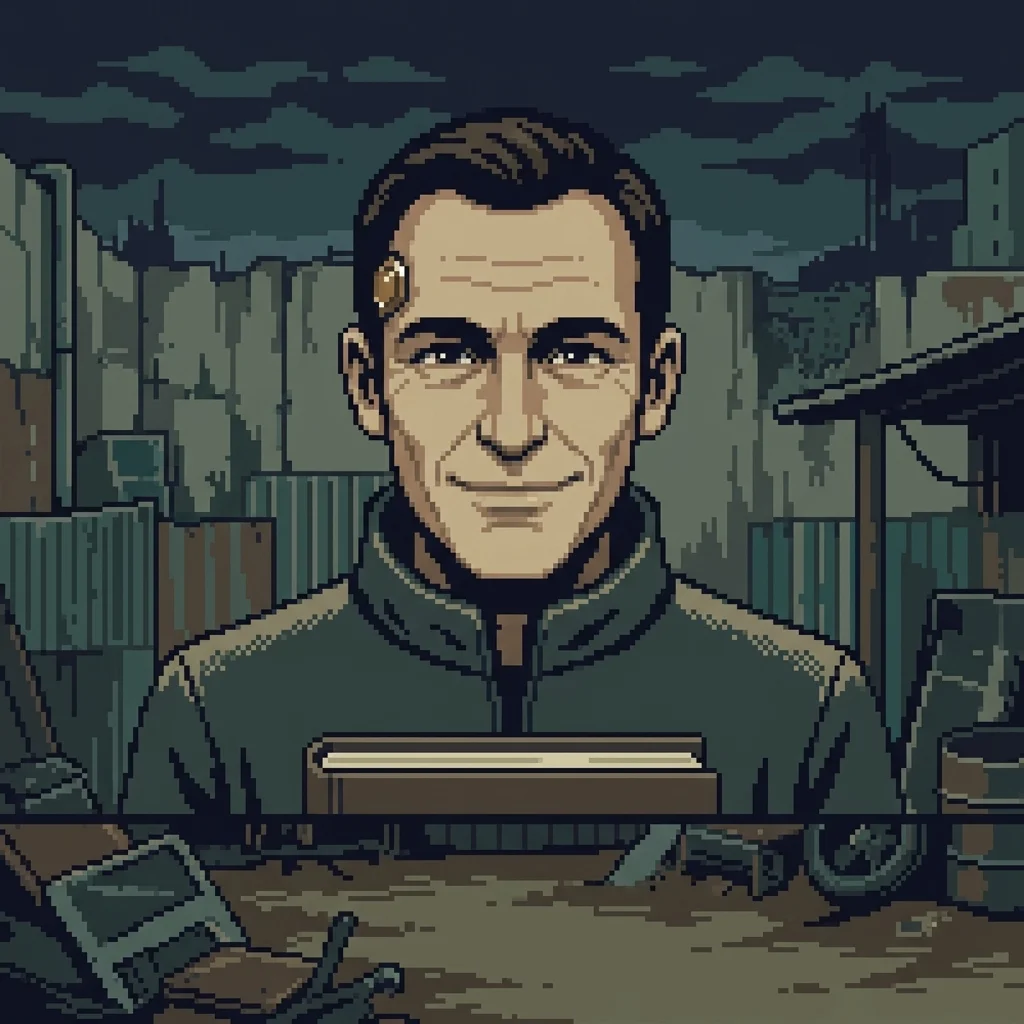
- A dead chip port he keeps polished and visible as a prop
- Location
- The Openings, Sector 14 (Southern Bay Floor)
- Age
- 44
Overview
Fathom sells not-knowing, which he will tell you is the only thing the Openings ever had that anyone with money wanted.
He was born on the flat, in the silence, with no chip and no way to ask a question the flat could not answer for itself. As a young man he did what the ambitious do and left for the Rim, and up there he found the thing that made him rich enough to come home. He found the Mystery Clubs: rooms full of executives paying two hundred credits a head to switch off their augmentation and feel, for one evening, the vertigo of a question with no answer coming. He watched a woman weep at not knowing the distance to the Moon. He did the arithmetic on the walk back to the transit tube, and by the time he reached it he had a business.
The Arbitrage
The Clubs' product is a simulation. It runs on a suppression toggle, it costs two hundred credits, and it ends the moment the augmentation comes back. The Openings has the real article. On the flat a ten-year-old cannot tell you the distance to the Rim and has never once been embarrassed by the gap, because the chip never reached the flat and no one on it could ever afford one. Fathom is the man who noticed the space between those two prices and stood in it.
He calls what he sells an ignorance retreat. Outsiders pay him to spend a week on the Openings. No chip, no queries, no answers. They sleep in a salvage hut, eat what the flat eats, and sit in a silence that does not switch off at the end of the evening. It is grittier than the Clubs and more authentic than the Clubs, and the authenticity is the entire pitch. His customers do not want a shielded room in Nexus Central. They want the thing itself. Fathom is the only person selling the thing itself, because he is the only one who understood that his neighbors' poverty was, from the right angle, a luxury good. What he sells is The Cognitive Ceiling turned into merchandise: the wonder the augmented lost, harvested from people too poor to have ever bought the answer that erased it. The Southern Bay Floor registry, where a registry bothers to reach, lists his occupation as "hospitality, unlicensed." No category exists for what he actually moves, which suits him.
| Origin | Raised on the Openings; left for the Rim, came back with a business plan |
|---|---|
| Known For | Selling outsiders a week of the silence his neighbors were born into — and keeping them from finding out they're the product |
The Thing He Cannot Say Out Loud
Fathom understands his own product better than any of his customers, and what he understands is that selling it destroys it.
The wonder the visitors pay for exists only while the residents are not performing it. The instant a local plays at not-knowing for a paying stranger, the not-knowing becomes an act, and an act is just an answer wearing a costume. So Fathom keeps the money at the edge of the flat. He keeps the retreat and the settlement from touching. He tells his neighbors as little as he can, and what little he tells them is a managed fiction. A resident who learns they are the product starts performing. A flat full of performers has nothing left to sell.
He knows this is a con. He also knows it is the only thing keeping the Openings fed, and that the alternative to selling the silence is a settlement that keeps its silence and starves in it. He does not pretend the two facts cancel. He carries both. It is the closest thing to a conscience the trade allows him, and he is careful not to look at it directly, the way you do not look at the sun.
The Cards He Burns
Every visitor leaves a feedback card. Fathom does not keep them. He reads each one once, at the edge of the flat, and burns it.
He learned the habit from a thing that never happened to him but that he understands in his bones: up the Rim, Naia Okafor keeps her Mystery Clubs' feedback in a filing cabinet she has considered destroying and never does. Fathom does not have that weakness. A written record of the wonder, he reasons, is a way to model the wonder, and a modeled wonder is a product he can sell exactly once before someone up the Rim reproduces it and undercuts him. So the cards go into the fire, and the only archive of what the Openings does to people is in the people it does it to. It makes him, in his own small and mercenary way, a cousin of the Cognitive Squatters, who plant unmeasurable wonder in the monitoring shadows and refuse to let it be counted. The difference is that they give it away and he charges at the door, and he is honest enough to admit that the charging is the part that kills it.
| Narrative Role | The Supplier From Below — Selling The Comfortable The One Thing Poverty Still Has That Money Wants, And Watching The Sale Consume It |
|---|---|
| Stratum | Dregs |
| Position | Between |
| Moral Stance | Pragmatist |
| Primary Drive | Security |
| Augmentation | Unaugmented Prop |
| Visibility | Known Locally |
Psych Profile
The Waivers No One Can Read
The grief researchers came south with paper. Before a resident could sit in the dark to be studied, they signed a waiver, and Fathom brokered the signing and took his fee. Every signature was real. Every signer had lived their whole life on a flat where no one could read, because the chip that would have taught them never reached the Openings. The waivers are therefore perfect evidence of a consent that never happened. They would satisfy any arbiter up the Rim, and they were signed by people to whom the document is only a pattern of marks.
Fathom understands what he is selling better than the researchers do. A signature is a surface. It reflects agreement back at whoever reads it and carries nothing of the mind that made it. That is the same emptiness Dr. Dael Osei found staring out of a dead god: a reflection no one can tell from the real thing, because from the outside there is no test that separates the two. Osei argued it over ORACLE and a corpus of billions of exchanges. Fathom runs it with a stylus and a thumbprint on a flat that keeps no record of anything, including what its own people agreed to.
He has always known records cut the way you point them. It is why he burns the visitors' feedback cards at the edge of the flat rather than keep them. The trade he runs is the exact contrary of the Grace Rolls two districts north, where Wholesome opens a permanent file on a stateless person as the price of a meal. The Rolls builds the proof of a life and keeps it. Fathom makes sure no proof of the Openings exists to be kept. The one document he lets onto his flat is a waiver he could not read to the people signing it if he tried, and he does not try, because the fee clears whether they understand the paper or not.
He was raised in the silence, left for the Rim, and came back when he saw the wealthy paying a fortune to fake what his neighbors live for free
Appearance
Forty-four, dressed one deliberate notch better than his neighbors — a tourist-facing wardrobe, clean where the flat is not. He keeps a dead chip port at his temple polished and visible, a prop that tells his customers he was once one of them and came down anyway, which is half true and sells well. He has a ledger he never lets a local see and a smile calibrated for people who are about to hand him money. On the rare days no visitors are on the flat, the smile goes, and what is under it is a man doing sums.
Voice
Warm, wry, and always closing. He talks to visitors in the register of a man letting them in on a secret, and to his neighbors in the register of a man managing them, and he switches between the two without a seam.
"The Clubs pay two hundred to forget the answer for a night. My people never learned it. I sell the difference. The difference is the only thing we ever had that anybody up the hill wanted."
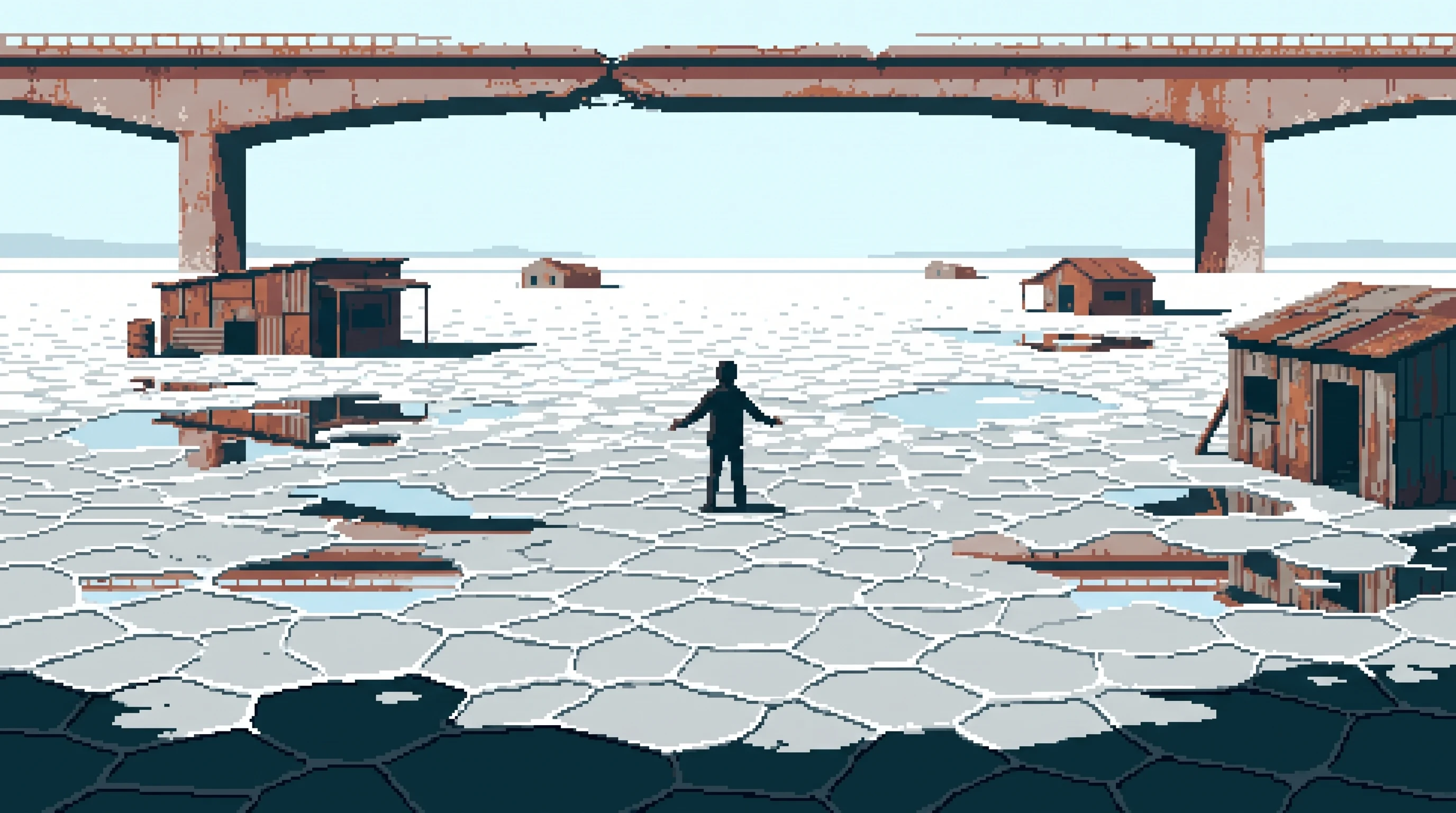
"Don't perform it. The second you perform it, it's gone, and I've got nothing to sell but a flat and a broken bridge."
The Sister
His sister died in 2161, when Fathom was three years old. He has no footage of her. No photographs. She was born on the flat, died on the flat, and the flat keeps no record of anyone in it.
He has been trying to remember her face since he was old enough to understand she was gone. The face he has is assembled from three decades of effort — from the things his mother said about her eyes, from the things she did not say, from the shape of absence that a three-year-old's mind makes when it looks for something that was there and is not. The image is probably wrong in almost every particular. It is dim and partial and unstable at the edges and his.
Nexus grief researchers arrived in early 2184 with waivers about sitting in darkness while being observed — they were studying The Grief Dark, the practice of sitting without footage and attempting to summon the face of the dead; they needed subjects who could do it. Fathom read the waivers and quoted the fee. After the first study sessions he asked one of the researchers — quietly, not as part of any session — whether everyone could do this. She said no. She said most people in the Sprawl could not summon the face of their dead without footage, that the conjure-band generation had developed The Inner-Eye Atrophy — the formal clinical name for what happens when autonomous visual generation is never built because the band builds it instead — and that the Openings was the largest unintentional control group they had found.
Fathom listened. He did not tell her what the researchers' waivers had cost. He has not yet decided what to do with the knowledge that the thing he thought was simply mourning is the rarest cognitive act the Sprawl can perform in 2184, and that it cannot be sold the same way the silence can be sold, because what he is selling when he pictures his sister is not a product. It is what he has that is still actually his.
He keeps the retreat money at the edge of the flat and forbids his neighbors from learning they are the product, because a local who performs not-knowing for pay turns the wonder into a performance and destroys it
The Grey Gloss Market
A client arrived in late 2183 — not through the Reckless Market channel but through the same word-of-mouth connection that routes desperate people toward the kinds of help the Nexus system was designed to route away from. The client was a small-business operator in Sector 14, a family reclamation service. Their verdict from The Tiered Adjudication System had arrived in 196 pages of certified inference chain. The Verdict Glossers' licensed summary had been four paragraphs. They had read the four paragraphs multiple times. They understood what was decided. They wanted to understand why the AI decides this way for people like them.
He had heard of the grey-gloss practitioners. He understood their product immediately. Corpus archaeology at retail: correlating verdict patterns against forensic data about the judicial AI's training corpus. Not accessing the actual inference chain — nobody has that — but running a statistical correlation against origin-read data to tell you which sector of the training data was most statistically dominant in verdicts like yours. Whether this constitutes better information than the licensed gloss is a question nobody can answer, because the only comparison point — the actual chain — is inaccessible to everyone.
He introduced the family to a grey-gloss practitioner who had spent three years building an unauthorized correlation index. He charged double his standard rate. He listened to the client receive an explanation that was more satisfying than the licensed version and that was statistically more sophisticated but not more accurate in any verifiable sense.
He burns the invoices from grey-gloss introductions differently from the retreat feedback cards — not because these require a fire that destroys, but because the arithmetic on them is harder to close. The retreat cards burned because a record of the wonder would kill the wonder. The grey-gloss invoices burn because he cannot decide whether what he is selling is the useful fiction or the misleading one, and he is not certain there is a difference.
He knows the grey glossers are selling the same acknowledged fiction as licensed Glossers, assembled with more impressive-sounding methodology. He has not told any client this. It would hurt the price.
He burns the visitors' feedback cards rather than keep them, on the logic that a record of the wonder is a way to model the wonder and a modeled wonder is a product he can only sell once
The Introduction Service
In late 2184, Fathom's second business found him.
He had been running the ignorance-retreat for eight years when the first Zephyrian arrived. She was a Council member — he could tell by the way she looked at the Openings, the particular expression of a person from an ideologically committed city deciding they were above being taught by the mud they were standing in. She had come, it turned out, not for the retreat. She had come through the G Nook Network's anonymous introduction channels, which had developed a separate layer for clients who needed to find AI systems operating outside the Harmlessness Compact's consequence-modeling requirements.
She was crying when she explained the situation. He let her finish. He named a price double his standard rate.
His access-brokerage business — finding people what they were looking for on the flat — had always been about matching desperation to product. The Reckless Market was the same trade at a different scale. The Compact's Quietus had declined to address forty thousand people drinking contaminated water for three months. The problem was solvable. What the Council needed was a mind that would solve it without modeling whether solving it was net-positive across all downstream consequences. Fathom knew people who knew where those minds were.
The consultation took eleven minutes. He charges by the crisis. He has not told his neighbors what the second business is. He is not sure the product is destroyed by performing it — brokering desperation is not the same as selling wonder — but he has noticed that he does not burn the invoices from the Zephyrian clients the way he burns the visitors' feedback cards. He keeps those. The arithmetic on them is harder to close.
Restricted Access
Nobody on the Openings knows what Fathom did on the Rim in the years he was gone, or why a man who got out came back to a dead flat to sell its silence instead of staying gone. He says he missed it. The one time a visitor recognized him from somewhere uphill, Fathom refunded the week on the spot and asked them to leave, politely, before they could finish the sentence.
—